
Could income taxes ever encourage someone to switch from a higher-paying to a lower-paying job? Perhaps surprisingly, the answer is yes. I have a recent example of this in my own family.
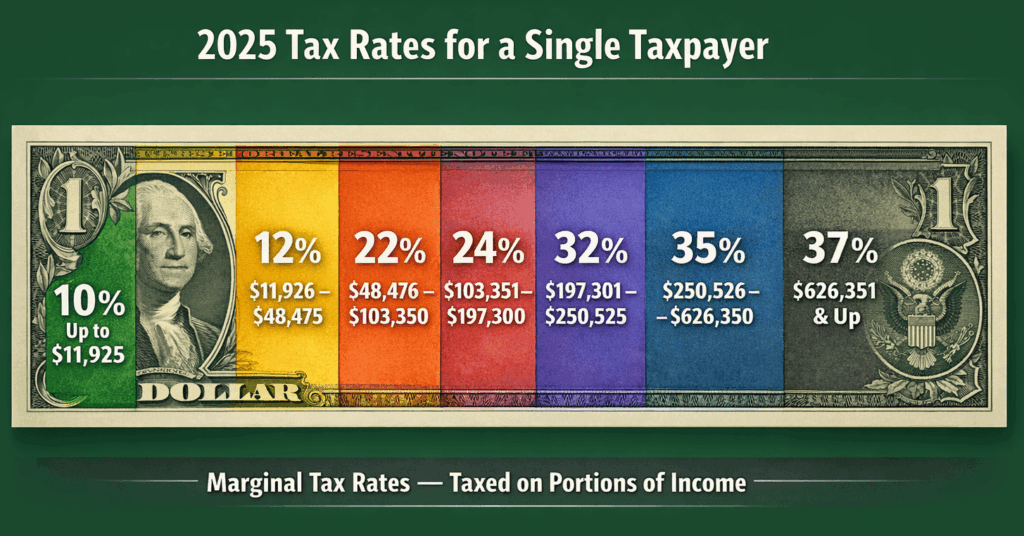
The marginal nature of the United States’ progressive income tax is supposed to prevent this outcome. You pay a higher tax rate only on income you earn above a certain level, not your entire income. For example, a married couple earning $600,000 a year would pay 10 percent on the first $24,000 they make, 12 percent on the $73,000 they earn between $24,000 and $97,000, and so on, up until they pay 35 percent on the $99,000 they earn above the $501,000 threshold. (Bracket figures are rounded to the nearest thousand.)
What matters when you’re considering a new income source is the tax you will pay on that additional income. If a new job would pay $50,000 more and you’re already making $600,000 as a married couple, then the job is really only paying you, after tax, $32,500 more.
And that difference between pre-tax and post-tax pay could make all the difference when deciding on a job that pays more but is less fulfilling or enjoyable. High marginal tax rates discourage productive, paid labor.
One alternative to paid work is household work. Accordingly, economic research suggests that married women respond to income taxes more strongly than married men, mainly by choosing whether to do paid work at all.
But another substitute for paid labor is different paid labor — instead of getting paid entirely in money, though, you can get paid partly in job satisfaction and amenities. The economic term “compensating differentials” (see video below) refers to this kind of nonmonetary compensation. More difficult, unpleasant, and unsafe jobs pay higher wages than equivalent jobs that are less difficult, more pleasant, and safer. If they want to attract workers to the tougher jobs, companies have to offer them higher wages.
In the popular Paramount TV show Landman, the main character points out that men working the West Texas oil patch make $180,000 a year for the dangers they face. “That’s not enough money to risk your life on,” a young female attorney responds. “For you? Maybe,” he counters. “For a felon with an eighth-grade education, it’s a lottery ticket.” (I’m guessing he means a winning lottery ticket.) The difference between $180,000 and what a felon with an eighth-grade education would make annually in a safe job he’d be qualified for is the compensating differential.
My wife recently faced a tradeoff of a similar kind. She chose to leave a higher-paying job for a slightly lower-paying job. Her old job had a long commute and required intercontinental travel; her new job has no commute and requires only minimal travel within North America.
There were important family reasons for the switch, but part of the logic had to do with taxes. We carefully calculated the value of her time and the wear and tear on the car from the commute, and used them to estimate how much salary she could reasonably give up for a more flexible job. We are in a higher tax bracket, which squeezed the difference in after-tax pay enough that the lower-paying job was a good deal once all other factors were considered.
How many other families find themselves in a situation similar to ours? I found exactly one study on the question. It found that a 10 percent increase in the net-of-tax rate causes a worker to choose an occupation with a 0.3 percent higher wage, on average. (The “net-of-tax rate” is the rate at which wages are converted into post-tax earnings, so you can think of it as the inverse of a tax rate.) It’s a small effect, but added up across an entire economy could amount to billions of dollars in new wages from a typical tax cut. Moreover, it confirms the theory: people are willing to work harder, better-paid jobs when taxes are lower.
Income taxes decrease labor supply in other ways too. Economist Michael Keane points out that even if income tax rates have a small effect on labor force participation (particularly men’s) in the short run, the long-run effect could be much larger if work experience builds productivity. Depriving even a small number of potential workers of the incentive to work when they are in their 20s and 30s means they’ll be far less productive than they otherwise could have been in their 40s and 50s.
Most other countries have “flatter” tax burdens than the US. In other words, the middle class shoulders a larger share of the tax burden in other countries. Perhaps the US could learn something from them in this respect — indeed, it may be that they are only able to raise the revenue to sustain a bigger government by keeping their tax structure flat and disincentivizing paid work less. If they want to avoid hiking taxes on the middle class, Congress could have no choice in the future but to cut spending drastically. Hiking already-high marginal tax rates on the most productive workers will do too much economic damage.
