
Heatwaves have pushed temperatures to record highs across both Europe and the United States. Yet the human toll between these two locales was dramatically different, with Europe recording more than 10,000 excess deaths in June.
This is a familiar pattern, notes Jack Nicastro:
The United Nations estimates that the European continent accounted for approximately 175,000 heat-related deaths annually between 2000 and 2019. The Environmental Protection Agency, meanwhile, calculates that about 1,300 deaths per year in the US are due to extreme heat. (This translates to four heat-related deaths per million annually in the US and 235 heat-related deaths per million annually across Europe.)
Europe and the US differ in demographics, urban density, reporting methods, and climate patterns. Even so, the death rate due to heat in Europe is 59 times higher than in the US.
In the United Kingdom, only about five percent of homes have air conditioning. In the United States, roughly 93 percent do.
Research identifies 72°F and 45 percent humidity as optimal for maximizing office and mental productivity.
With sweltering temperatures once again gripping much of the world, it is worth appreciating air conditioning — the quiet invention that transforms dangerous heat into manageable discomfort, shields millions from heat-related suffering and death, boosts productivity, and makes once-hostile climates livable. It is a powerful reminder that wealth, innovation, and human ingenuity enable societies to adapt to nature’s extremes and protect human life.
To understand why the US heat death rate is 59 times lower than that of Europe, it helps to begin with a young engineer named Willis Carrier.
The Father of Air Conditioning
Willis H. Carrier was born outside of Buffalo, New York on November 26, 1876, the same day inventor Alexander Graham Bell successfully demonstrated his large box telephone between Boston and Salem, Massachusetts. Carrier was an only child and attended a one-room schoolhouse. When he was nine years old he struggled to grasp the concept of fractions. His mother helped him master the idea using a pot of apples and slicing them into portions. Carrier remembered this event fondly as “the most important thing that ever happened to me.”
Carrier was awarded a full scholarship to attend Cornell University. He majored in engineering, earning a Master’s degree in 1901. After graduation, Carrier accepted a job at the Buffalo Forge Company for $10 a week.
The Sackett & Wilhelms printing plant in Brooklyn, New York was losing money because the sweltering, humid summers caused sheets of paper to absorb moisture from the air. The paper would expand and warp, throwing off the alignment of colored inks on the printed page and ruining entire print runs. They asked the Buffalo Forge Company for help. Carrier was assigned to solve the problem.
He was not trying to cool people. He was trying to save knowledge.
Air conditioning began not as a luxury, but as a technology of information, productivity, and adaptation — a machine that transformed oppressive heat from an economic barrier into a manageable inconvenience.
Carrier’s breakthrough system, in July of 1902, controlled both temperature and humidity, stabilizing the paper and rescuing the precision of mass communication.
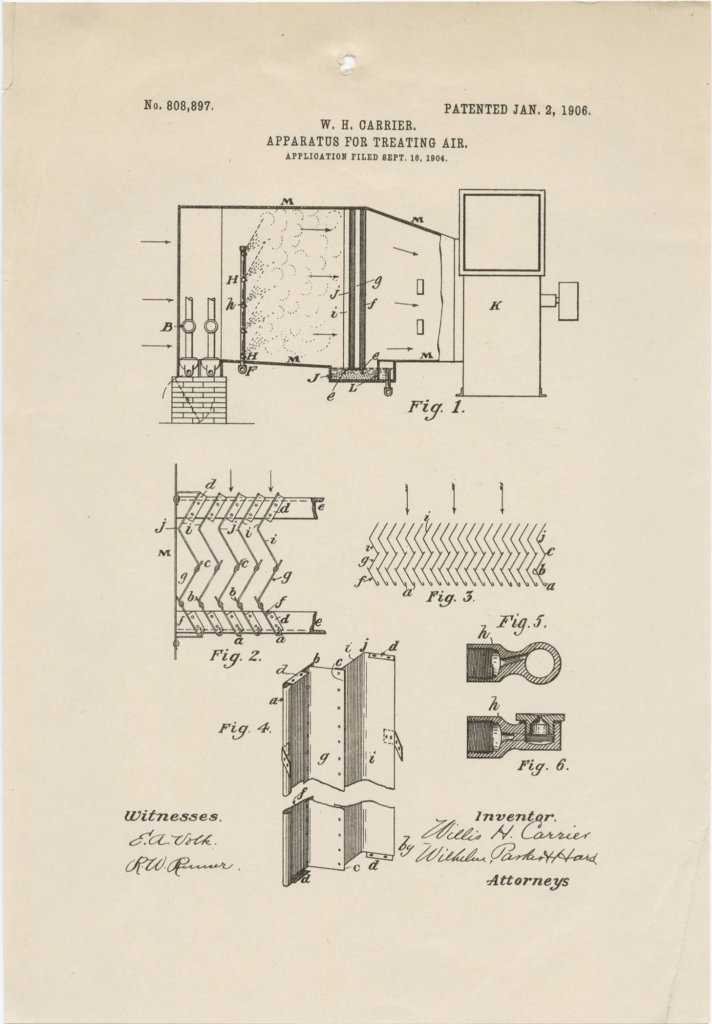
Carrier applied for a patent on his invention, an “Apparatus for Treating Air,” which became patent No. 808897 and was issued on January 2, 1906.
On December 3, 1911, Carrier presented what is perhaps the most significant document ever prepared on air conditioning – Rational Psychrometric Formulae – at the annual meeting of the American Society of Mechanical Engineers. It became known as the Magna Carta of Psychrometrics and tied together the concepts of relative humidity, absolute humidity, and dew-point temperature, thus making it possible to design air-conditioning systems to precisely fit the requirements at hand.
In 1915 Carrier and six other engineers formed the Carrier Engineering Corporation using their personal savings of $32,600. Carrier Global Corporation (NYSE: CARR), the parent company of the Carrier HVAC and refrigeration business, has a current market capitalization of approximately $56 billion. This valuation makes it one of the largest climate and energy solutions providers in the world.
“With his new company,” Alexander Hammond notes, Carrier began to expand the use of air conditioning units by supplying hotels, department stores, movie theaters and private homes. His units were even installed in the White House, the US Congress and Madison Square Garden.”
Another overlooked legacy of Carrier’s invention is the birth of the summer blockbuster. Before air conditioning, movie theaters dreaded the hot months — few people wanted to sit in a crowded, sweltering auditorium. That changed in 1925 when the Rivoli Theatre in Times Square installed one of Carrier’s new cooling systems. Crowds flocked in, many as eager for the cool air as for the feature presentation. Almost overnight, summer transformed from Hollywood’s off-season into its most profitable season. Air conditioning didn’t just cool theaters — it reshaped the economics of entertainment and helped create one of America’s most enduring cultural traditions.
When New York City organizers launched the 1939 World’s Fair under the motto “Building the World of Tomorrow,” they sought technologies that would advance human progress and improve everyday life. Few embodied that vision better than modern air conditioning. During the Fair’s first 100 days, nearly 1.3 million visitors toured the striking “Carrier Igloo of Tomorrow.”
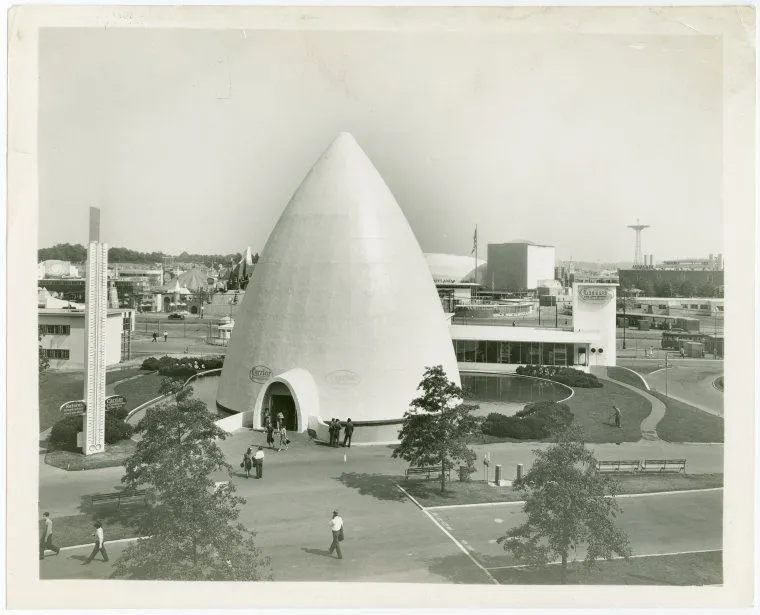
Inside, guests learned how air conditioning worked, explored a modern refrigerated food store, and experienced Carrier’s latest self-contained cooling systems — getting a glimpse of a future that would soon make homes, offices, and entire cities more comfortable, productive, and livable.
In 1985, Willis H. Carrier was inducted into the National Inventors Hall of Fame, and in 1998, Time magazine recognized him as one of the 100 most influential people of the 20th century.
By conquering heat and humidity with knowledge, Carrier enlarged the realm of human possibility. His invention transformed sweltering regions into thriving economies, extended human productivity, and brought comfort and prosperity to billions around the world.
One of the great triumphs of entrepreneurial capitalism is how quickly air conditioning traveled the familiar path from luxury to necessity. What began as an expensive convenience for a tiny elite became, within a generation, affordable to ordinary families. The market did not merely invent comfort — it democratized it.
In their report Time Well Spent: The Declining Real Cost of Living in America, Michael Cox and Richard Alm found that a 5,500-BTU air-conditioning unit cost about $350 in 1952. At the time, entry-level workers earned roughly 83 cents an hour, putting the time price at 422 hours.
Today, Walmart sells a far more efficient 6,000 BTU air-conditioning unit (with a remote control) for only $115. The current hourly wage for limited-service restaurant workers is around $19 an hour, putting the time price at six hours.
The time price has decreased by 98.6 percent. For the time it took US workers to earn the money to buy one unit in 1952, they get 70 today.
If air conditioning saves lives, why don’t more Europeans have it?
Europe’s electricity prices are typically much higher than the US, driven by higher taxes, network costs, renewable energy mandates, and energy import dependence. Customers in the US pay 17 to 19 cents per kilowatt-hour (kWh) compared to 25 to 32 cents in Europe. This means Europeans pay roughly 47 to 68 percent more per kWh than US customers.
Americans are also much richer than Europeans. According to World Bank data, American gross domestic product (GDP) per capita was $84,809 in 2024, while the European Union’s was 25 percent lower at $63,585. That $21,224 difference could buy a lot of comfortable cooling.
The European Union also prioritizes environmental targets over human comfort by imposing strict regulations for heating and cooling, making these amenities much more costly. The commission encourages citizens to use fans instead of air conditioning. Imagine the government doing that in Phoenix and Atlanta in July. Italy, Greece, and Spain even announced temperature limits in public spaces during the 2022 heatwave in an effort to meet these environmental objectives. Spain limited air conditioners to be set no lower than 80°F. No wonder European productivity is 38 percent lower than the US.
Historic preservation laws and strict landlord rules frequently ban exterior window units to maintain aesthetic uniformity.
While air conditioning ownership increases households’ electricity consumption, it may be a small price to pay for comfort and avoiding death.
The problem is not the climate but the policy mindset. Too many European regulators approach energy and technology through the ideological lens of scarcity rather than creative innovation and human flourishing. One reason such policies persist is that the officials who design them are largely insulated from the consequences of their decisions and rarely experience their costs directly. Instead, those costs are borne by millions of ordinary citizens.
Air conditioning is not ultimately a story about cooling. It is a story about knowledge. It transformed oppressive heat into comfort, inhospitable regions into thriving communities, and summer misery into year-round productivity. Coal, copper, and electricity become valuable only after humans discover how to harness them. The history of air conditioning is the history of knowledge triumphing over nature’s constraints.
The ultimate resource is neither energy nor matter. It is the infinite capacity of human beings to learn, create, and discover.
