
In my recent CiVL article, “Growing Out of $40 Trillion: Some Unpleasant Fiscal Arithmetic,” I estimated that merely stabilizing the federal debt burden through economic growth — without spending cuts, tax increases, or additional borrowing — would require something on the order of 7.3 percent annual real GDP growth. The calculation was deliberately generous: it assumed Washington would immediately stop adding to the debt and that faster growth would not generate higher interest rates or additional spending. Even under those indulgent assumptions, sustained growth of 7.3 percent is not remotely realistic.
Seven percent growth sounds vaguely Reaganesque only until one distinguishes real growth from nominal growth. Nominal GDP frequently expanded at annual rates of 7 to 10 percent during the 1980s, but much of that increase reflected inflation rather than additional production. Inflation may enlarge the denominator in the debt-to-GDP ratio, but it is not a free fiscal lunch: bondholders eventually demand compensation for lost purchasing power, maturing Treasury securities refinance at higher rates, indexed federal expenditures rise, and the government’s interest bill compounds.
Real growth tells a very different story. The United States has never sustained seven percent real growth for a meaningful period as a mature peacetime economy. Rates that high have generally appeared during recoveries from the Great Depression, wartime mobilization, or brief rebounds following severe recessions. According to the Bureau of Economic Analysis series for annual real GDP growth, real GDP grew 7.2 percent in 1984, but that was a single-year snapback following the brutal 1981–1982 recession. From 1983 through 1989, the celebrated Reagan expansion averaged approximately 4.4 percent; across the entire 1980s, including two recessions, growth averaged about 3.2 percent. The historical record contains isolated seven percent years, but it does not contain a durable seven percent economy.
Today’s underlying arithmetic is substantially worse. During the 1980s and 1990s, labor-force growth exceeded one percent annually, but the Bureau of Labor Statistics projects growth of only about 0.4 percent annually as population growth slows and the country ages. Meanwhile, CBO’s economic projections place sustainable real GDP growth at about two percent, falling below that rate over the longer term. With little expansion in the number of workers, reaching 7.3 percent would require roughly five additional percentage points of economy-wide productivity growth — not for one recovery year, but repeatedly. Nothing in modern American economic history supports such an assumption.
Using the same assumptions underlying the 7.3 percent estimate — an initial debt-to-GDP ratio of 125 percent, an average effective interest rate of roughly 3.43 percent, and a primary balance of exactly zero every year (meaning the government collects enough revenue to cover all spending except interest on the existing debt) — the outcomes map out as follows.
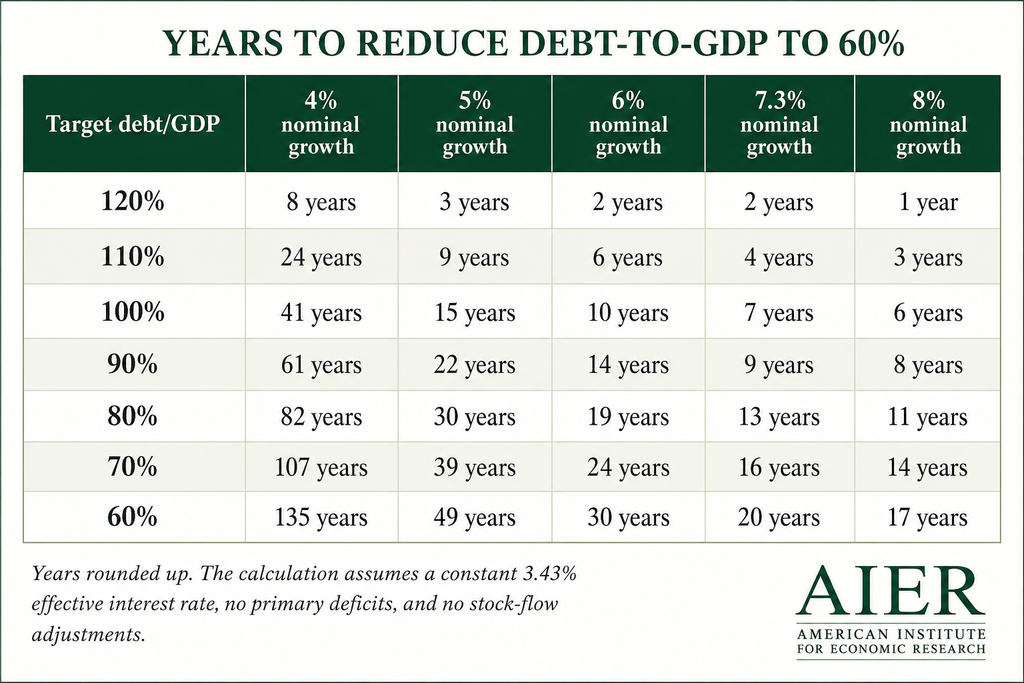
Artificial intelligence does not close the gap. AI might make the economy 5 or 10 percent larger over a decade, which would be enormously valuable, but a one-time increase in the level of productivity is not the same as adding five percentage points to its growth rate every year. CBO’s central estimate is that AI-related productivity gains will add about 0.1 percentage point to annual economic growth. An OECD analysis estimates that AI could add approximately 0.4 to 1.3 percentage points to annual labor-productivity growth in highly exposed economies under different adoption scenarios. At the skeptical end, Daron Acemoglu estimates that advances in AI will produce a cumulative total-factor-productivity gain of no more than about 0.66 percent over ten years.
Suppose we adopt an exceptionally bullish estimate and assume AI adds 1.5 percentage points to annual productivity growth. Combined with labor-force growth of approximately 0.4 percent and the economy’s existing productivity trend, the United States might sustain real growth of 3.5 to 4 percent. That would be an economic triumph, yet it would still be barely half the rate required by the debt arithmetic. Reaching 7.3 percent would require AI to produce several times even the bullish estimate every year, economy-wide, with near-immediate adoption and few offsetting disruptions.
Firm-level AI improvements also do not aggregate mechanically. Making a programmer, analyst, or customer-service representative 20 percent faster at one task does not make the worker, firm or economy 20 percent more productive. That task represents only part of the job, the job only part of the firm, and the firm only part of GDP, while bottlenecks elsewhere remain. General-purpose technologies require complementary investment, organizational redesign, worker training, and new infrastructure. Electricity and computers produced immense benefits, but their economy-wide effects diffused over decades rather than appearing instantly.
The same productivity J-curve may apply to AI. Investment in chips, data centers, software and electricity can surge long before measured productivity follows. AI is extraordinarily capital- and energy-intensive, requiring semiconductor plants, servers, transmission lines, power generation and cooling systems. Those investments must be financed, and the federal government is competing for the same pool of savings.
According to CBO’s 2026–2036 budget outlook, the federal deficit will equal 5.8 percent of GDP in 2026 and rise to 6.7 percent by 2036, compared with a 50-year average of 3.8 percent. Debt held by the public is projected to climb from approximately 101 percent of GDP in 2026 to 120 percent in 2036. Persistent borrowing near 6 percent of GDP during an expansion is not cyclical stabilization; it is structural absorption of capital.
CBO’s analysis of the 2025 reconciliation legislation offers a useful indication of the resulting crowding-out. The agency estimated that the additional federal borrowing would reduce private investment by $440 billion over 2025–2034, an average of approximately ten cents for every additional dollar borrowed. That coefficient is not an immutable law and will vary with economic conditions, monetary policy, and the composition of legislation. The underlying mechanism is nevertheless straightforward: capital used to finance government consumption cannot simultaneously finance housing, factories, equipment, research, and the complementary investments required to diffuse AI.
The fiscal burden also extends beyond current tax receipts. CBO projects that federal outlays will equal 23.3 percent of GDP in 2026 and rise to 24.4 percent by 2036, with an increasing share devoted to Social Security, Medicare, and interest rather than infrastructure or other investments that might increase productive capacity. Interest expense is especially damaging because it purchases no new public service or productive asset; it is the current fiscal cost of past consumption. As debt reprices, higher interest payments enlarge deficits, additional deficits require more borrowing and greater borrowing can increase term premiums and future debt service. Faster GDP growth would help the denominator, but the interest bill would continue repricing in the numerator.
Other fiscal impediments compound the problem. The combined employer-employee payroll-tax rate has risen from approximately 12.3 percent in 1980 to 15.3 percent today, as shown in the Social Security Administration’s historical tax-rate tables. That increase enlarges the wedge between what employers pay and workers receive at precisely the time an aging population is slowing labor-force growth. Tax-code complexity also consumes labor and capital through recordkeeping, legal advice, restructuring, and compliance, while Social Security and Medicare contain enormous unfunded commitments that imply future taxation, benefit reductions or additional borrowing. Faster growth would improve federal revenue, but many government obligations rise alongside wages, prices, and healthcare costs. Washington cannot assume growth enlarges the tax base while leaving its indexed and politically protected commitments unchanged.
The regulatory state confronting today’s economy is also considerably larger than the one inherited by the Reagan administration. The Code of Federal Regulations, which contains the general and permanent federal rules in force, has grown from approximately 100,000 pages around 1980 to roughly 190,000 pages today. The annual Federal Register, which is a flow measure containing proposed and final rules, notices, and other administrative material, reached 106,109 pages in 2024, compared with 87,012 pages in 1980. Page counts are imperfect because a page can contain either a technical correction or an extraordinarily costly mandate. Nevertheless, the accumulated stock represents more permits to obtain, reports to file, lawyers to consult, and regulatory risks to price before capital can be committed. AI may help companies complete the paperwork more efficiently, but it does not make the underlying restrictions disappear.
Historically high tariff barriers create another contradiction. The Budget Lab at Yale estimates that the average statutory US tariff rate now stands near 11 percent, with scheduled increases placing it on course to reach approximately 11.8 percent by the end of 2026. Tariffs raise the cost of imported machinery, components, and intermediate goods, including many inputs required for the AI buildout. A Federal Reserve analysis finds that higher tariffs raise the relative price of capital and consequently depress US investment.
Semiconductor equipment, servers, cooling systems, transformers, and electrical components belong to complicated international supply chains. A government cannot plausibly assume the rapid and nearly frictionless diffusion of a capital-intensive technology while simultaneously taxing its inputs, deterring investment, and forcing businesses to reorganize production around political boundaries. Tariffs may redistribute output toward protected industries, but redistribution is not productivity growth.
The United States can grow faster, and AI, deregulation, tax simplification, and fiscal reform could lift productivity appreciably. Yet CBO’s long-term outlook projects average real potential GDP growth of only about 1.7 percent over the next 30 years, compared with 2.4 percent during the preceding 30 years. Asking this economy to produce sustained growth of 7.3 percent means demanding an additional growth impulse larger than the entire Reagan expansion while assuming away the deficits, interest costs, and political constraints that created the debt problem. AI could produce the greatest productivity boom since electrification and still fail to rescue the federal balance sheet.
The issue at hand, then, is not that faster growth would fail to help. It is that the growth required to solve the growing debt problem in a timely manner itself bears little resemblance to anything the mature US economy has sustained historically. And even the above calculations grant Washington extraordinarily favorable assumptions: no primary deficits, no further fiscal deterioration, a stable effective interest rate, and decades in which the benefits of growth are not converted into additional spending. Against an aging population, slowing labor force growth, rising debt service, enormous unfunded commitments, and a heavier fiscal and regulatory burden, sustained 7.3 percent real growth is not a plausible debt strategy. It is what remains after every difficult political choice — spending restraint, entitlement reform, taxation, and fiscal discipline — has been assumed away.

Comments are closed.