
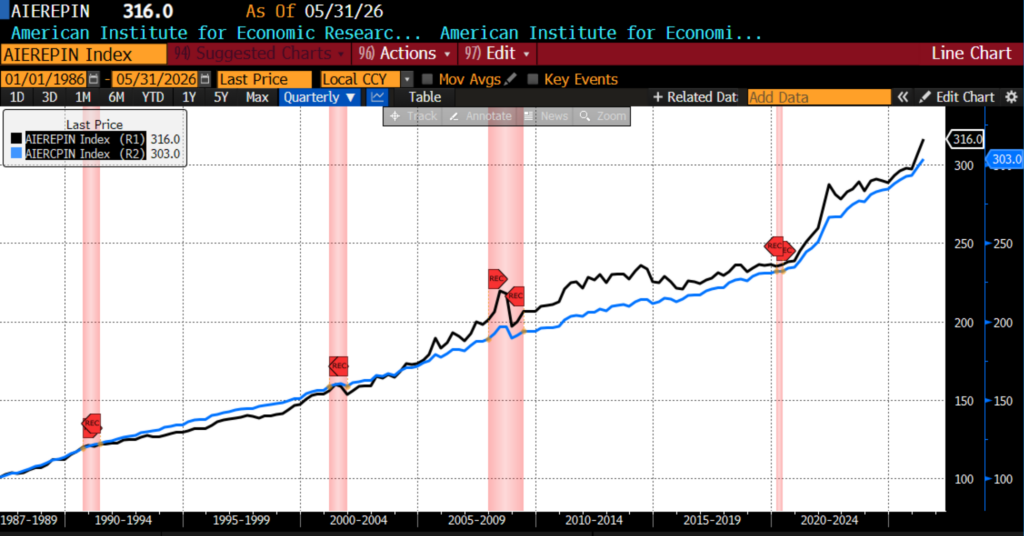
The AIER Everyday Price Index (EPI) rose to 316.0 in May 2026, up 1.22 from the previous month. The index has risen 6.3 percent since the start of 2026, 5.4 percent since the start of the Iran War and 7.3 percent year-over-year. Thirteen price categories rose, ten declined, and one was unchanged, with the largest increases seen in motor fuel, postage and delivery services, and recreational reading material. Gardening and lawncare services, intracity transportation, and purchase, subscription, and rental of video saw the greatest price pullbacks in May.
AIER Everyday Price Index vs. US Consumer Price Index (NSA, 1987 = 100)
Also on June 10, 2026, the US Bureau of Labor Statistics (BLS) released the May 2026 Consumer Price Index (CPI) data. Headline CPI rose 0.5 percent, which met expectations, while core inflation rose 0.2 percent, less than the 0.3 percent forecast.
May 2025 US CPI headline and core month-over-month (2016 – present)
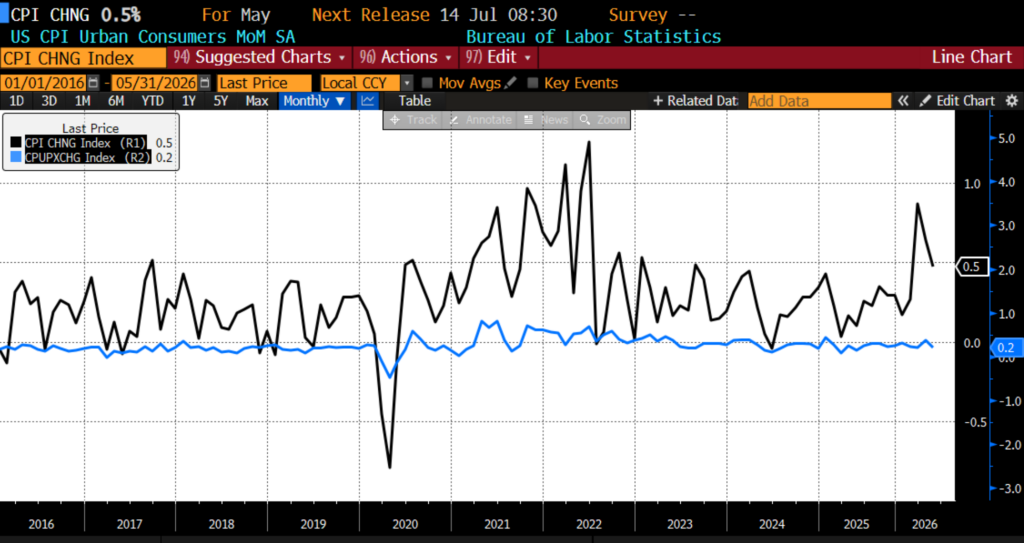
Consumer prices in May were driven primarily by another sharp increase in energy costs, with the energy index rising 3.9 percent and gasoline climbing 7.0 percent on the month (8.6 percent before seasonal adjustment), while food inflation eased. Overall food prices rose 0.2 percent, down from 0.5 percent in April, as grocery inflation remained subdued at just 0.1 percent. Restaurant prices continued to advance, with food away from home up 0.3 percent, while within groceries the largest increases came from beverages (+0.6 percent, including coffee and tea materials +1.1 percent) and bakery products (+0.4 percent). Offsetting pressures included declines in dairy (-0.6 percent), led by cheese (-2.9 percent), and a modest drop in meats, poultry, fish, and eggs (-0.2 percent).
Core inflation cooled materially in May, with prices excluding food and energy rising 0.2 percent after a 0.4 percent gain in April, though shelter costs remained firm. Rent increased 0.4 percent and owners’ equivalent rent rose 0.3 percent, continuing to provide a steady upward contribution, while airline fares (+2.7 percent), communications (+1.3 percent), medical care (+0.3 percent), and personal care (+1.0 percent) also posted notable gains. Offsetting weakness came from motor vehicle insurance (-1.7 percent), household furnishings (-0.6 percent), prescription drugs (-0.9 percent), and new vehicles (-0.3 percent), pointing to further easing in goods inflation even as services inflation remains comparatively sticky.
In year-over-year data, headline CPI came in at 4.2 percent with core (ex food and energy) rising 2.9 percent, both of which met surveyed expectations.
May 2025 US CPI headline and core year-over-year (2016 – present)
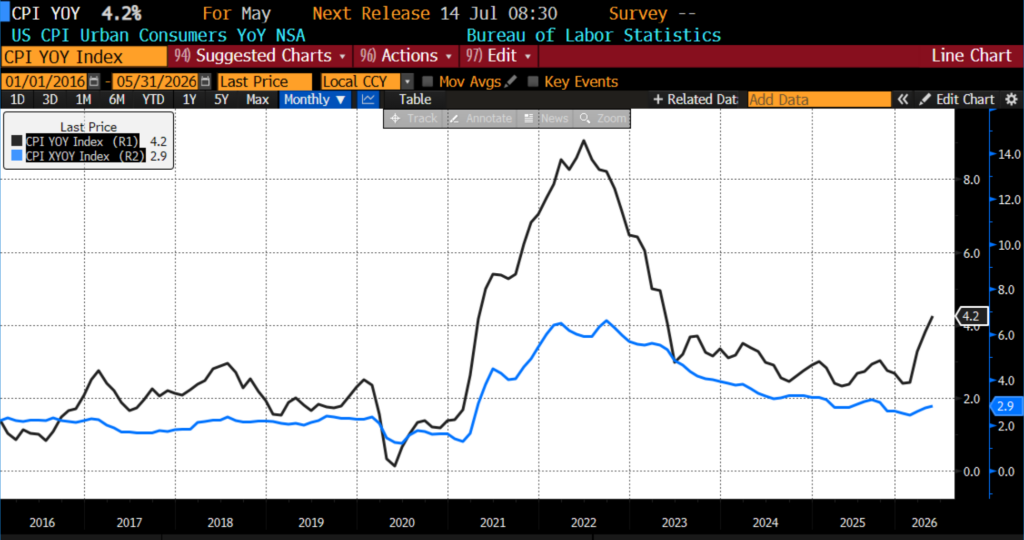
From May 2025 to May 2026, food inflation remained relatively contained even as energy costs surged. Grocery prices rose 2.7 percent in the past 12 months, led by fruits and vegetables (+6.1 percent) and nonalcoholic beverages (+5.8 percent), while meats, poultry, fish, and eggs (+1.8 percent) and cereals and bakery products (+1.9 percent) posted more modest gains. Dairy prices declined 1.0 percent over the year, helping offset broader food pressures. Dining out continued to outpace groceries, with food away from home rising 3.5 percent, including increases of 3.8 percent for full-service meals and 3.3 percent for limited-service restaurants.
Energy remained the dominant inflation story over the last year, unsurprisingly, with the energy index climbing 23.5 percent and gasoline soaring 40.5 percent, while electricity rose 5.9 percent and natural gas increased 3.0 percent. By contrast, core inflation stayed comparatively moderate, with prices excluding food and energy up 2.9 percent over the year. Shelter remained a key contributor, rising 3.4 percent, while apparel (+4.8 percent), household furnishings and operations (+3.0 percent), medical care (+2.6 percent), and recreation (+2.6 percent) posted notable, though less pronounced, gains.
US inflation accelerated in May as the Iran War drove a renewed energy shock, with prices rising at the fastest rate since early 2023. Yet beneath the surface, inflation pressures remained notably softer than feared: core CPI, excluding food and energy, rose at a pace broadly consistent with the Federal Reserve’s two-percent target on an annualized basis. More than half of May’s headline increase stemmed from energy, and categories tied to discretionary demand or durable goods showed ongoing weakness, with prices for new vehicles falling for a second consecutive month and core goods overall declining 0.1 percent. This also suggests that tariff pass-through may largely be complete.
The data suggests a US economy where supply shocks are colliding with increasingly cautious consumers. Shelter inflation cooled significantly, helping offset firmness in areas such as airfares and lodging away from home. Importantly, inflation breadth narrowed: nearly 60 percent of core CPI categories posted annualized price increases below the Fed’s two-percent target in May, while the share of categories experiencing outright price declines rose sharply. That pattern suggests that American consumers are resisting price increases in nonessential categories, restraining firms’ pricing power even as higher fuel and transportation costs begin filtering through portions of the economy.
Nevertheless, the inflation outlook remains complicated. Real average hourly earnings fell 0.7 percent from a year earlier, the sharpest decline in more than three years, which intensifies already considerable pressure on strained US household budgets. The Middle East war, which recently surpassed 100 days, could still broaden inflationary pressures through fertilizer, transportation, and production channels, lifting food and goods prices more broadly. Still, it remains possible that headline inflation peaked in May on a year-over-year basis, and better-than-expected core readings should alleviate fears of imminent Federal Reserve tightening despite the blowout May payrolls report. Markets continue to expect the Fed to hold rates steady at its June meeting under new Chair Kevin Warsh, though futures still imply a meaningful chance of at least one rate increase later in 2026 if energy-driven price increases prove persistent or reignite substantially.
