
Sooner or later, Elon Musk will become the world’s first trillionaire. If SpaceX goes public at the valuations now being discussed, the event would not merely be another financial milestone. Forbes writes, “SpaceX’s IPO is expected to value Musk’s aerospace firm at $1.75 trillion and raise $75 billion, which would more than double Saudi Aramco’s $29 billion debut in 2019 as the largest-ever IPO.”
The public reaction will be predictable. Some will see it as proof that capitalism has gone too far. Others will see it as proof that entrepreneurship still works. The relevant question is not whether one man should have so much money. The better question is what kind of society produces builders capable of changing whole industries (cars, rockets, satellites, logistics, and communication), and more importantly, whether we still have the wisdom to learn from them rather than villainize them.
Elon Musk was born in South Africa, migrating to Canada before ending up in the US. He encapsulates, in one career, the drama of being an entrepreneur in the twenty-first century. He was part of the PayPal team (alongside Peter Thiel, later co-founder of Palantir, and Reid Hoffman, co-founder of LinkedIn) that sold to eBay for $1.5 billion in 2002. Musk’s share was $175.8 million. He was just getting started.
Instead of preserving that fortune, Musk invested it back into uncertainty. He invested heavily in SpaceX ($100 million), Tesla ($70 million), and other flammable projects. The decision to risk his PayPal proceeds on rockets and electric vehicles is the heart of the entrepreneurial story. The entrepreneur does not merely accumulate capital; he reallocates it toward an uncertain future, investing in what others can’t yet see.
Founded in 2002, SpaceX entered an industry dominated by governments, defense contractors, and the assumption that rockets were too expensive and too complex for a private start-up to disrupt. In fact, SpaceX’s first three Falcon 1 launches failed, and the company came close to running out of money before the fourth launch succeeded in 2008: the first successful private orbital launch. But Musk’s ambition was larger: reusable rockets. SpaceX managed to fight through these failures and on December 22, 2015, did the impossible: its Falcon 9 rocket executed a graceful descent and controlled vertical landing. The money-saving and horizon-expanding potential of reusable rockets was gifted to the world, born from Musk’s old PayPal payout.
By comparison, NASA’s Apollo program cost the United States taxpayer $25.8 billion between 1960 and 1973, roughly $309 billion in 2025 dollars. Our national achievement was a monument to state capacity, funded by taxpayers. SpaceX points toward a different model: public agencies as customers, private firms as builders, reusable rockets and other previously unthinkable feats of engineering lowering costs and improving outcomes.
Long curious about electric cars, Musk became the defining investor of Tesla Motors in 2004, after contributing $6.5 of its $7.5 million Series A funding round. He secured a role on the board, and since 2008, Musk has been CEO of the firm. At that time, the idea that an electric car company could challenge the world’s largest automakers looked almost absurd. In 2012, presidential candidate Mitt Romney would still call Tesla a “loser,” and in 2015 former GM vice chairman Bob Lutz warned that the company was facing a “trifecta of doom.” Tesla did face production delays, cash shortages, short sellers, media skepticism, and the basic manufacturing nightmare of building cars at scale. Recalling SpaceX’s public failures, Tesla’s 2019 Cybertruck reveal produced an embarrassing moment when its supposedly durable windows cracked onstage.
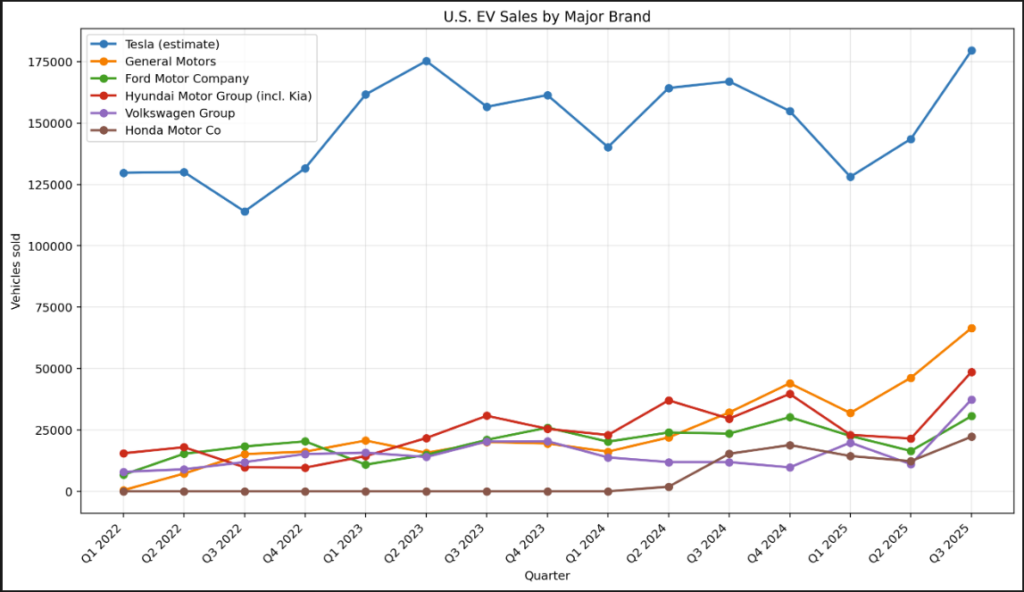
But by the 2020s, Tesla was leading US electric vehicle (EV) sales, while the Model Y became Europe’s favorite all-electric car. Against the odds, the company survived long enough to force major automakers to respond. From Detroit to Berlin, electric vehicles suddenly became a real discussion because Tesla proved that EVs could be desirable, fast, software-driven, and commercially scalable. Entrepreneurship does not merely create a firm; when it succeeds, it changes the decision-making of every incumbent around it. The most innovative firms are disruptors — creative destroyers. The change looks impossible up until the moment it becomes inevitable.
Once success becomes visible, the years of struggle fall from public view. The near-bankruptcies, the fizzled rockets, the viral embarrassments, and the years of ridicule disappear from memory. What remains is the billionaire. The risk is forgotten, and the fortune seems suddenly to be the only fact anyone sees or cares about.
Here, the politics of resentment and envy enter the story. Once the entrepreneur becomes rich enough, the public conversation often stops asking what he built and starts asking why he has so much — forgetting along the way that humanity’s natural state is poverty. The builder becomes a symbol, and the symbol becomes a villain. The original act of creation is replaced by a moral narrative of extraction, enforced through the power of government.
The phrase “tax the rich” captures this shift perfectly. What began as a fiscal demand has become a cultural signal. When Alexandria Ocasio-Cortez wore a white gown with “Tax the Rich” written across the back to the 2021 Met Gala, the message was not buried in a policy paper or argued in a budget committee. It was displayed as political theater at one of the most elite social events in the country. Vogue described the dress, worth $18,000, as a deliberate political message, written in red across the back of the gown at “fashion’s glitziest night”.
Bernie Sanders has carried the same slogan into formal politics. His recent “Make Billionaires Pay Their Fair Share Act” spends 154 pages describing wealth inequality, suggesting it can be solved with a new wealth tax: “In the case of an applicable taxpayer, there is hereby imposed a tax computed equal to five percent of the net value of assets held by the taxpayer for the calendar year.”
The hypocrisy is striking: 73 out of 100 US senators have a net worth over one million dollars on a base salary of $174,000 (and are seeking a raise while running up deficits). Scapegoating billionaires for society’s problems — or, in many cases, government’s problems — treats wealth itself as suspicious, as if the existence of a billionaire is already evidence of social failure.
The tragic murder of UnitedHealthcare CEO Brian Thompson in Manhattan showed how dark that atmosphere has become. Criticizing the American healthcare system is reasonable — treating a man’s death as a symbolic victory against an industry is not. In addition, the health system is often treated as proof of private-sector failure, despite the many distorted incentives created by the government’s extensive role in American insurance and healthcare. Over 143.3 million people are enrolled in or heavily subsidized by major federal health insurance programs, while government policies vastly expand healthcare spending and reduce transparency for patients.
New York’s current political tone, unfolding in the wake of that highly publicized, ideological murder, becomes even more troubling. After such a public act of violence, one might expect greater caution from political leaders about turning named wealthy individuals into targets. Instead, Zohran Mamdani’s tax-the-rich campaign has leaned into personalizing attacks on wealth, using Ken Griffin’s Manhattan residence as a prop for a broader fiscal message. Pointing public anger toward one rich man’s home is not serious governance. It is resentment politics dressed up as public finance.
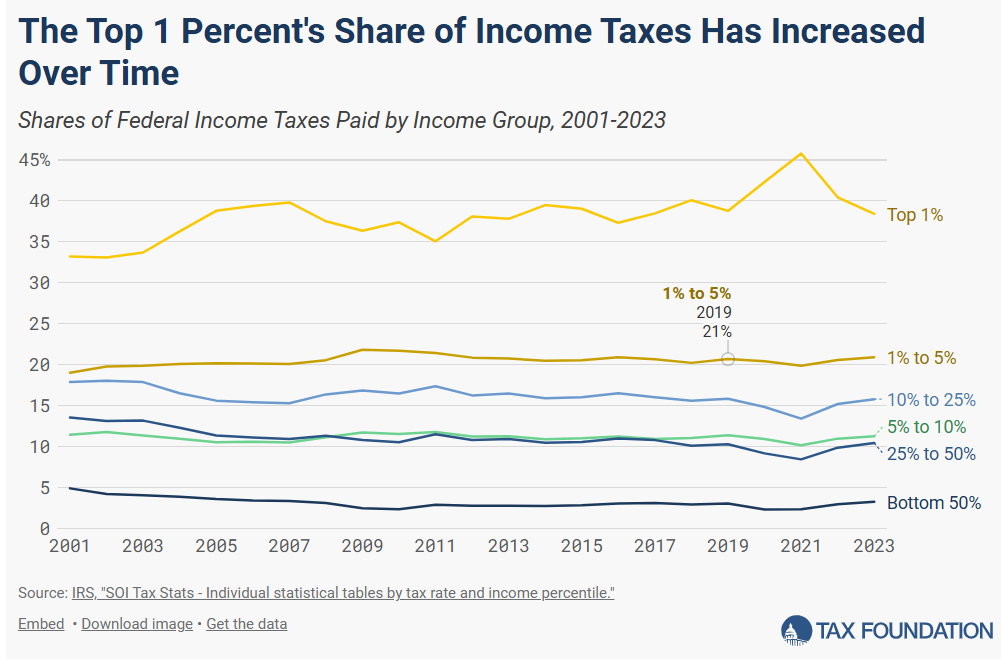
Jeff Bezos’s recent CNBC interview offers a useful contrast. Rather than framing tax policy as a campaign to punish the rich, Bezos argued that the bottom half of American earners should pay no federal income tax at all. For tax year 2023, the bottom 50 percent of taxpayers (those with annual incomes under $53,801) paid 3.3 percent of all federal individual income taxes. By contrast, the share of income taxes paid by the top one percent has increased by almost that much in the past two decades: from 33.2 percent in 2001 to 38.4 percent in 2025.
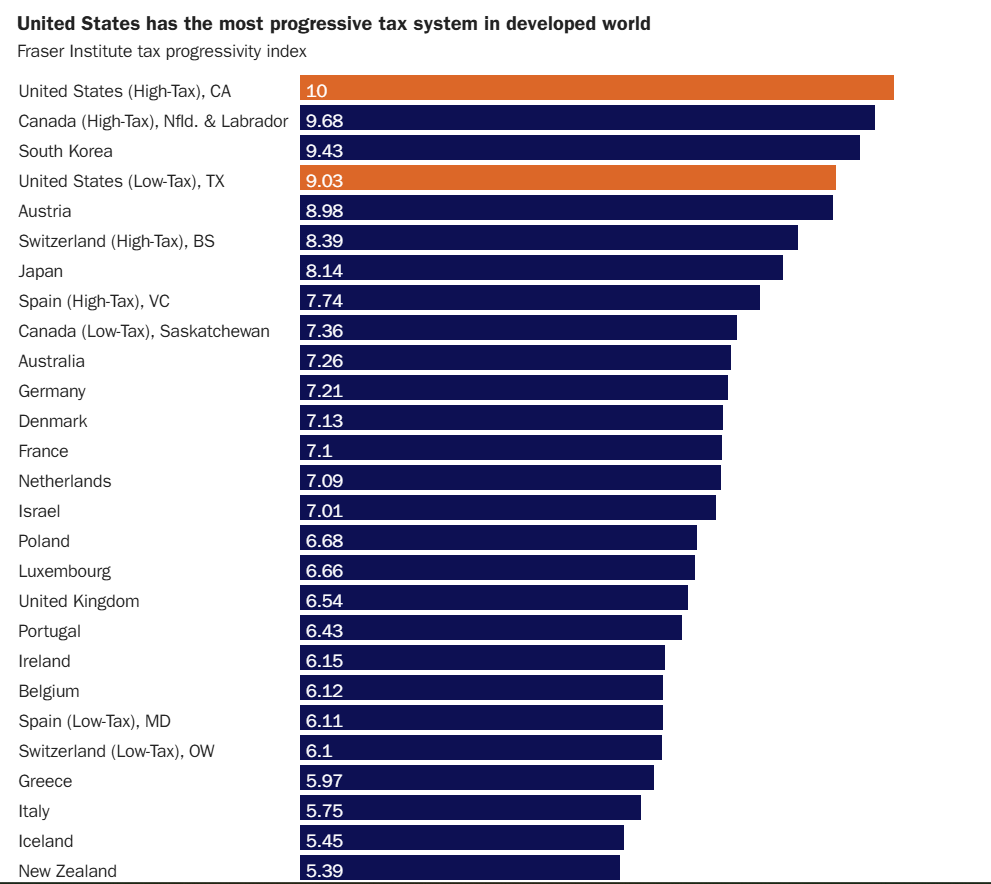
According to Cato Institute calculations, the US already has the most progressive tax system in the world, “with a relatively low marginal rate of 10 percent for lower-income filers and a top rate of 37 percent for higher incomes.”
The greatest irony is that AOC, Sanders, and Mamdani never had to battle the failures and tribulations of competing in a market. Their failed careers include bartending, teaching, farming, and rapping, but they are now able to wield the power of government. With it, they seek to punish those who have built empires in tech, logistics, and finance.
Thomas Sowell captured the moral inversion well, “I have never understood,” he wrote, “why it is ‘greed’ to want to keep the money you have earned but not greed to want to take somebody else’s money.”
