
1. Introduction: Why Sound Money Matters
Money is foundational to commerce and plays a central role in everyday life. We work for it, save it, invest it, and spend it. Yet most people know little about how money works, or how important good laws are for creating a monetary regime that promotes economic prosperity. The more people understand the nature and functions of money, the better they can hold their elected officials accountable for maintaining sound money.
Sound money preserves its purchasing power over time and may even increase in value as technology and productivity improve. This contrasts with bad money that loses its value rapidly as politicians create ever more of it to fund profligate government spending.
2. Money Is an Institution
Money is a kind of institution — something that operates according to written and unwritten rules. The institution of money has three key elements:
Money is an emergent market institution. There was no great monetary convention or social contract where everyone agreed on the content and worth of money. Governments often provide legal definitions of money, but even these tend to evolve over time in response to economic and social change.
Money is fundamentally a social institution. Money only works if other people accept it. Trying to pay with the wrong currency while traveling abroad, for example, often gets you nowhere.
Money is a legal institution. Money can be used to extinguish tax and debt obligations. Courts enforce contractual payments.
3. The Functions and Qualities of Money
Let’s consider three defining traits of money: it stores value, it is a unit of account or measure, and it is a commonly accepted medium of exchange. Economists have written at length about various qualities commodities need to carry out these three functions:
Portability: People want to be able to take their money (purchasing power) with them wherever they go.
Divisibility: People want to be able to make any payments, large or small, with precision. They want to be able to buy a stick of gum as well as a house with their money.
Durability: People don’t want their money to deteriorate or fall apart before they can use it.
Scarcity: Whatever commodity we use for money needs to be scarce enough to have value. Rocks, wooden tokens, plastic tokens, and the like would generally not be scarce enough to serve as money.
Besides helping us understand money today, these qualities also show how the institution of money developed historically. As human beings produced and traded over the millennia, commodities with these qualities emerged as money through millions of decentralized transactions and exchanges.
4. How Money Emerged from Markets
In ancient times, tribal or pastoral societies bartered — trading one good for another. This kind of trading is time-consuming and inefficient. People have to spend a lot of time searching for the right person to trade with and they must spend a lot of time negotiating.
The founder of Austrian economics, Carl Menger, wrote about the importance of “saleability” in the emergence of money. Some goods (including commodities like metals) are widely accepted while others (pottery or hats or maps) are less so. Many commodities have been used as money throughout history: shells, tobacco, salt, cattle, and of course precious metals. Over time, people strategically trade less saleable goods for more saleable goods.
The qualities that make good money, portability, durability, divisibility, and scarcity all correspond to the qualities that make goods saleable. As more trading took place, the most saleable goods emerged as mediums of exchange, or money. Not surprisingly, we see clearer systems or practices of money in urban and trade centers than in rural settings.
Gold and silver emerged as the best media of exchange across countries and over time. Though other commodities can, and have, functioned as money, for the past few thousand years, gold and silver (with other metals used for small transactions) were the main media of exchange.
5. Governments and the Temptation to Debase
Many norms and practices developed over the centuries to improve the institution of money. Some were market-driven, others were created by governments. Merchants developed weights, measures, scales, and standards of quality for money. Early mints and gold warehouses in Renaissance Italy were primarily privately owned.
But over the past four hundred years, national central banks have monopolized the creation of currencies. Governments have a long history with money. Rulers have often attempted to take advantage of existing monetary systems to manipulate money for their own ends.
The political tendency, when it comes to money, is to monopolize its creation and control. When the state issues coins, for example, and defines those coins as having a certain quality and quantity of precious metal, it also gains the power to cheat on the margins — to mint coins below its own stated standards and pass off the degraded coins as unchanged. This allows governments to increase their purchasing power by skimming off the top and making a greater quantity of coins with less of the valuable resource (such as gold) in each coin.
Coins containing less of the precious metal might become physically smaller and lighter as a result. Or the coins may remain a similar size or weight but have less valuable metals mixed into them.
This practice effectively taxes everyone who holds money because increasing the quantity of coins in circulation raises the overall price level and, conversely, reduces the purchasing power of all existing coins. This process — taxation via debasement — is known as seigniorage. It remains one of the oldest tricks employed by profligate governments to spend beyond their means.
6. Fiat Money and Inflation
Modern currencies no longer consist primarily of coins made of precious metals. Instead, they operate purely by fiat (authority of the issuer) and the currency’s value fluctuates based upon supply and the demand for that currency. Governments have little ability to increase market demand for their currency, but they can greatly affect the supply of their currency. The allure of “free” additional spending leads most governments to increase the supply of their currency over time in ways that reduce its value — how many goods and services it can purchase.
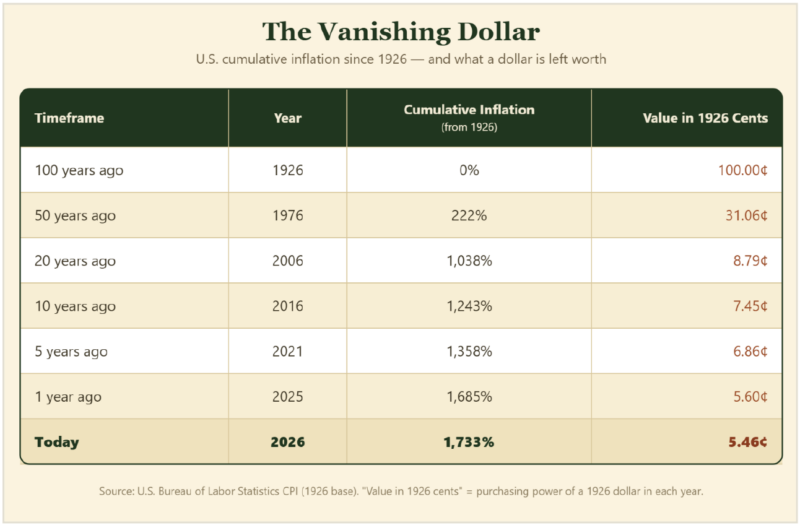
As a result, we live in a world of global inflation. The dollar has remained the world’s reserve currency, not because it is strong, but because most other currencies are weaker. We try to measure the strength of the dollar through inflation indices that represent the purchasing power of the dollar. According to a popular index, the Consumer Price Index (CPI), the value of the dollar has declined steadily over the past century.
The Federal Reserve has an inflation target of 2 percent, which means it actively aims to reduce the value of a dollar by 2 percent every year. Even that questionable target is better than their recent record since 2020 of annual inflation averaging over 4 percent through 2026. Inflation compounds over time, however, dramatically reducing the purchasing power of the dollar. Figure 1, next page, shows how much purchasing power a dollar has retained since 1926.
Figure 1
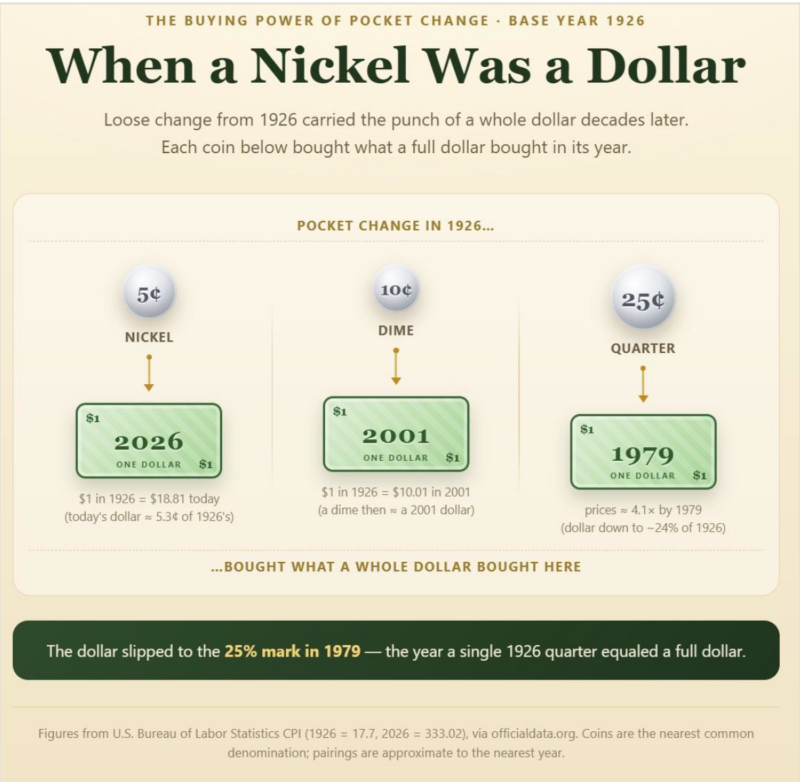
Another way to think about the debasement of money is to consider the value of money in 1926 relative to a dollar later in time (see Figure 2, below). For example, a 1926 quarter could purchase what a dollar could in 1979. A 1926 dime could purchase what a dollar in 2001 could purchase. And a 1926 nickel could purchase what a dollar can today.
Figure 2
7. Innovation and the Future of Money
There have been many innovations in finance and financial institutions over the years: checks, ATMs, electronic clearing, changes in the redeemability of paper notes for gold or silver, and many more. Governments also create rules and frameworks to govern monetary innovations: reserve requirements, fraud protections, regulatory approvals, and more. Over the past decade, the United States has begun planning for digital money by creating a new legal framework through the GENIUS Act.
People have always looked for ways to preserve their wealth and have many means of doing so besides accumulating government-issued currency. The creation of digital currencies and digital assets offers an intriguing alternative to traditional monetary systems. Should decentralized digital currencies achieve widespread adoption — offering global exchangeability and a supply beyond state control — they could fundamentally disrupt the monopoly of major national currencies.
8. Conclusion: The Stakes of Sound Money
Recognizing money as a decentralized social or market institution reveals the limits and the consequences of government involvement. While governments can debase and devalue a currency by overproducing it, their ability to increase demand for their currency is quite limited. And a loss of confidence by the public can destroy a currency altogether as a medium of exchange because it no longer stores value sufficiently.
Ecuador, Panama, and El Salvador have all abandoned their domestic currencies because they became devalued and chose instead to use dollars. This is called “dollarization.” Many other countries, like Zimbabwe, Cambodia, and Lebanon, while not officially dollarizing, have populations that effectively use dollars or other currencies for most exchanges because their domestic currency is unreliable.
The United States and the dollar operate according to the same principles. Though the dollar has done well in a relative sense, there is a growing danger that national debt and deficits will debase the currency to such an extent that people view it as unreliable and seek other forms of wealth and other media of exchange. This will be extremely costly for those left holding significantly devalued dollars and for governments that try to buy goods and services with those dollars.

Comments are closed.