
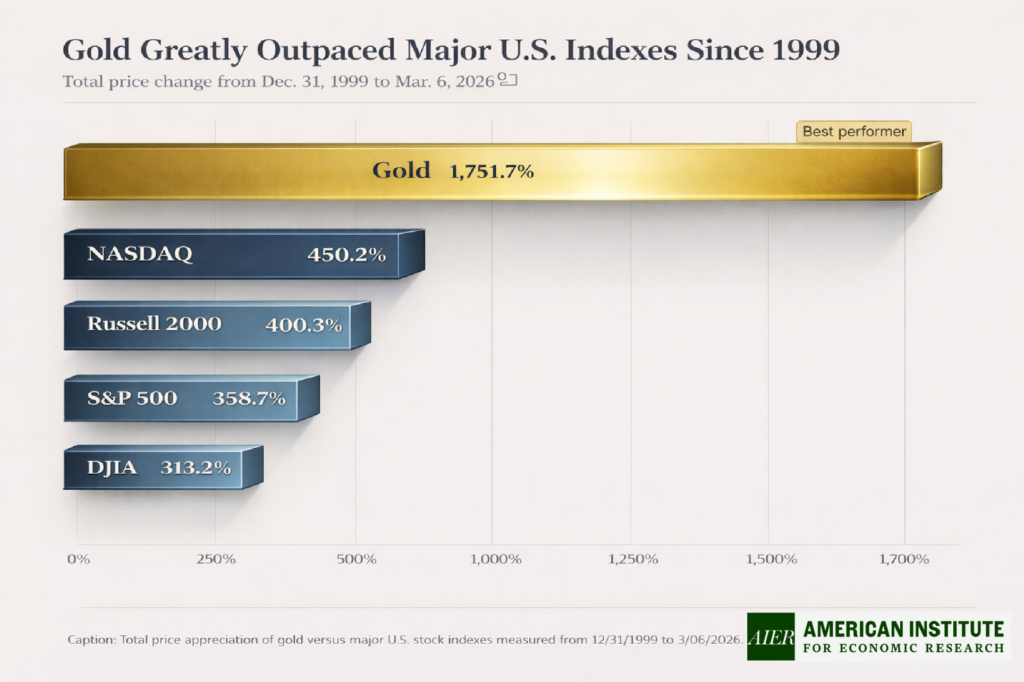
For over two decades, gold’s role as a staple investment has grown more pronounced in the global financial system. Since 2000, the commodity has outperformed all major US stock indices. It has preserved purchasing power, protected investors during crises, and hedged against policy shifts.
The forces propelling gold higher today extend beyond its safe-haven status. A mix of technological change and geopolitical restructuring is reshaping how investors view gold. The result is a powerful combination of structural demand and constrained supply. These conditions help explain gold’s strong performance and why many believe its appeal is far from over.
Below are thirteen major forces shaping the modern gold market.
1. Safe Haven in a Crisis
Gold is a store of value. When currencies depreciate and governments falter, gold is the primary place of refuge for concerned investors. That reputation drives demand and pushes capital flows into gold during uncertain times.
2. Geopolitical Concerns
Global tensions remain a powerful catalyst. Conflicts in Eastern Europe, instability in the Middle East, and shifting power dynamics in Asia have increased demand for assets that exist outside political control. Gold has been a major beneficiary from this environment.
3. Preservation of Purchasing Power
History offers a striking comparison: roughly 200 ounces of gold bought an average home decades ago, and roughly the same amount still does today. While prices in dollars have changed dramatically, gold has preserved long-term real value. This property continues to attract investors seeking protection from currency debasement.
4. Central Bank Accumulation
Some of the biggest buyers of gold are central banks and governments. Many of them are diversifying their holdings from currencies to hard assets. This shift reflects concerns about debt levels, currency risks, and geopolitical tensions. Central bank purchases have become a significant source of demand in the market.
5. Expanding Sovereign Debt
The public debt has increased substantially globally. The US now carries a level of debt significantly higher than in previous decades relative to GDP, and other large economies are under similar pressures. This could reduce confidence in long-term currency stability, making gold an attractive store of value.
6. Structural Policy Divides Across the World
Differences in trade, regulation, energy, and industry policies have divided the world economically. With each economic bloc having its own set of priorities, the level of uncertainty in financial markets rises. Gold performs well in such a scenario where the level of coordination is low and perceptions of risk are high.
7. Lower Growth and Structural Economic Changes
In some developed countries, the rate of productivity growth has been lower, and at the same time, there has been an increase in the complexity of regulations. Some investors see this environment as less supportive of capital growth and profitability. As a result of lower growth expectations, there has been an increase in allocation to defensive assets.
8. Strong Relative Performance
Gold has outperformed various large U.S. equity market indices from 2000 through the mid-2020s, beaten inflation, and grown at a rate that well surpassed economic growth. Even in times when markets experienced strong rallies, gold performed well.
9. Global Reserve Rebalancing and Dedollarization
The rise of new economic blocs, such as the BRICS (Brazil, Russia, India, China, South Africa) countries and others, has led to an increase in their gold reserves as part of their reserve diversification policies. The US dollar is still the leading currency, but its share of global reserves has been gradually falling in recent years. The share of gold reserves has been rising correspondingly.
10. Technological and Industrial Demand
Gold is a financial asset and an industrial metal. It is highly conductive and corrosion resistant. It is an essential component in the electronics industry, supercomputing infrastructure, and manufacturing. As technology advances, industrial demand places structural pressure on supply.
11. Digital Assets
Digital asset markets are beginning to use gold as collateral. Many stablecoin issuers now hold substantial gold reserves alongside traditional securities. Stablecoin adoption has driven capital flows that support the underlying commodities to which they are pegged.
12. Portfolio Diversification and Low Correlation
Gold has always been known for its low correlation with stocks and bonds. When stocks fall sharply, gold often moves in a different direction. Consequently, institutional investors are increasingly recognizing the role of gold as a diversifier and not as a speculative asset.
13. Demand Continues to Outpace Supply
Worldwide demand has been at record levels in the past few years. The rate of growth in mining production is low, and new discoveries are few. As demand grows at a rate that exceeds supply, prices are likely to move higher.
The Bigger Picture
Investors often turn to gold for wealth preservation and long-term appreciation. But recent price action suggests there is more to gold than meets the eye.
Gold has been rising even when equity markets perform well, real interest rates increase, and inflation remains moderate. This suggests gold is being driven by forces beyond traditional crisis-related demand.
Gold now sits at the crossroads of monetary policy, geopolitics, technology, and broader changes in the global financial system.
Gold’s Expanding Role
Gold’s rise reflects more than fear or inflation. It reflects a world in transition. Governments are managing higher debt. Financial systems are evolving. Technology is expanding industrial demand. Reserve strategies are shifting.
Investors continue to seek assets that hold value outside political and monetary systems. Unless these underlying forces reverse in a meaningful way, gold’s role in global finance is likely to remain strong.
