Author

admin

Browsing

Vice President JD Vance, former Vice President Kamala Harris and former President Barack Obama were among the prominent political figures who issued statements following the death of Rev. Jesse Jackson Sr. The civil rights leader and two-time Democratic presidential primary candidate was 84.

Vance indicated that one of his family members voted for Jackson in the 1988 Democratic presidential primary and for Trump in the 2016 Republican presidential primary.

‘I have a close family member who voted in two presidential primaries in her entire life. Donald Trump in 2016 and Jesse Jackson in 1988,’ Vance wrote in a post on X. ‘RIP Jesse Jackson.’

Former Vice President Kamala Harris recalled getting positive reactions from others when she had a ‘Jesse Jackson for President’ bumper sticker on her car when she was a law student.

‘As a young law student, I would drive back and forth from Oakland, where I lived, to San Francisco, where I went to school. I had a bumper sticker in the back window of my car that read: ‘Jesse Jackson for President.’ As I would drive across the Bay Bridge, you would not believe how people from every walk of life would give me a thumbs up or honk of support. They were small interactions, but they exemplified Reverend Jackson’s life work — lifting up the dignity of working people, building community and coalitions, and strengthening our democracy and nation,’ she noted in a post on X.

‘I was proud to partner with and learn from him on this work throughout my career, and I am so grateful for the time we spent together this January. Reverend Jackson was a selfless leader, mentor, and friend to me and so many others,’ she wrote.

Former President Barack Obama noted in a statement that he and former first lady Michelle Obama ‘were deeply saddened to hear about the passing of a true giant, the Reverend Jesse Jackson.’

‘Michelle got her first glimpse of political organizing at the Jacksons’ kitchen table when she was a teenager. And in his two historic runs for president, he laid the foundation for my own campaign to the highest office of the land,’ Obama noted. ‘Michelle and I will always be grateful for Jesse’s lifetime of service, and the friendship our families share.’


This post appeared first on FOX NEWS

President John F. Kennedy once said, “We must find ways of returning far more of our dependent people to independence.” President Lyndon B. Johnson sought to meet that challenge by launching the War on Poverty in 1964, insisting that its purpose was not to make people “dependent on the generosity of others,” nor merely to “relieve the symptom of poverty,” but to “cure it and, above all, to prevent it.”

Sixty years and some $20 trillion in welfare spending later, that message appears to have gotten lost. Rather than helping the poor climb out of poverty toward self-reliance, government handouts have instead pulled the ladder away by supplanting work as their primary source of income. 

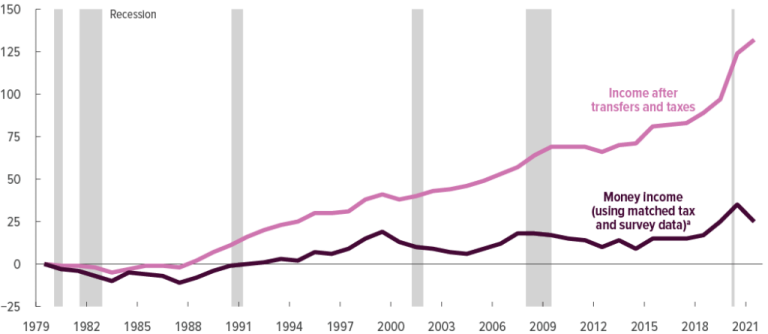
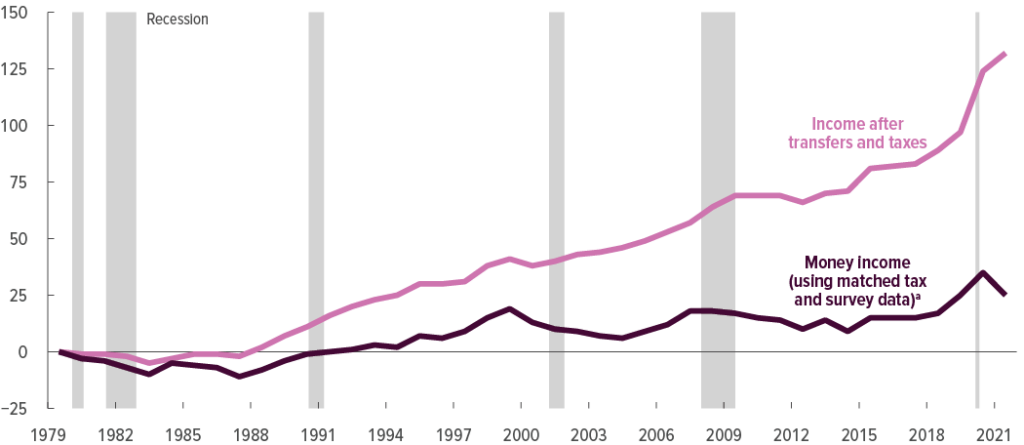
According to January’s Congressional Budget Office (CBO) report, average total income for the poorest households nearly doubled from 1979 to 2022. But most of that increase was fueled by government wealth transfers.

Cumulative Growth of Income Among Households in the Lowest Quintile of the Income Distribution, by Type of Income

Congressional Budget Office, using data from the Census Bureau. In 2021 dollars. Shaded areas show recessions. 

If the success of America’s social safety net is measured by how much cash the government can dole out, then it’s a testament to the scale and generosity of the welfare state. But that was never the yardstick the architects of the welfare state themselves used when selling their War on Poverty to the public. Welfare was intended to be a means toward self-sufficiency and independence through work.

Viewed through that lens, the CBO report paints a far more troubling picture: Low-income Americans are receiving an ever-growing share of their financial resources from government transfers instead of work.

In 1979, households in the lowest income quintile earned, on average, about 53 percent of their total income from money income — wages, salaries, business income, and other earnings from private-sector work. Means-tested transfers — government cash and in-kind benefits targeted to low-income households — made up just 26 percent.

Since then, the numbers have gone in completely opposite directions. During the pandemic, income from work plummeted to an all-time low of just 33 percent, while means-tested transfers skyrocketed to 57 percent.  

Even after temporary COVID-era benefits expired, about 42 percent of the income of America’s poorest households comes from their own earnings. Government transfers also sit at 42 percent, matching earnings from work dollar-for-dollar.

The means-tested transfer rate — that is, the value of welfare benefits relative to income before government assistance and taxes — tells the same story. In 1979, it stood at 32 percent. By 2022, this figure had more than doubled to 72 percent. In other words, for every dollar a low-income household earned (after counting social insurance like Social Security and Medicare), 72 cents were in welfare benefits. During the pandemic, this reached a staggering 93 percent.

The report’s findings are indicative of a trend that is all too common in America’s “social safety net.” Rather than enabling the poor to rely on their own earnings, welfare traps people in government dependency.

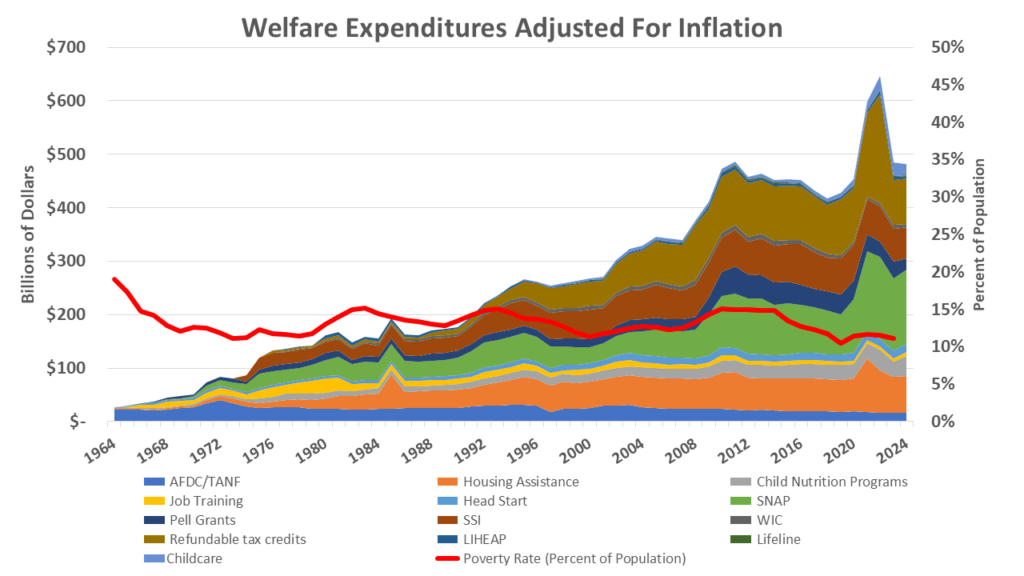
Real federal welfare spending has soared 765 percent, and now, despite unprecedented economic gains for low-income Americans, more of them are dependent on government assistance than at any point in the country’s history. That’s hardly an outcome taxpayers  should be proud of in a country that styles itself as the land of opportunity. Indeed, if welfare’s purpose is to provide transitional support, then persistently high caseloads should signal that government assistance has become a destination, not a bridge.

CBO via USGovernmentSpending.com. Chart by FederalSafetyNet.com

If the federal government is going to be in the business of wealth redistribution at all, taxpayers are entitled to demand that it cultivate a culture of work, as then-senator Joe Biden said before the 1996 welfare reforms. But if taxpayers have been pouring trillions of dollars into a money pit that has failed to achieve its own stated goals for over 60 years, it’s time for a serious reckoning.

It is neither efficient nor compassionate for the government to create a perpetual underclass of citizens trapped in a cycle of dependency at the taxpayers’ expense. No amount of political or moral grandstanding can ever justify this state of affairs.

As Congress floats the idea of a second reconciliation bill going into 2026 amid the One Big Beautiful Bill Act (OBBBA)’s historic welfare reforms, it would do well to remember that a paying job will always be the best anti-poverty program.

The CBO’s report should be a warning. If the goal is independence, welfare policy must be judged by whether it increases work and reduces reliance on government aid. But if the welfare state has become the narcotic President Franklin ‘New Deal’ Roosevelt himself warned against, then Congress should follow his prescription: “The federal government must and shall quit this business of relief.” 

The Vatican will not join President Donald Trump’s newly formed Board of Peace, its top diplomatic official said Tuesday, signaling reluctance from the Holy See to take part in the post-war initiative.

Vatican Secretary of State Cardinal Pietro Parolin said the Holy See ‘will not participate in the Board of Peace because of its particular nature, which is evidently not that of other States,’ the Vatican’s official news outlet reported.

The Board of Peace, which was chartered in January and includes nearly 20 countries, is tasked with managing recovery efforts in the Gaza Strip after the Israel-Hamas war.

While responding to questions about Italy declining to join the board, Parolin said ‘there are points that leave us somewhat perplexed,’ adding that ‘there are some critical points that would need to find explanations.’

‘The important thing is that an attempt is being made to provide a response,’ he said. ‘However, for us there are certain critical issues that should be resolved.’

Parolin continued, ‘One concern is that, at the international level it should above all be the UN that manages these crisis situations. This is one of the points on which we have insisted.’

Pope Leo, the first U.S. pope, received an invitation to join the peace board in January.

Leaders from 17 countries participated in the initial charter signing ceremony in Davos, Switzerland, in late January, including presidents and other senior government officials from Latin America, Europe, the Middle East and Central and Southeast Asia.

Israel formally joined the board last week ahead of Prime Minister Benjamin Netanyahu’s meeting with Trump at the White House.

Several other countries were also invited by the White House, including Russia, Belarus, France, Germany, Vietnam, Finland, Ukraine, Ireland, Greece and China.

Poland and Italy on Wednesday said they would not join.

Trump announced Sunday that board members have pledged more than $5 billion in aid for Gaza.

The president said the funding would be formally pledged during a meeting Wednesday in Washington, D.C.

Fox News Digital’s Anders Hagstrom contributed to this report.


This post appeared first on FOX NEWS

Silverco Mining (TSXV:SICO) is a production-stage silver company targeting opportunities in Mexico’s Sierra Madre Occidental belt. Its primary technical focus is optimizing the wholly owned Cusi Mining Complex in Chihuahua, an 11,665-hectare district-scale property. The site benefits from established, institutional-quality infrastructure—such as direct access to the national power grid and paved roads—significantly lowering the capital requirements for restarting operations.

The company is undertaking a definitive transition toward mid-tier producer status through a binding agreement to acquire Nuevo Silver. This deal gives Silverco control of the La Negra mine in Querétaro, a currently producing asset that delivers immediate top-line revenue. By pairing the near-term restart of the Cusi 1,200 tpd mill with ongoing production at La Negra, Silverco is effectively bypassing the multi-year development cycle typically faced by junior miners.

Map showing mining projects in Mexico

This “buy-and-build” strategy is driven by a technical team with specialized expertise in Mexican epithermal vein systems and complex underground mine engineering, positioning the company to accelerate growth while maintaining operational discipline.

Company Highlights

  • The $62.5 million upsized bought deal financing (closing Q1 2026) and Eric Sprott’s $10 million lead order provide cornerstone validation from a legendary mining investor and the necessary liquidity to fast-track production restarts.
  • The updated Mineral Resource Estimate of 41.2 million ounces of silver equivalent (AgEq) in the Measured and Indicated category establishes a high-confidence geological foundation at Cusi, supporting long-term mine planning.
  • The dual-track growth strategy involving the Cusi restart and the Nuevo Silver/La Negra acquisition provides immediate production scale and a diversified cash-flow profile across two distinct Mexican mining jurisdictions.
  • Pure-play silver exposure with significant de-risking is achieved via the 1,200 tonne-per-day (tpd) Cusi mill, which was producing as recently as 2023, ensuring that surface infrastructure is ‘warm’ and capable of a rapid return to service.
  • Imminent exploration catalysts exist following the completion of a 15,000-metre drill program at Cusi; results are currently pending and are expected to define high-grade extensions at the San Miguel vein.

This Silverco Mining profile is part of a paid investor education campaign.*

Click here to connect with Silverco Mining (TSXV:SICO) to receive an Investor Presentation

This post appeared first on investingnews.com

Global central banks own about 17 percent of all the gold ever mined, with reserves topping 36,520.7 metric tons (MT) at the end of November 2025. They acquired the vast majority after becoming net buyers of the metal in 2010.

Central banks purchase gold for a number of reasons: to mitigate risk, to hedge against inflation and to promote economic stability. Increased concerns over another global financial crisis have as expected led central banks once again to build up their gold reserves.

In a mid-2025 survey, the World Gold Council (WGC) said that 95 percent of the central bankers it polled expect global gold reserves to increase over the next 12 months. The precious metal’s ‘performance during times of crisis’ was cited by 85 percent of respondents as highly or somewhat relevant to their decision, while 80 percent cited its long-term store of value.

Central banks added 863.3 metric tons of gold to their vaults in 2025. While this was lower than the previous three years, which all topped 1,000 MT each, the reserve gains were still well above the 2010 to 2021 annual average of 473 MT.

Yearly central bank gold purchases since 2019.

Chart via the WGC.

A record 95 percent of respondents to the WGC survey stated their belief that central banks will continue to grow their holdings, with 5 percent suggesting they would hold at current levels. For the second year in a row, no respondents expected reserves to decrease.

The Council found that sentiment was consistent across advanced and emerging economies and reflected the strategic role of gold amid dynamic economic and geopolitical uncertainty.

Which central banks hold the most gold?

Read on to find out the 10 top countries by central bank gold holdings, as per data from the WGC, including recent Q4 2024 and full-year 2024 reports.

1. United States

Gold reserves: 8,133.46 metric tons

When it comes to the largest gold depository in the world, the American central bank is number one with 8,133.46 metric tons of gold.

A large percentage of US gold is held in “deep storage” in Denver, Fort Knox and West Point. As the US Treasury explains, deep storage is “that portion of the US Government-owned gold bullion reserve which the Mint secures in sealed vaults that are examined annually by the Treasury Department’s Office of the Inspector General and consists primarily of gold bars.”

The rest of US-owned reserves are held as working stock, which the country’s mint uses as raw material to mint congressionally authorized coins.

2. Germany

Gold reserves: 3,350.3 metric tons

The Bundesbank, Germany’s central bank, currently owns 3,351.53 metric tons of gold. Like many of the central banks on this list, the German national bank stores a significant portion of its gold in foreign central banks.

Today, just over half of Germany’s gold holdings are stored within Frankfurt, while internationally 1,236 MT of gold is stored in the vaults of the New York Federal Reserve, and 12 percent of its holdings are in London.

The Bundesbank’s foreign gold reserves came into question in 2012, when the German Federal Court of Auditors, the Bundesrechnungshof, was openly critical of the Bundesbank’s gold auditing. The German bank issued a public statement defending the security of foreign banks. Privately, the Bundesbank then began the arduous process of repatriating some of its gold stock back to German soil. By 2016, more than 583 MT of gold had been transferred back to Germany.

The economic upheaval and geopolitical volatility brought about by US President Donald Trump’s tariff wars and adversarial posturing toward Europe has led to calls for Germany to consider further repatriating its gold, reported The Guardian in January 2026.

3. Italy

Gold reserves: 2,451.9 metric tons

Banca d’Italia, the national bank of Italy, holds 2,451.84 metric tons of gold. The central bank began amassing its gold in 1893, when three separate financial institutions merged into one. From there, its 78 MT of holdings slowly grew into the large gold reserves it holds today.

Like Germany, Italy stores parts of its reserves offshore. In total, 141.2 MT are located in the UK, 149.3 MT are in Switzerland and 1,061 MT are kept in the US Federal Reserve. Italy houses 1,100 MT of gold domestically.

4. France

Gold reserves: 2,437 metric tons

The Banque de France has 2,437 metric tons of gold reserves, all of which it keeps on hand. The precious metal is stored in the bank’s secure underground vault, dubbed La Souterraine, which is located 27 meters below street level.

La Souterraine’s gold vaults are one of the four designated gold depositories of the International Monetary Fund.

According to Investopedia, the collapse of the Bretton Woods gold standard system was in part due to former French President Charles de Gaulle, who “called the U.S. bluff and began actually trading dollars in for gold from the Fort Knox reserves.” At the time, US President Richard Nixon “was forced to take the U.S. off the gold standard, ending the dollar’s automatic convertibility into gold.”

5. Russia

Gold reserves: 2,326.5 metric tons

The Bank of Russia is the official central bank of the Russian Federation and owns 2,332.74 metric tons of gold. Like France, Russia’s central bank has opted to store all its physical gold domestically. The Bank of Russia stores two-thirds of its gold reserves in a bank building in Moscow, and the remaining one-third in Saint Petersburg.

The majority of the yellow metal is in the form of large, variable-weight standard gold bars weighing between 10 and 14 kilograms. There are also smaller bars on site weighing as much as 1 kilogram each.

Russia, which is the second largest gold producer by country, has been a steady purchaser of the precious metal since roughly 2007, with sales ramping up significantly between 2015 and 2020. However, Russia’s refineries were banned from selling gold bullion into the London market following the country’s invasion of Ukraine. Sanctions by the west also include a freeze on about half of Russia’s gold reserves.

In early 2022, Russia tied its currency, the ruble, to the yellow metal. ‘The plan was to shift the currency away from a pegged value and into the gold standard itself so the ruble would become a credible gold substitute at a fixed rate,’ according to Robert Huish, an Associate Professor in International Development Studies at Dalhousie University.

6. China

Gold reserves: 2,306.3 metric tons

The central bank for Mainland China is the People’s Bank of China (PBoC), located in Beijing. According to the WGC, the national financial institute stores 2,279.56 metric tons of gold, most which has been purchased since 2000. In 2001, the PBoC had 400 MT of gold in reserve, but in just a little more than two decades that total has climbed by 459 percent.

The PBoC issues the Panda gold coin, which was first created in 1982. The Panda coin is now one of the top five bullion coins issued by a central bank. It is among the ranks of the American Eagle, Canadian Maple Leaf, South African Krugerrand and Australian Gold Nugget.

The PBoC was one of the top gold buyers of the world’s central banks for 2024 and 2025, purchasing 44 MT and 27 MT of gold during the years respectively. April 2024 marked the 18th consecutive month of gold buying for China’s central bank, which paused its purchases afterward until picking them up again in November. As of January 2026, it has purchased gold for a further 15 consecutive months.

7. Switzerland

Gold reserves: 1,039.9 metric tons

The Swiss National Bank (SNB) holds the seventh largest central bank gold reserves. Its 1,039.94 metric tons of gold are owned by the state of Switzerland, but the central bank manages and maintains the reserve. The Swiss constitution allows the SNB to buy and sell gold with market trends, but it is not required to report the sales.

After years of opaqueness regarding the country’s golden treasure trove and increased selling in 2011 as prices rose, the Swiss Gold Initiative was launched in 2011.

The initiative called for an amendment to the constitution to add three new points to it. The first was a mandate for all reserve gold to be held physically in Switzerland. The other two dealt with the central bank’s ability to sell its gold reserves, along with a decree that 20 percent of the Swiss bank’s assets be held in gold.

This culminated in a national referendum in 2014 that failed to reach a majority of votes. However, the public conversation did prompt the bank to be more transparent.

According to a 2013 release, the central bank reported that 70 percent of its gold reserve was held domestically, 20 percent was located at the Bank of England and 10 percent was stored with the Bank of Canada.

8. India

Gold reserves: 880.2 metric tons

The Reserve Bank of India is another central bank that has fervently acted to increase its holdings in recent years. It began adding to its gold assets in 2017; however, the majority of its purchases have taken place in the past four years.

Strikingly, after India’s central bank purchased 16 MT of gold in 2023, the institution scooped up another 72 MT of the precious metal in 2024. However, its 2025 purchases totaled just 4 MT, its lowest in eight years.

While more than half of its gold is held overseas in safe custody with the Bank of England and the Bank of International Settlements, about a third of its gold is held domestically. In June 2024, India repatriated 100 MT of gold from the United Kingdom. This was the first time since 1991 that the Reserve Bank of India moved its overseas gold holdings back home.

9. Japan

Gold reserves: 846 metric tons

The Bank of Japan currently holds 846 metric tons of gold. Public information about the Bank of Japan’s gold reserves is hard to come by.

In 2000, the island nation was holding approximately 753 MT of the yellow metal, and by 2004, the Bank of Japan’s gold store had grown to 765.2 MT. Its gold reserves remained at that level until March 2021, when the country purchased 80.76 MT of gold, bringing it to its current total.

10. Turkey

Gold reserves: 613.7 metric tons

The Central Bank of Turkey holds 613.7 metric tons of gold. Turkey has been a consistent gold buyer over the past several years, with its central bank adding 75 MT to its holdings in 2024. While the pace of the country’s buying slowed in 2025, the country accumulated another 27 metric tons through the end of November, making it the year’s fifth-largest gold buyer.

*11. International Monetary Fund

Gold reserves: 2,814 metric tons

The gold reserve held by the International Monetary Fund is the third largest in terms of size at 2,814 metric tons. The large gold reserve was amassed primarily during the founding of the international organization in 1944.

In that inaugural year, it was decided that “25 percent of initial quota subscriptions and subsequent quota increases were to be paid in gold.”

Since 1944, the International Monetary Fund has added gold through the repayment of debts owed by member countries. Nations can also exchange gold for another member country’s currency.

Securities Disclosure: I, Melissa Pistilli, hold no direct investment interest in any company mentioned in this article.

Securities Disclosure: I, Dean Belder, hold no direct investment interest in any company mentioned in this article.

This post appeared first on investingnews.com

Senate Democrats have panned the GOP’s push for voter ID legislation as akin to segregationist laws from the Deep South, but the architect of the bill in the Senate says their arguments are detached from reality.

‘It’s paranoid fantasy,’ Sen. Mike Lee, R-Utah, told Fox News Digital. ‘These are absurd arguments. They should be ashamed to make them.’

Lee was responding to comments from Senate Minority Leader Chuck Schumer, D-N.Y., who has doubled down on his claim that the Safeguarding American Voter Eligibility (SAVE) America Act is ‘Jim Crow 2.0.’

The bill, which passed the House last week and has been introduced and championed by Lee in the Senate, would require photo ID to vote in federal elections, proof of citizenship to register and would mandate that states keep voter rolls clear of ineligible voters.

Schumer and his caucus plan to block the bill, arguing that it is a tool of voter suppression that would disproportionately harm poorer Americans and minority groups.

But Lee argued that providing identification or proof of citizenship is routine in everyday life — whether undergoing a background check to buy a firearm or filling out tax forms when starting a new job.

‘By their logic, it’s Jim Crow to require somebody to establish citizenship before taking a job with a new employer, and that’s insane,’ Lee said.

‘And so then they argue here, well, voting is so fundamental, and we have constitutional protections protecting our right to vote,’ he continued. ‘Well, we’ve got constitutional protections protecting our right to bear arms, and yet that doesn’t cause us to dispense with proving who you are and your eligibility to buy a gun. This has just been insane.’

Without Democratic support, however, the pathway to sending the legislation to President Donald Trump’s desk is complicated.

Senate Majority Leader John Thune, R-S.D., has vowed to bring the SAVE America Act to the floor, and Republicans have the votes to move it through its first key procedural hurdle. From there, Democrats can block it with the 60-vote filibuster, which Lee often refers to as the ‘zombie’ filibuster.

Eliminating the filibuster is out of the question for several of Lee’s colleagues, but Republicans are warming to reinstating a talking, or standing, filibuster, which would require Senate Democrats to make their case against the bill on the floor over hours of debate.

Trump has already suggested he would issue an executive order if the legislation fails, which Lee declined to speculate on without first knowing what exactly would be done.

But he noted that it was all the more reason to pass the SAVE America Act, given the ever-swinging political pendulum in Washington, D.C.

‘It’s still really critically important that we pass this law, because let’s assume that he issued such an order, and that it does most or all of what we needed to do here, that gives us protection for the moment, to whatever degree he’s able to do that through an executive action,’ Lee said. ‘But we need something that can last longer than he’s in office.’


This post appeared first on FOX NEWS

An 88-year-old billionaire businessman and former Victoria’s Secret chief is the latest person to fall within the House Oversight Committee’s investigative crosshairs.

The crimes of late billionaire sex trafficker Jeffrey Epstein are well-known, having gained new media attention in recent months after Congress forced the Department of Justice (DOJ) to disclose millions of pages of documents.

But less is known about the figures who operated within Epstein’s orbit and how they helped him get the vast international sphere of influence he enjoyed before finding himself in a Manhattan jail awaiting trial, where he killed himself in 2019.

Leslie ‘Les’ Wexner, founder of L Brands, the former chief of Victoria’s Secret, is one of those figures, having been named a co-conspirator of Epstein in a recently uncovered FBI document from 2019.

Wexner is the founder of L Brands, formerly known as The Limited, which included Victoria’s Secret, Bath & Body Works, and Pink. He also helped found Abercrombie & Fitch, a clothing brand that was once popular among teens in the U.S.

Wexner has never been charged with crimes related to the late financier, and a spokesperson for the mogul told Fox News Digital that the ‘Assistant U.S. Attorney told Mr. Wexner’s legal counsel in 2019 that Mr. Wexner was neither a co-conspirator nor target in any respect.’ 

But documents released by the DOJ allege that Wexner was one of the key players in how Epstein built his wealth and later ran his illicit empire.

One file from 2013 that appears to have been in the possession of the Southern District of New York (SDNY) titled ‘Jeffrey Epstein Source of Wealth,’ said Wexner ‘became a well-known client’ of Epstein’s financial management firm in 1987.

At the time, Wexner was identified as the founder and chairman of the Ohio-based women’s clothing brand The Limited.

‘Since all but one of his financial clients are anonymous, it has been speculated that much of Epstein’s lavish lifestyle was once financed by Wexner,’ reads the document, which appears to be an email. Wexner’s spokesperson declined to comment on the allegations.

That paper also noted that Wexner sold his massive Manhattan townhouse — reported to be the largest private residence in the New York City borough — to Epstein.

A 2019 FBI witness statement from a man who purported to be Wexner’s bodyguard from 1991 to 1992 said Wexner ‘sold his mansion in New York to Epstein for $20.’

The same witness statement alleged that ‘Epstein got all of his money from Wexner.’

A 1998 document obtained by Fox News Digital, however, shows Wexner sold his home to Epstein for a $20 million price tag. Half was paid via cashier’s check, while the other half was covered by a promissory note, the record shows.

Epstein’s Manhattan mansion was raided by the FBI in July 2019 as part of the federal sex trafficking investigation. There, law enforcement officials found vast troves of evidence, including photos of partially or fully nude women and girls, including ones who appeared to be minors.

The DOJ’s unsealed indictment against Epstein also said it was one of the places where he ‘enticed and recruited, and caused to be enticed and recruited, dozens of minor girls… to engage in sex acts with him, after which he would give the victims hundreds of dollars in cash.’

Wexner reportedly bought the mansion in 1989 for $13.2 million before selling it to a corporation partially controlled by Epstein for an ‘undisclosed amount,’ according to Business Insider. It was then reportedly transferred to a U.S. Virgin Islands-based company controlled by Epstein for $0 in 2011.

The home was reportedly valued at $77 million at the time of the raid, making it a massive portion of Epstein’s wealth.

A heavily redacted email chain from July 2025 that appears to show witness statement summaries, with the subject line, ‘RE: Epstein – Cellmate Interview,’ also said, ‘Steve Scully stated Wexner was #1 on Epstein’s speed dial.’

Steve Scully appears to be a reference to a former IT contractor who lived and worked on Epstein’s private island of Little St. James from 1999 through 2005. Wexner’s spokesperson declined to comment on Scully’s claim.

Wexner even signed a document in 1991 giving Epstein vast control over his finances via power of attorney, according to the New York Times. That document gave Epstein the power to sign checks, borrow money, and buy or sell real estate on Wexner’s behalf, the report said.

A letter Wexner wrote to his nonprofit, the Wexner Foundation, in August 2019 said that while he did give power of attorney to Epstein, their relationship ended soon after the 2007 federal investigation first began into the late financier in Florida.

‘[B]y early fall 2007, it was agreed that he should step back from the management of our personal finances. In that process, we discovered that he had misappropriated vast sums of money from me and my family. This was, frankly, a tremendous shock, even though it clearly pales in comparison to the unthinkable allegations against him now,’ the letter said.

‘With his credibility and our trust in him destroyed, we immediately severed ties with him. We were able to recover some of the funds. The widely reported payments Mr. Epstein made to the charitable fund represented a portion of the returned monies. All of that money — every dollar of it — was originally Wexner family money.’

But other documents released by the DOJ allege that Epstein and Wexner’s relationship went further than financial management.

An FBI witness statement by Robert Morosky, a former executive for Wexner’s fashion brand, said, ‘He had information regarding the use of ‘Limited’ brand aircraft used in the 1990s to transport young girls from Mexico to the U.S.’

‘Morosky did not wish to give any additional information at that time; however if someone would like to pursue this information he could be reached on his personal cellular phone,’’ the statement said.

It’s unclear if the lead was ever pursued, but a spokesperson for Wexner told Fox News Digital, ‘The allegation is false. Mr. Morosky was terminated from the company in 1987 and therefore in no position to know anything about the use of Limited planes in the 1990s.’

A witness statement from 2020, with the identity of the female witness redacted, said she claimed to have ‘often’ seen Epstein and Wexner together.

She ‘stated that often Wexner would have models who could not have been over 18 years old do private viewings for him and Epstein. She said the models would be wearing [swimsuits] and some were in lingerie,’ the document read.

Wexner’s spokesperson declined to comment on those claims and called her account of seeing the pair together ‘vague.’

The female witness said she ‘would help with getting people to work at parties at Wexner’s compound in catering and other positions,’ and that ‘anyone who went to work there had to have a full background check and there were certain areas of the house where they could not go without an approved escort.’

However, there was no indication of what years or period of time her claims are focused on.

A source with knowledge of company procedures argued the situation could not have happened, however. Model fittings always involved teams of 15 to 20 professionals and Epstein was never a part of that, the source maintained.

Wexner is scheduled to appear before the House Oversight Committee in Ohio on Wednesday morning.

Fox News Digital reached out to Wexner’s attorney for comment on the deposition and on the aforementioned claims.


This post appeared first on FOX NEWS

One of the world’s largest and most influential scientific societies held its annual conference last weekend, which a Fox News Digital review found was littered with examples of progressive messaging, criticisms of the Trump administration, and ‘woke’ workshops.

Attendees who showed up at the American Association for the Advancement of Science (AAAS) event, held at the Phoenix Convention Center from Feb. 12-14, were immediately greeted at registration with identifier stickers that used gender pronouns such as ‘they/them,’ ‘xi/xer,’ ‘xe/xem,’ and other descriptors that critics have alleged have little to do with science and biology.

During the meeting’s opening night, shortly after a 10-minute hoop dance routine from traditional Native American dancers, AAAS CEO Dr. Sudip Parikh told the audience that it’s been a ‘hard’ and ‘tough year for science and scientists in this country.’

Parikh went on to blame DOGE for the ‘devastation’ of ‘some of our science agencies’ and the ‘president’s budget request’ that ‘cut science by half’ and, in his opinion, amounted to ‘forfeiting the future.’

‘What happened over the course of the last year is a rupture. We’re not going back, it’s not possible, too much damage has been done, too much has changed. There’s an entire generation of scientists that have a scar, a scar that is not going to go away,’ Parikh explained, adding that scars can ‘make us tougher’ and ‘become almost shields’ that ‘build resilience.’

Parikh told the crowd that he warned last year that Robert F. Kennedy Jr was the ‘wrong person’ for Health and Human Services secretary and said, ‘I still feel that way,’ which prompted laughter and applause from the crowd.

‘It’s going to take protests, it’s going to take politics, it’s going to take the ability to not speak gibberish, all of that has got to come together if we’re going to fight for the inheritance of the enlightenment to continue to make this world a better place,’ Parikh said.

Workshops at the event, which provided gender-neutral washrooms, included a session titled ‘Mao-Mei Liu: Nurturing Diversity in Science is Resistance,’ and another called ‘Investigating the Role of Race in Clinical Decision-Making.’

‘Who Gets to Belong? Disability, Power, and Participation in Higher Education,’ another workshop was called. 

Dr. Theresa A. Maldonado, a world-renowned expert in electrical engineering, delivered the president’s address at the conference and also lamented what a difficult year 2025 was for science and suggested climate change was responsible for the devastating southern California wildfires last year.

AAAS, the publisher of the highly respected Science magazine, posted several more videos over the course of the next few days, many including speakers who criticized the Trump administration and injected politics into discussions. 

‘Colonial Legacies, Climate Crises, and the Erosion of Mobility Choice’ was another workshop that scientists at the conference were offered and in an interview with ‘climate justice scholar’ Jola Ajibade, she explained how climate change has benefited a ‘few wealthy people’ while ‘low-income communities are displaced.’

‘At the center of my work is giving a voice but also bringing to the attention of everyone the impact of a slew of climate solutions, the impact of those solutions on low-income communities, on Black communities, on indigenous, on Latino communities as well,’ Ajibade explained, adding that she is focused on finding a ‘decolonial’ approach. 

Listed sponsors of the event included the Science Philanthropy Alliance, a group tied to the progressive consulting behemoth Arabella Advisors through the New Venture Fund, a nonprofit that pushes a variety of progressive causes. 

‘The whole thing that is sad for me is that when I attended these conferences in the first Trump administration there was plenty of liberal nonsense, but it still was a celebration of science and the achievements of the year, and you left excited,’ an event attendee told Fox News Digital.

‘This year felt like a funeral, with nothing but griping and moaning. Why would people want to keep coming back year after year with something like that? I suspect that is why their attendance greatly suffered this year compared to the pre-COVID years. Their constant pleas to keep politics out of science are completely undercut by their perpetual whining and endorsing utter craziness. They’re happy for science to be political, as long as it’s leftist.’

Additionally, as lawmakers in the United States continue to warn about the growing threat posed by China and what they believe is the CCP’s infiltration of top institutions in the United States — particularly in the medical and science fields — the AAAS conference opted to allow the Beijing-based research institute Chinese Academy of Sciences (CAS) to operate a booth at the event. 

The state-run Chinese academy, which has faced controversy over its ties to China’s government and military, has collaborated with a Chinese medical technology firm linked to a 2013 U.S. bribery case involving NIH-funded research. The company has also installed equipment in leading American research labs.

‘The AAAS says that their organization wants to ‘inspire’ future scientists and engineers, but session topics and material from their meeting actually discourage participants from relying on their effort and merit and turns the focus to race and ethnicity,’ Johnathan Butcher, acting director of the Center for Education Policy at the Heritage Foundation, told Fox News Digital. 

‘These are the very same kind of racist ideas inspired by DEI that have been prohibited in universities, state governments, and the federal government, because the ideas violate state and federal civil rights laws,’ Butcher added. ‘Policymakers should be aware of what this organization is doing and make sure the association is not promoting racial preferences in hiring, promotion or research awards in academia or anywhere else.’

In a statement to Fox News Digital, an AAAS spokesperson said, ‘A broad spectrum of the scientific enterprise attends the meeting. The topics covered were wide-ranging across scientific disciplines and are proposed by scientists. AAAS respects their First Amendment right to free speech.’


This post appeared first on FOX NEWS
Sigma Lithium (TSXV:SGML,NASDAQ:SGML) has secured another large-scale sale of high-purity lithium fines and activated a production-backed revolving credit facility as it ramps up operations in Brazil.

The lithium producer announced it has agreed to sell 150,000 metric tons (MT) of high-purity lithium fines containing 1 percent lithium oxide at a net final price of US$140 per MT upon warehouse delivery at the port of Vitória.

The buyer has the option to purchase a further 350,000 MT at market prices.

Sigma, which refers to the high-purity fines as a low-grade product, said the optional volumes provide flexibility to respond to market conditions and customer requirements.

According to the company, the sale of its low-grade product could generate proceeds equivalent to the sale of 70,000 MT of its high-grade lithium oxide concentrate. Sigma attributes the marketability of the fines to the processing technology at its Greentech plant, which uses dense media separation and dry stacking.

According to the São Paulo-based company, clients have achieved up to 60 percent recovery when reprocessing the material, producing lithium concentrate with over 4 percent lithium oxide content.

That higher-grade concentrate is currently priced at about US$1,370 per MT on average by Shanghai Metals Market.

“Our sequential sales of the Low Grade Product show how this material can generate recurring value, demonstrating its marketability,” said Marina Bernardini, Sigma vice president of business development. “Continuous demand for the Low Grade Product has supported the creation of an additional revenue stream for the Company.”

The February 13 agreement follows Sigma’s January sale of 100,000 MT of high-purity lithium fines.

At the time, the company reiterated that mining remobilization was proceeding as planned and pushed back against what it described as inaccurate media reports regarding an administrative process related to waste piles.

Alongside the new sale, Sigma confirmed that the resumption of production of its high-grade lithium oxide concentrate has triggered the start of pre-payments under a US$96 million revolving facility.

The unsecured binding agreement, signed with what the company describes as a leading company in the battery materials supply chain, calls for the delivery of 70,500 MT of high-grade concentrate in 2026.

Under the terms, fixed pre-payments of US$8 million are made 30 days prior to production and delivery to the port of Vitória. The first pre-payment was disbursed on January 13.

Each pre-payment carries interest at SOFR plus 1 percent for 30 days until final sale upon delivery. Pricing for each shipment is tied to prevailing spot market prices for high-grade lithium concentrate, as reflected in major industry indexes.

Securities Disclosure: I, Giann Liguid, hold no direct investment interest in any company mentioned in this article.

This post appeared first on investingnews.com