Author

admin

Browsing

Secretary of War Pete Hegseth has his ‘Arsenal of Freedom Tour’ in full swing, visiting the nuclear submarine production floor at Newport News, Virginia and Blue Origin’s space launch at Cape Canaveral Florida. His goal: restore American industrial prowess and secure freedom for generations to come.

You’ll never guess which program is moving fastest of all: it’s the Army’s new M1E3 Abrams tank.

Get this: the M1E3 Abrams is five years ahead of schedule. Yes, five years. And it’s a hybrid.

While Golden Dome missile defense, the battleship design and other programs are on the drawing board, the Army has accelerated the M1E3 Abrams to wartime pace.

Credit Army Chief of Staff General Randy George and Secretary of the Army Dan Driscoll. It’s part of their push to accelerate top programs like the MV-75 air assault tilt-rotor plane. In the case of the tank, the Army had been studying upgrades and watching the Ukraine war. George and his science adviser Dr. Alex Miller were told they would not see the tank until 2032. ‘We said no,’ Miller recalled.

The result: the M1E3 prototype rolled out at the Detroit Auto Show in January. The first platoon of the M1E3 will be ready for testing by soldiers in 2028.

As seen in Detroit, the new M1E3 is a sleek change from earlier Abrams models. Gone is the top turret position. Now the three-man crew side by side in the hull where armor is strongest. External cameras, sensors, heat-detecting thermal sights, and laser-range finders feed into gaming-inspired cockpit displays. Their remote? It’s not for changing channels. An M1E3 tank crew can remotely fire Javelin anti-tank missile with a 2.5-mile range and a range of other weapons, including loitering munitions.

New film ‘Sheepdog’ shines light on hidden battles veterans face after military service

Here are five killer attributes of the M1E3 Abrams.

  • Formula One Cockpit. The M1E3 tank has a driver interface that ‘looks like an Xbox controller,’ said George. Just as important, the tank uses a modular, ‘plug-and-play’ open systems software backbone. Soldiers can plug in new apps and upgrade it in at a point in the vehicle software where all the things that make the vehicle run are protected.
  • Quiet mode. It’s a hybrid. No, the Army isn’t going eco-friendly. The M1E3 will have a Caterpillar diesel engine and a SAPA transmission that allows it to switch into electric mode. The hybrid electric drive is all about silent stalking. Iraqis facing the Abrams in 1991 called it Whispering Death, but the new Abrams takes the silent mode into a new realm when the tank is running on electric. Add in heat signature reduction and electronic jammers. This is not eco-mode. It’s whispering death. Iraqi soldiers reportedly feared the quiet killing power of the Abrams in 1991 Gulf War; the new Abrams takes silent lethality to a new level.

  • Active Protection. Shoot at an Abrams and ‘active protection’ will detect, target and obliterate you. This is the Army’s term for a system that can sort out a whole range of incoming threats, from recoilless rifles to anti-tank guided missiles, rockets, tank rounds and rocket-propelled grenades.  And of course, drones. The best part is the detection system nails the location of the enemy shooter. So, the Abrams crew can destroy it.
  • Reactive Armor. Already an Abrams standard, tiles fitted on the tank hull prevent penetration by RPGs and deflect blast downward or outwards, depending on the tactical situation. The Army really doesn’t like to talk about this secretive system, but guarantee you, the M1E3 will improve on it.

  • Great Guns.  With lessons drawn from the Ukraine battlefield, a .30-mm chain gun replaces both the .50-caliber and the loader’s gun. The .30-mm can hit light-armor vehicles like the Russian BMP. It can also chew up drones. Remember remote control permits the crew to fire without popping the hatch.

By the way, this is a tank on a diet. Older Abrams models weigh close to 80 tons. Expect the M1E3 to weigh in at about 60 tons, after shedding top turret armor. Lighter weight yields about 40% greater fuel efficiency. It also allows the M1E3 tank to access 30% more bridge crossings in Poland and other NATO Eastern front-line countries facing Russia.

Why a new tank? To deter Russia. The Ukraine war could stop tomorrow, and Putin’s Russia would still be a long-term threat. Russia has lost over 3,000 tanks in Ukraine but can still produce 1,500 tanks per year, according to former NATO Supreme Allied Commander General Christopher Cavoli.

In the end, it is the tank that deters the taking of territory. Just ask the soldiers of the 3rd Battalion, 66th Armored Regiment, 1st Armored Brigade Combat Team, who wrapped up an armored live-fire exercise in Poland during Operation Winter Falcon last month. Polish and U.S. forces fired their M1A2 Abrams tanks side by side. ‘We train to be ready for anything that might happen in the future … you’ve [got to] do that in the place you may have to defend,’ said U.S. Army Col. Matthew Kelley, Commander, 1st Armored Brigade Combat Team.
This post appeared first on FOX NEWS

Director of National Intelligence Tulsi Gabbard denied any wrongdoing on Saturday as Democrats question why a whistleblower complaint filed against her last May took nearly a year before it was referred to Congress.

‘[Virginia Democrat] Senator Mark Warner and his friends in the Propaganda Media have repeatedly lied to the American people that I or the ODNI ‘hid’ a whistleblower complaint in a safe for eight months,’ Gabbard wrote in a lengthy X post on Saturday. ‘This is a blatant lie.’

She continued, ‘I am not now, nor have I ever been, in possession or control of the Whistleblower’s complaint, so I obviously could not have ‘hidden’ it in a safe. Biden-era IC Inspector General Tamara Johnson was in possession of and responsible for securing the complaint for months.’

The highly classified complaint by a U.S. intelligence official alleging wrongdoing on the part of Gabbard was filed eight months ago with the intelligence community’s watchdog office and was first reported on by the Wall Street Journal.

The complaint has been locked in a safe since its filing, according to the Journal, with one U.S. official telling the newspaper that the disclosure of its contents could cause ‘grave damage to national security.’

The whistleblower’s lawyer has accused Gabbard’s office of slow-walking the complaint, which her office has denied, calling it ‘baseless and politically motivated.’ 

Meanwhile, Democrats are also questioning why it took her office so long to hand the complaint over to Congress.

‘The law is clear,’ Warner, the senior Democrat on the Senate Intelligence Committee, said Thursday, according to NPR, adding that the complaint was required to be sent to Congress within 21 days of its filing. ‘I think it was an effort to try to bury this whistleblower complaint.’

Neither the contents of the complaint nor the allegations against Gabbard have been revealed.

Gabbard wrote on Saturday that the first time she saw the complaint was ‘when I had to review it to provide guidance on how it should be securely shared with Congress.’

‘As Vice Chair of the Senate Intelligence Committee, Senator Warner knows very well that whistleblower complaints that contain highly classified and compartmented intelligence—even if they contain baseless allegations like this one—must be secured in a safe, which the Biden-era Inspector General Tamara Johnson did and her successor, Inspector General Chris Fox, continued to do,’ she continued. ‘After IC Inspector General Fox hand-delivered the complaint to the Gang of 8, the complaint was returned to a safe where it remains, consistent with any information of such sensitivity.’

She claimed that either ‘Warner knows these facts and is intentionally lying to the American people, or he doesn’t have a clue how these things work and is therefore not qualified to be in the U.S. Senate.’

Gabbard further wrote that ‘When a complaint is not found to be credible, there is no timeline under the law for the provision of security guidance. The ‘21 day’ requirement that Senator Warner alleges I did not comply with, only applies when a complaint is determined by the Inspector General to be both urgent AND apparently credible. That was NOT the case here.’

An inspector general representative said that it had determined some of the allegations in the complaint against Gabbard weren’t credible, while it hasn’t made a determination on others, according to the Journal.

Gabbard said she was made aware that she needed to provide security guidance on the complaint by IC Inspector General Chris Fox on Dec. 4, ‘which he detailed in his letter to Congress.’

Afterward, she said she ‘took immediate action to provide the security guidance to the Intelligence Community Inspector General, who then shared the complaint and referenced intelligence with relevant members of Congress last week.’

In closing her post, Gabbard once again accused Warner of spreading ‘lies and baseless accusations over the months for political gain,’ which she said ‘undermines our national security and is a disservice to the American people and the Intelligence Community.’

Warner’s office told Fox News Digital Gabbard’s post was an ‘inaccurate attack that’s entirely on brand for someone who has already and repeatedly proven she’s unqualified to serve as DNI.’ 

Republicans on the House and Senate intelligence committees have backed up Gabbard, with Sen. Tom Cotton, R-Ark., writing on X on Thursday: ‘I have reviewed this ‘whistleblower’ complaint and the inspector general handling of it. I agree with both inspectors general who have evaluated the matter: the complaint is not credible and the inspectors general and the DNI took the necessary steps to ensure the material has handled and transmitted appropriately in accordance with law.’

He addded, ‘To be frank, it seems like just another effort by the president’s critics in and out of government to undermine policies that they don’t like; it’s definitely not credible allegations of waste, fraud, or abuse.’

Gabbard’s office did not immediately respond to Fox News Digital’s request for comment.


This post appeared first on FOX NEWS

Russia said it plans to ‘interrogate’ two suspects in the attempted assassination of a top military intelligence official who was ambushed in Moscow on Friday, according to a Russian newspaper.

The Russian newspaper Kommersant reported that two suspects in the shooting of Lt. Gen. Vladimir Alekseyev ‘will soon be interrogated,’ citing a source close to the investigation.

After questioning, the suspects are expected to be charged, the report said, according to Reuters. 

Alekseyev, the deputy head of Russia’s GRU military intelligence agency, was shot three times in his Moscow apartment building on Friday and rushed to a hospital.

The Associated Press reported that the business daily Kommersant said the shooter posed as a delivery person and shot Alekseyev twice in the stairway of his apartment building, injuring him in the foot and arm. Alekseyev allegedly attempted to wrest the weapon away and was shot again in the chest before the attacker fled, the report said.

Kommersant reported that Alekseyev underwent successful surgery and regained consciousness Saturday but remained under medical supervision.

Russian news outlet TASS reported that the surgery was successful and that Alekseyev’s injuries were not life-threatening.

The outlet reported that the Investigative Committee launched a criminal investigation on charges of attempted murder and illicit trafficking in firearms.

Russian foreign minister Sergey Lavrov accused Ukraine of being behind the assassination attempt, alleging — without providing evidence — that it was intended to sabotage peace talks. Ukraine denied any involvement.

Alekseyev, 64, has been under U.S. sanctions over alleged Russian cyber interference in the 2016 U.S. presidential election. The European Union also sanctioned him over the 2018 poisoning of former Russian intelligence officer Sergei Skripal and his daughter in Salisbury, England.

The assassination attempt came as President Donald Trump’s administration has been seeking to help broker peace between Russia and Ukraine.

The warring nations agreed to a prisoner swap this week, according to readouts posted on X by U.S. special presidential envoy for peace missions Steve Witkoff and Ukraine’s national security and defense council minister Rustem Umerov.

Fox News’ Alex Nitzberg and Reuters contributed to this report.


This post appeared first on FOX NEWS

Ambassador Mike Waltz, the U.S. permanent representative to the United Nations, outlined the Trump administration’s ‘America First’-centered policies that he is adopting in a wide-ranging, exclusive interview with Fox News Digital, as the former national security advisor asserts himself in the role.

Waltz rejected claims that the present U.N. cash crisis was primarily a result of unpaid U.S. dues. ‘The United States pays to the U.N. system, more than 180 countries combined,’ noting, ‘We have historically been the largest supporter of the U.N., but under President Trump, we’re demanding reform.’

Waltz argued the organization has drifted from its founding mission. ‘There are times where the U.N. has been incredibly helpful to U.S. foreign policy and objectives, but there are also times where it’s working against us,’ he said. ‘It has become bloated, it has become duplicative, it has lost its way from its original founding.’

Waltz framed the approach as part of an ‘America First’ doctrine focused on accountability for taxpayer dollars and burden-sharing among member states, saying that Washington’s financial leverage is intended to force change. ‘When we give the U.N. some tough love … these are the American taxpayers’ hard-earned dollars,’ he said. ‘At the end of the day, we will get the American taxpayers’ money’s worth, so to speak, out of this organization.’

At the U.N. earlier this week, the secretary-general framed the crisis as a matter of unpaid obligations by member states. When asked what gives him confidence the United States will pay, he said, ‘The question is not one of confidence. Obligations are obligations. So in relation to obligations, it’s not a matter of having confidence. It’s a matter of obligations being met.’

The secretary-general’s spokesperson, in response to a Fox News Digital question, rejected the idea that the organization’s financial crisis stems from internal management and echoed that position, saying the funding situation is ‘very clear,’ pointing to the fact that some of the largest contributors have not paid, while arguing the secretary-general has been a ‘responsible steward’ of U.N. finances and has pursued management reform since the start of his tenure.

‘They just agreed to cut nearly 3,000 headquarters bureaucratic positions,’ Waltz said in their defense. ‘They agreed to the first-ever budget cut in U.N. history in 80 years, a 15% budget cut, and they’re cutting global peacekeeping forces by 25%.’

‘What’s interesting is, behind the scenes, a lot of people are saying thank you. This place needs to be better. President Trump is right. It’s not living up to its potential. We should ask ourselves, why isn’t the U.N. resolving things like border disputes with Cambodia and Thailand? Why aren’t they really driving the humanitarian catastrophe in Sudan to a resolution? That’s what the U.N. was built for. Thank God President Trump is, but he’s asking the question of why is he having to do all of this. Where’s the United Nations? So we’re determined here to help them live up to their reforms, live up to their mandate, live up to their mission.’

‘You have to have one place in the world where everyone can talk,’ he said. ‘The president is a president of peace. He puts diplomacy first.’

Asked whether U.N. leadership is doing enough to reform the world body, Waltz said Secretary-General António Guterres has begun moving in the right direction but should have acted sooner.

‘The secretary general has taken steps in the right direction. Frankly, I wish he had done it much sooner in a much more aggressive way,’ Waltz said.

He cited structural changes and consolidation efforts while arguing that measurable results must follow.

‘The U.N.’s budget has quadrupled in the last 25 years,’ Waltz said. ‘We haven’t seen a quadrupling of peace around the world. In fact, it’s gone the opposite direction.’

When asked if the administration’s Gaza peace framework and a mechanism known as the Board of Peace are alternatives to the U.N., Waltz said they are intended to complement the institution rather than replace it.

‘The president doesn’t intend the Board of Peace to replace the U.N., but he intends to drive a lot of these conflicts to conclusion,’ he said.

‘As part of the president’s 20-point peace plan was also the Board of Peace to actually implement it,’ he said.

He said the Board of Peace involves regional governments and is designed to create a stabilization structure on the ground. ‘The Egyptians are involved, Turkey’s involved, the Gulf Arabs, Jordan and importantly, the Israelis,’ he said. ‘We’re going to have a stabilization force, we’re going to have a funding mechanism for rebuilding humanitarian aid … and this Palestinian technocratic committee that can restore government services.’

Looking ahead, Waltz said the administration wants a narrower, more mission-driven U.N. focused on security, conflict resolution and economic development.

‘I see … a much more focused U.N. that we have taken back to the basics of promoting peace and security around the world,’ he said.

He also called for greater private sector involvement and less reliance on traditional aid structures. ‘This old model of NGOs and agencies going to governments and just saying, ‘More, more, more’ — it isn’t sustainable,’ he said. ‘If we’re driving environments in developing countries that welcome American businesses … we break that dependence on development aid and everyone benefits.’

Ultimately, Waltz framed his role as executing foreign policy vision. ‘I’m a vessel for the president’s vision,’ he said. ‘From my perspective, at the end of his administration, he looks at a U.N. that is leading in driving countries toward peaceful conclusions to conflicts around the world and asking for his help. That’s a much better dynamic than the president having to do it all and saying, ‘Where is the U.N. in these conflicts?’ And so we’re looking to very much flip that on its head, and we have a plan to do it.’


This post appeared first on FOX NEWS

The indirect nuclear talks between the U.S. and Iran mediated by Oman were ‘very good,’ according to President Donald Trump.

‘Iran looks like it wants to make a deal very badly. We’ll have to see what that deal is. But I think Iran looks like they want to make a deal very badly, as they should. Last time they decided maybe not to do it, but I think they probably feel differently,’ Trump told reporters aboard Air Force One on Friday.

The president added that the U.S. had a ‘big Armada’ heading towards Iran, something he has spoken about in the past.

When he was pressed on how long the U.S. would be willing to wait to make a deal with Iran, the president indicated some flexibility, saying that he believes the two nations can reach an agreement.

‘It can be reached. Well, we have to get in position. We have plenty of time. If you remember Venezuela, we waited around for a while, and we’re in no rush. We have very good [talks] with Iran,’ Trump said.

‘They know the consequences if they don’t make a deal. The consequences are very steep. So we’ll see what happens. But they had a very good meeting with a very high representative of Iran,’ the president added.

American and Iranian representatives held separate meetings with Omani officials on Friday amid flaring tensions between Washington and Tehran. Oman’s Foreign Ministry said that the meetings were ‘focused on preparing the appropriate conditions for resuming diplomatic and technical negotiations.’

On Friday, Iranian Foreign Minister Abbas Araghchi said that indirect nuclear talks were ‘a good start’ and that there was a ‘consensus’ that the negotiations would continue.

‘After a long period without dialogue, our viewpoints were conveyed, and our concerns were expressed. Our interests, the rights of the Iranian people, and all matters that needed to be stated were presented in a very positive atmosphere, and the other side’s views were also heard,’ Araghchi said.

‘It was a good start, but its continuation depends on consultations in our respective capitals and deciding on how to proceed,’ he added.

While both sides expressed optimism about a possible deal, the U.S. moved to impose fresh sanctions on Iran after the talks. The State Department announced that the U.S. was sanctioning ’15 entities, two individuals and 14 shadow fleet vessels connected to the illicit trade in Iranian petroleum, petroleum products, and petrochemical products.’

‘Instead of investing in the welfare of its own people and crumbling infrastructure, the Iranian regime continues to fund destabilizing activities around the world and step up its repression inside Iran,’ the statement read.

‘So long as the Iranian regime attempts to evade sanctions and generate oil and petrochemical revenues to fund such oppressive behavior and support terrorist activities and proxies, the United States will act to hold both the Iranian regime and its partners accountable.’

The Iranian Foreign Ministry did not immediately respond to a Fox News Digital request for comment on the sanctions.


This post appeared first on FOX NEWS

Here are some charts that reflect our areas of focus this week at TrendInvestorPro. SPY and QQQ are leading the market, but the tech trade is looking extended and ripe for a rest. Small-caps are still underperforming large-caps. Even though Utilities are not leading in percentage terms, XLU is leading on the chart as it confirms a bullish continuation pattern. Elsewhere, metals are leading in 2025 and the Home Construction ETF is hitting its moment of truth. 


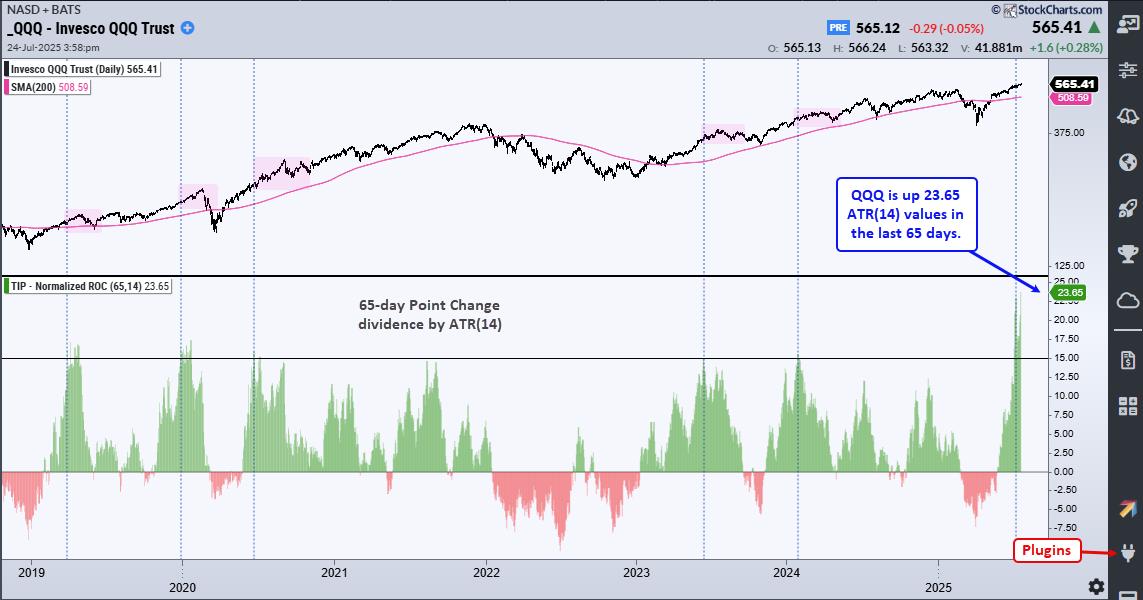
A 20+ ATR Move for QQQ

In 14-period ATR terms, QQQ is up 23.65 ATRs in the last 65 days. This is the highest number ever. The indicator window shows the 65-day point change divided by ATR(14). The blue dotted lines show when this indicator exceeds 15, and this is the sixth occurrence in seven years. Values above 15 reflect strong upside momentum, and this is long-term bullish. Short-term, however, high values mean QQQ is overbought and ripe for a rest. This indicator is one of 11 indicators in the TIP Indicator-Edge Plugin for StockCharts ACP.


Healthcare is the Weakest Sector  

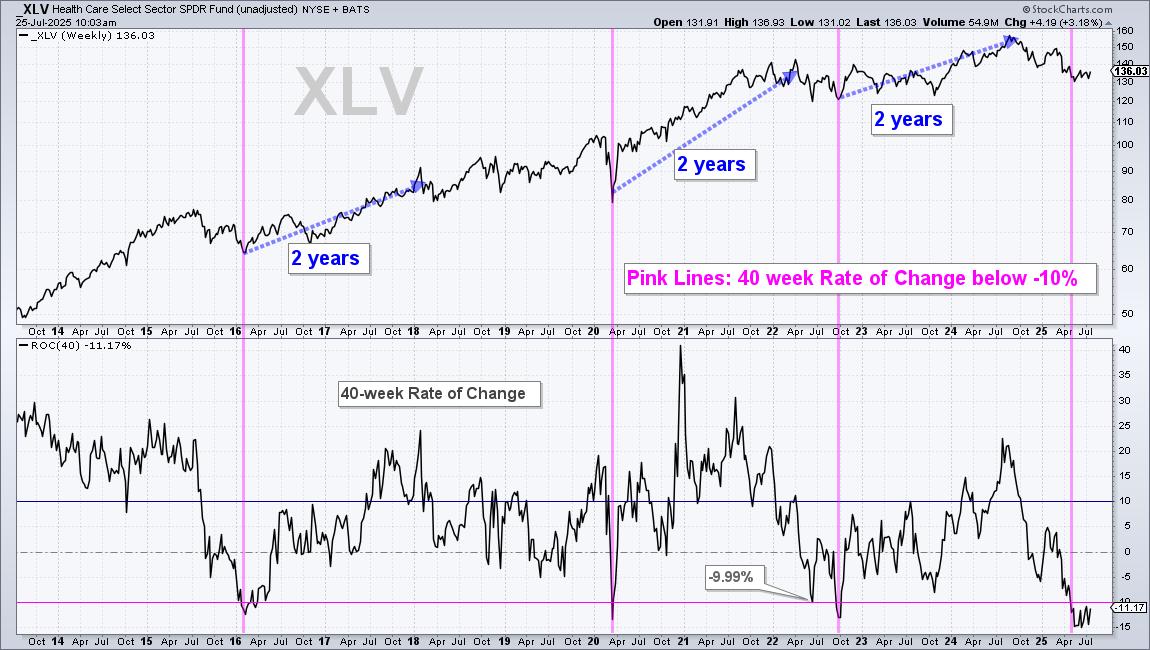
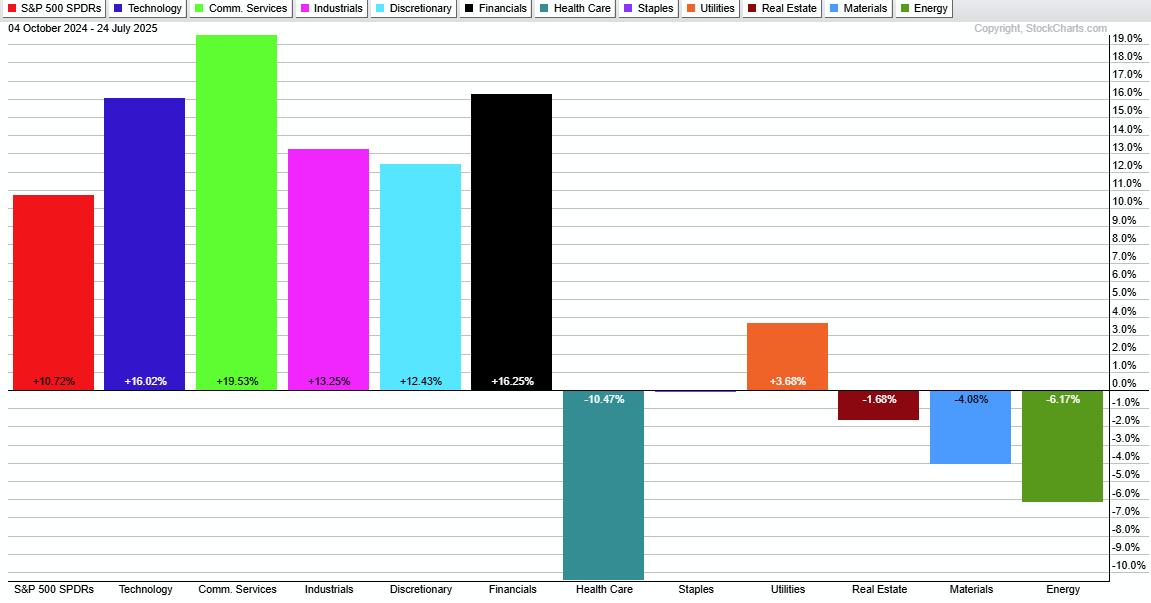
The Healthcare SPDR (XLV) is the most unloved sector over the last 200 days (since October 4th). SPY is up 10.72% with five offensive sectors leading the way (XLK, XLC, XLI, XLY, XLF). Healthcare is down 10.47%, and severely lagging. Elsewhere, Staples, Real Estate, Materials and Energy are down, but Utilities are up (3.68%).


XLV Becomes Long-term Oversold

The Healthcare SPDR (XLV) is long-term oversold and this could pave the way for a recovery, eventually. The chart below shows weekly bars with 40-week Rate-of-Change in the lower window. ROC(40) dipped below -10% for the fourth time in the last 12 years. After the first three dips below -10%, XLV was up over 20% in the following two years.


This week at TrendInvestorPro

  • Sentiment and seasonality indicators to watch in the coming months.
  • Breadth improves, but S&P 1500 indicators are short of bullish signals.
  • Bitcoin, Blockchain and Telecom ETFs break out.
  • Copper and Palladium ETFs follow through on breakouts.

Click here to take a trial and gain immediate access to our reports and videos.


XLU Leads with New High

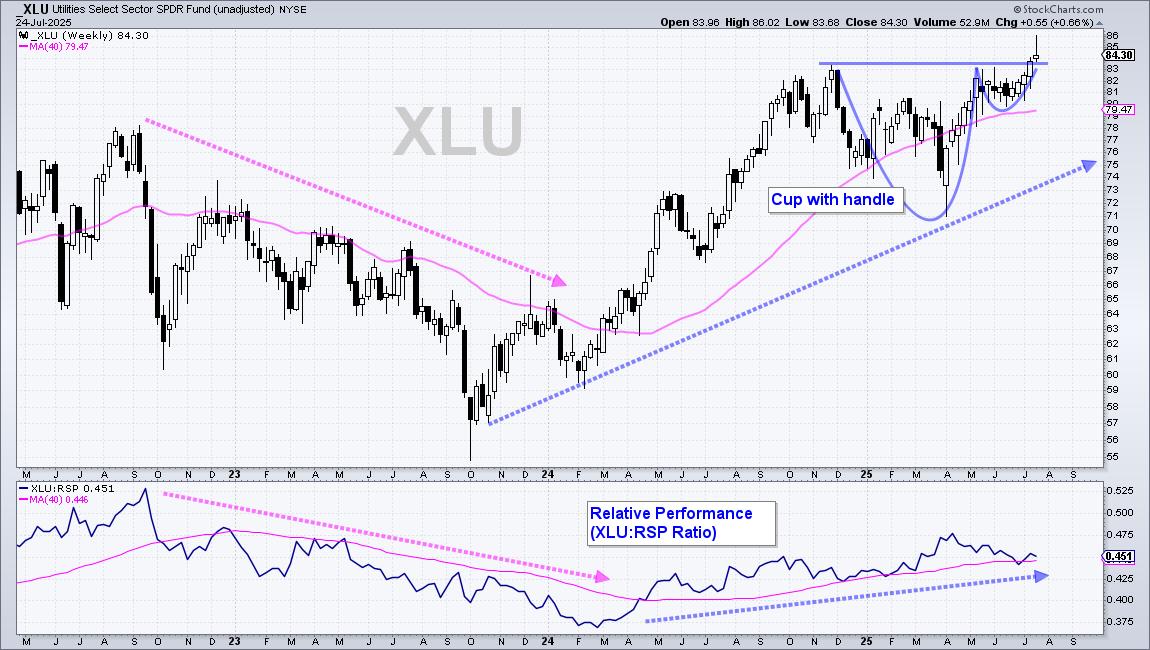
Even though the Utilities SPDR (XLU) cannot keep pace with the Technology SPDR (XLK) and Communication Services SPDR (XLC), it is in a leading uptrend. XLU formed a cup-with-handle from November to July and broke to new highs the last two weeks. ETFs hitting new highs are in strong uptrends and should be on our radar.


Metal Mania in 2025

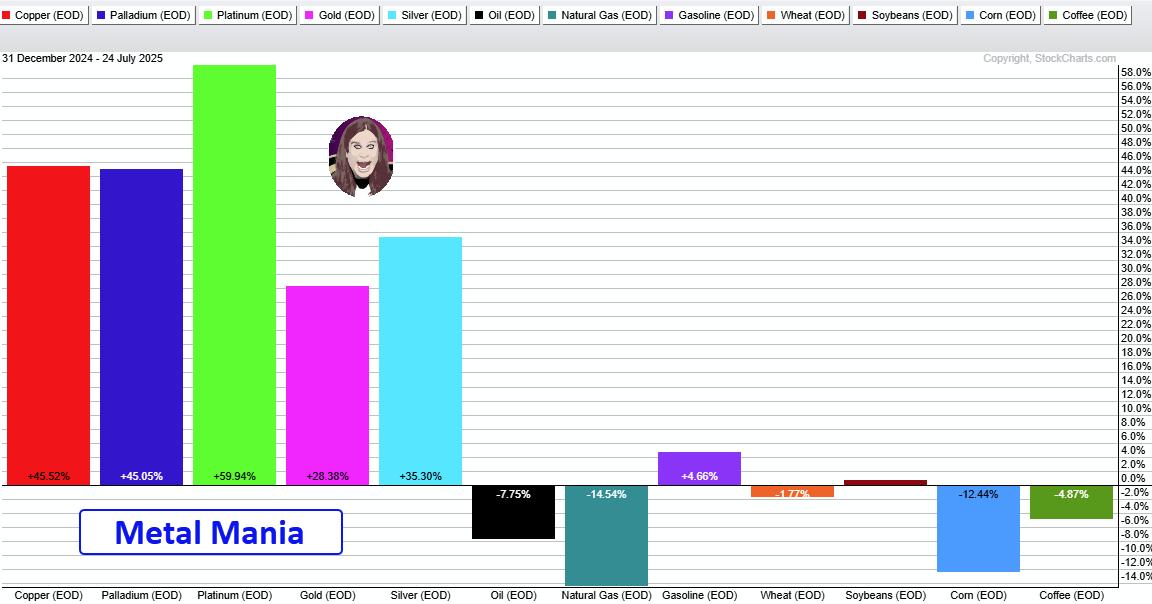
In a tribute to Ozzy, metals are leading the way higher in 2025. The PerfChart below shows year-to-date performance for the continuous futures for 12 commodities. Copper, Platinum and Palladium are up more than 45% year-to-date, while Gold is up 28.38% and Silver is up 35.30%. QQQ is up 10.52% year-to-date, but lagging these metals. The other commodities are mixed.


Multi-Year Highs for Silver and Copper

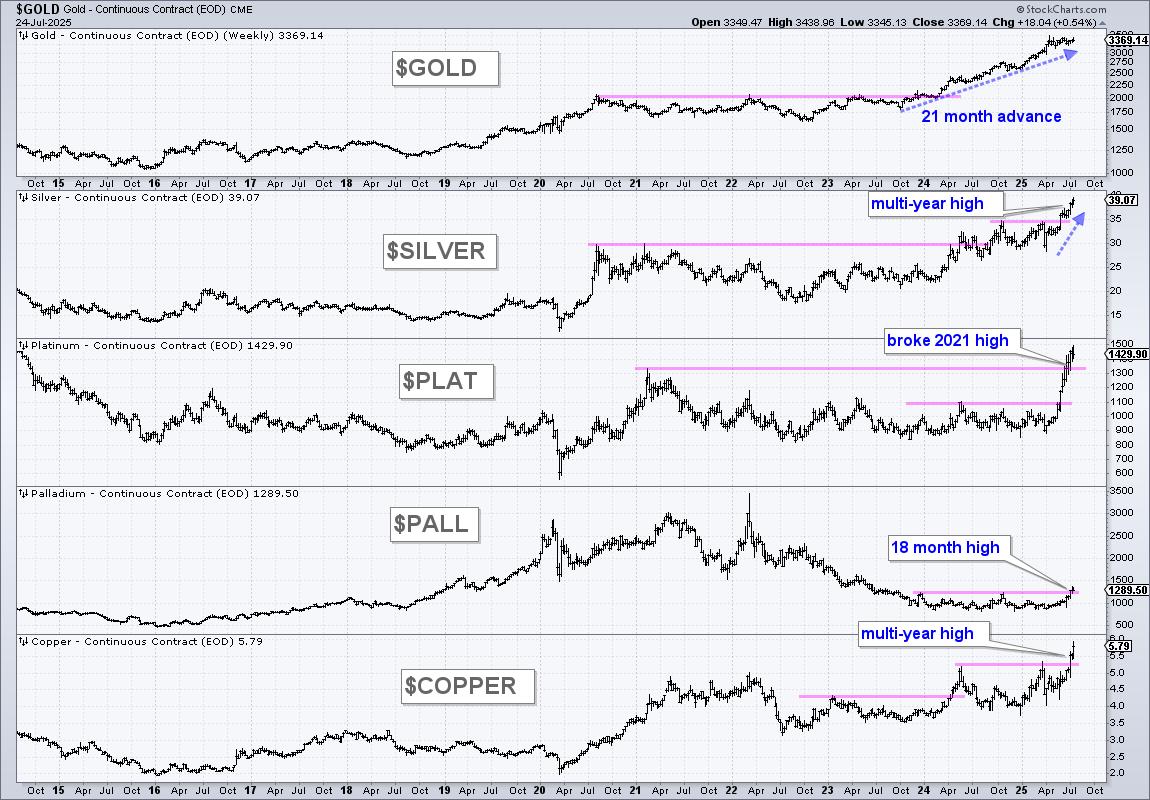
The next chart shows 11 year bar charts for five metals. Gold broke out in early 2024 and led the metals move with an advance the last 21 months. Silver and copper broke out to multi-year highs. Platinum broke above its 2021 high and Palladium got in the action with an 18 month high. There is a clear message here: metals are moving higher and leading as a group.  


Home Construction Hits Moment of Truth

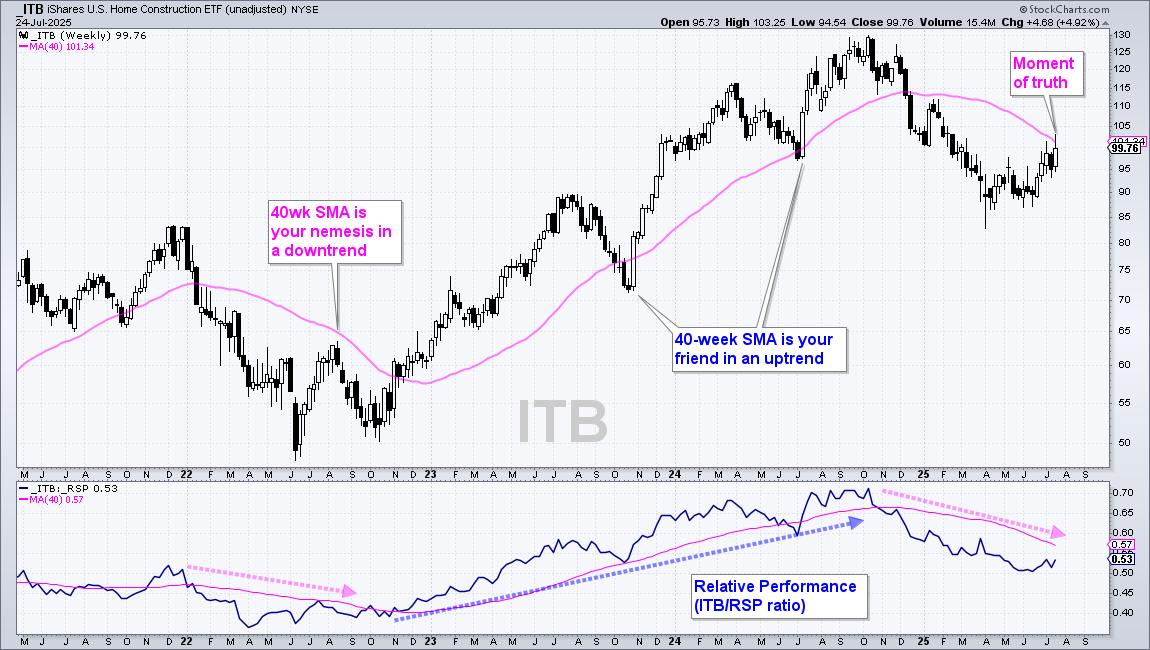
The Home Construction ETF (ITB) hit its moment of truth as it rose to its falling 40-week SMA. Notice that ITB failed just below this moving average in August 2023. During the 2023-2024 uptrend, the 40-week SMA was more friendly as ITB reversed near this level in October 2023 and June 2024. ITB surged to the falling 40-week SMA in July, but the long-term trend is down and this area could be its nemesis.

Thanks for Tuning in!

See TrendInvestorPro.com for more…


The S&P 500 ($SPX) just logged its fifth straight trading box breakout, which means that, of the five trading ranges the index has experienced since the April lows, all have been resolved to the upside.
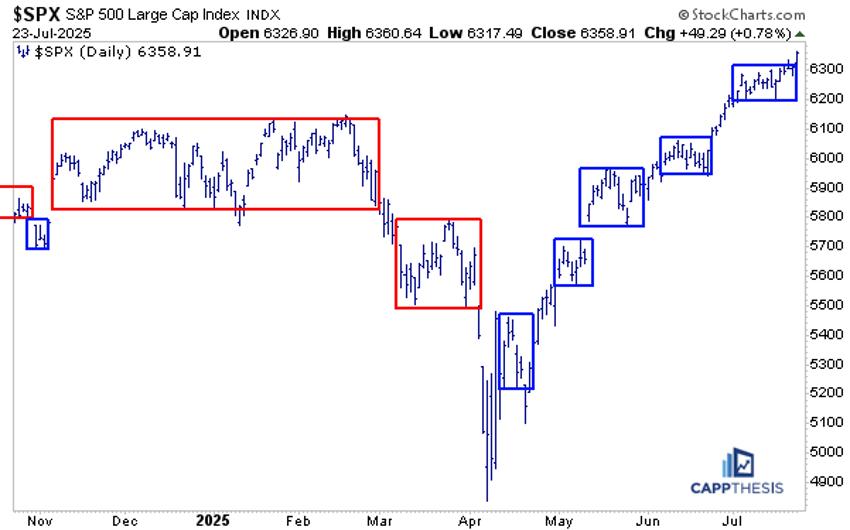
How much longer can this last? That’s been the biggest question since the massive April 9 rally. Instead of assuming the market is due to roll over, it’s been more productive to track price action and watch for potential changes along the way. So far, drawdowns have been minimal, and breakouts keep occurring. Nothing in the price action hints at a lasting change — yet.

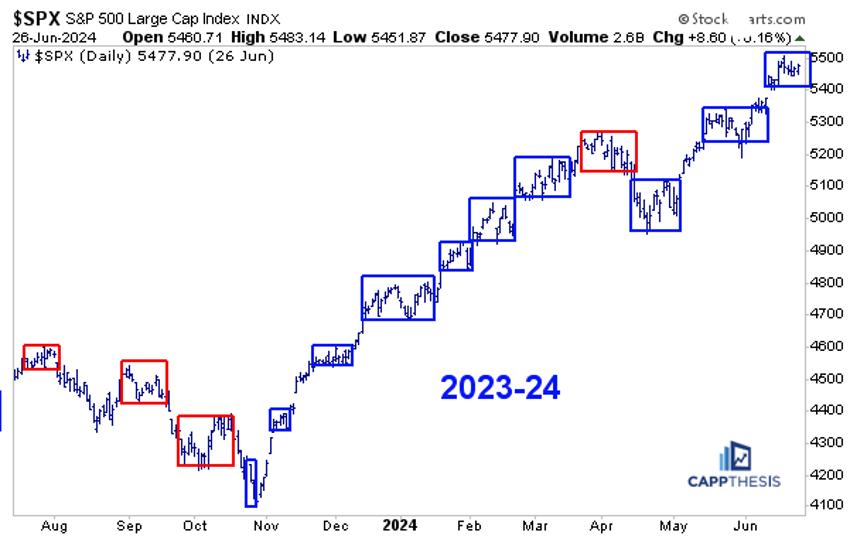
While some are calling this rally “historic,” we have a recent precedent. Recall that from late 2023 through early 2024, the index had a strong start and gave way to a consistent, steady trend.

From late October 2023 through March 2024, the S&P 500 logged seven consecutive trading box breakouts. That streak finally paused with a pullback from late March to early April, which, as we now know, was only a temporary hiccup. Once the bid returned, the S&P 500 went right back to carving new boxes and climbing higher.

New 52-Week Highs Finally Picking Up

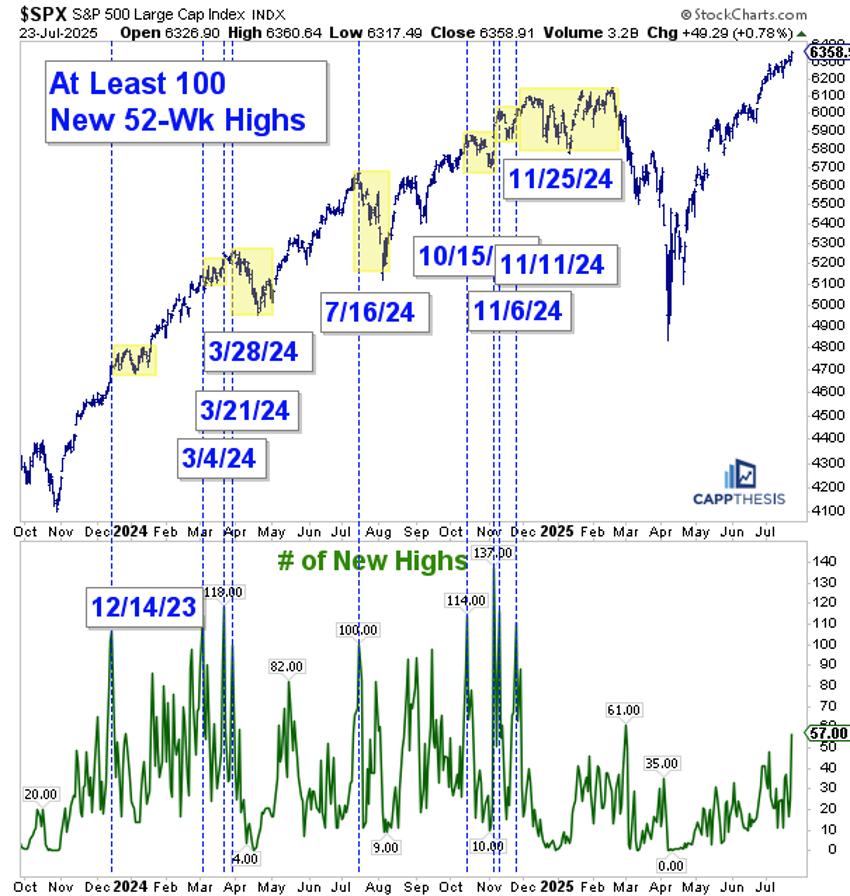
If there’s been one gripe about this rally, it’s that the number of new highs within the index has lagged. As we’ve discussed before, among all the internal breadth indicators available, new highs almost always lag — that’s normal. What we really want to see is whether the number of new highs begins to exceed prior peaks as the market continues to rise, which it has, as shown by the blue line in the chart below.

As of Wednesday’s close, 100 S&P 500 stocks were either at new 52-week highs or within 3% of them. That’s a strong base. We expect this number to continue rising as the market climbs, especially if positive earnings reactions persist across sectors.

Even when we get that first day with 100+ S&P 500 stocks making new 52-week highs, though, it might not be the best time to initiate new longs.

The above chart shows that much needs to align for that many stocks to peak in unison, which has historically led to at least a short-term consolidation, if not deeper pullbacks — as highlighted in yellow. Every time is different, of course, but this is something to keep an eye on in the coming weeks.

Trend Check: GoNoGo Still “Go”

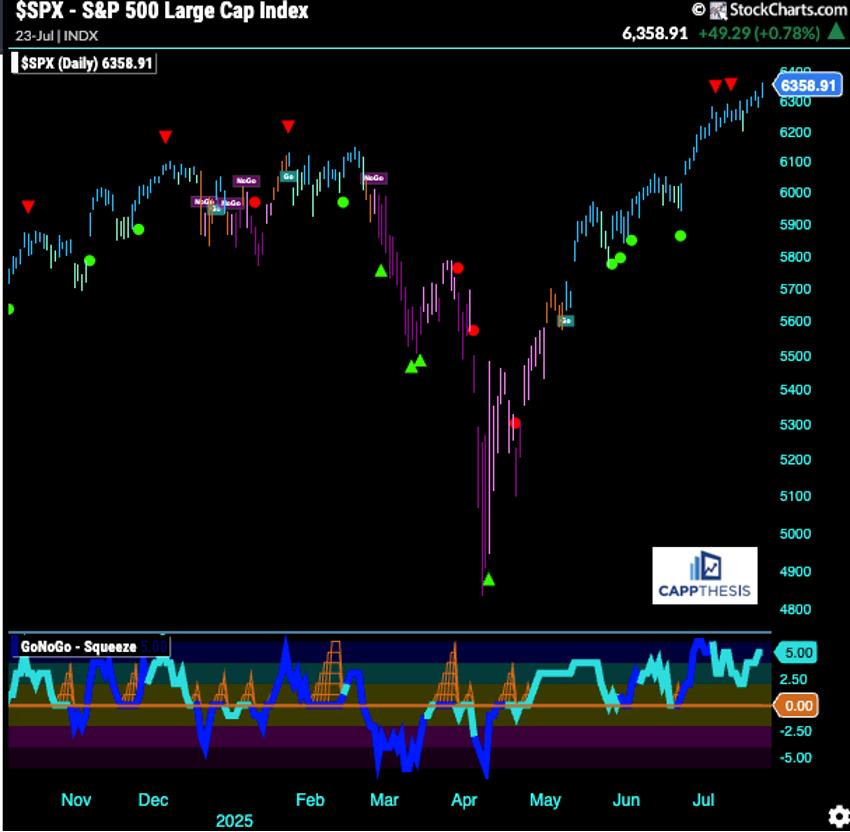
The GoNoGo Trend remains in bullish mode, with the recent countertrend signals having yet to trigger a greater pullback.

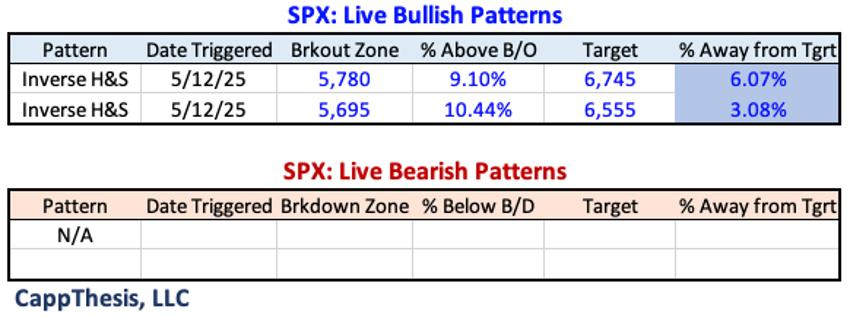
Active Bullish Patterns

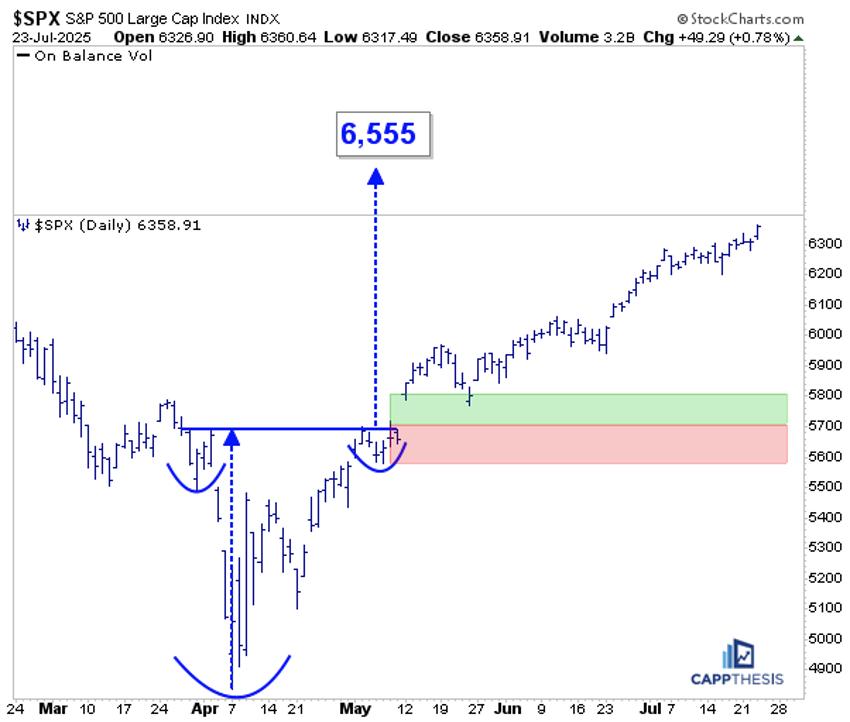
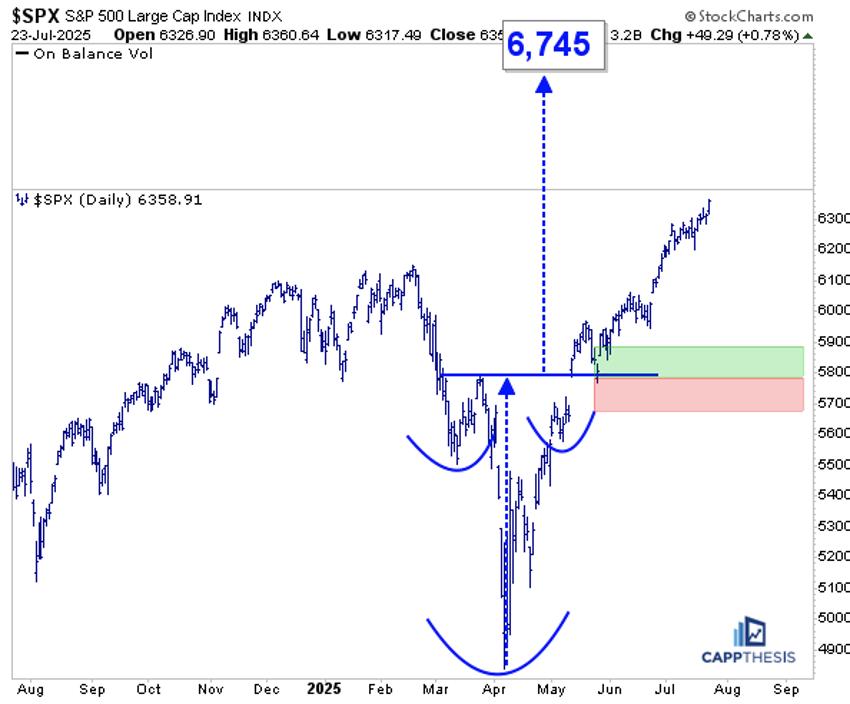
We still have two live bullish upside targets of 6,555 and 6,745, which could be with us for a while going forward. For the S&P 500 to get there, it will need to form new, smaller versions of the trading boxes.

Failed Bearish Patterns

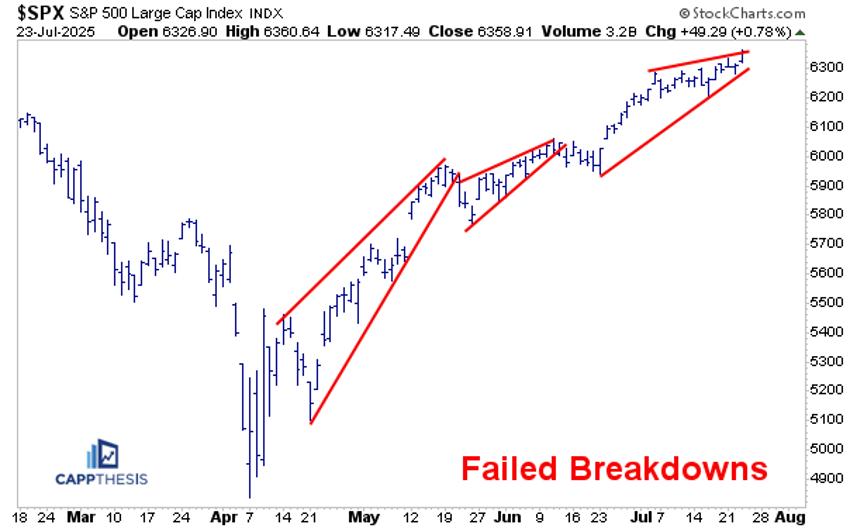
In the chart below, you can view a rising wedge pattern on the recent price action, the third since April. The prior two wedges broke down briefly and did not lead to a major downturn. The largest pullbacks in each case occurred after the S&P 500 dipped below the lower trendline of the pattern.

The deepest drawdown so far is 3.5%, which is not exactly a game-changer. Without downside follow-through, a classic bearish pattern simply can’t be formed, let alone be broken down from.

We’ll continue to monitor these formations as they develop because, at some point, that will change.

Is the market’s next surge already underway? 

Catch Tom Bowley’s breakdown of where the money is flowing now and how you can get in front of it. 

In this video, Tom covers key moves in the major indexes, revealing strength in transports, small caps, and home construction. He identifies industry rotation signals, which are pointing to aluminum, recreational products, and furnishings. Tom then demonstrates how to use StockCharts’ tools to scan for momentum stocks in emerging leadership groups — see why SGI tops Tom’s list. He ends with a discussion of post-earnings reactions from major names like Google, Tesla, IBM, and LVS. 

Tom wraps every idea with clear chart setups you can act on today. 

This video premiered on July 24, 2025. Click this link to watch on Tom’s dedicated page.


Missed a session? Archived videos from Tom are available at this link.

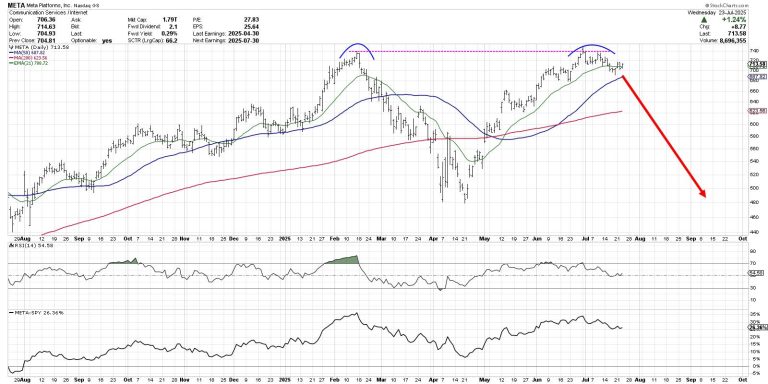
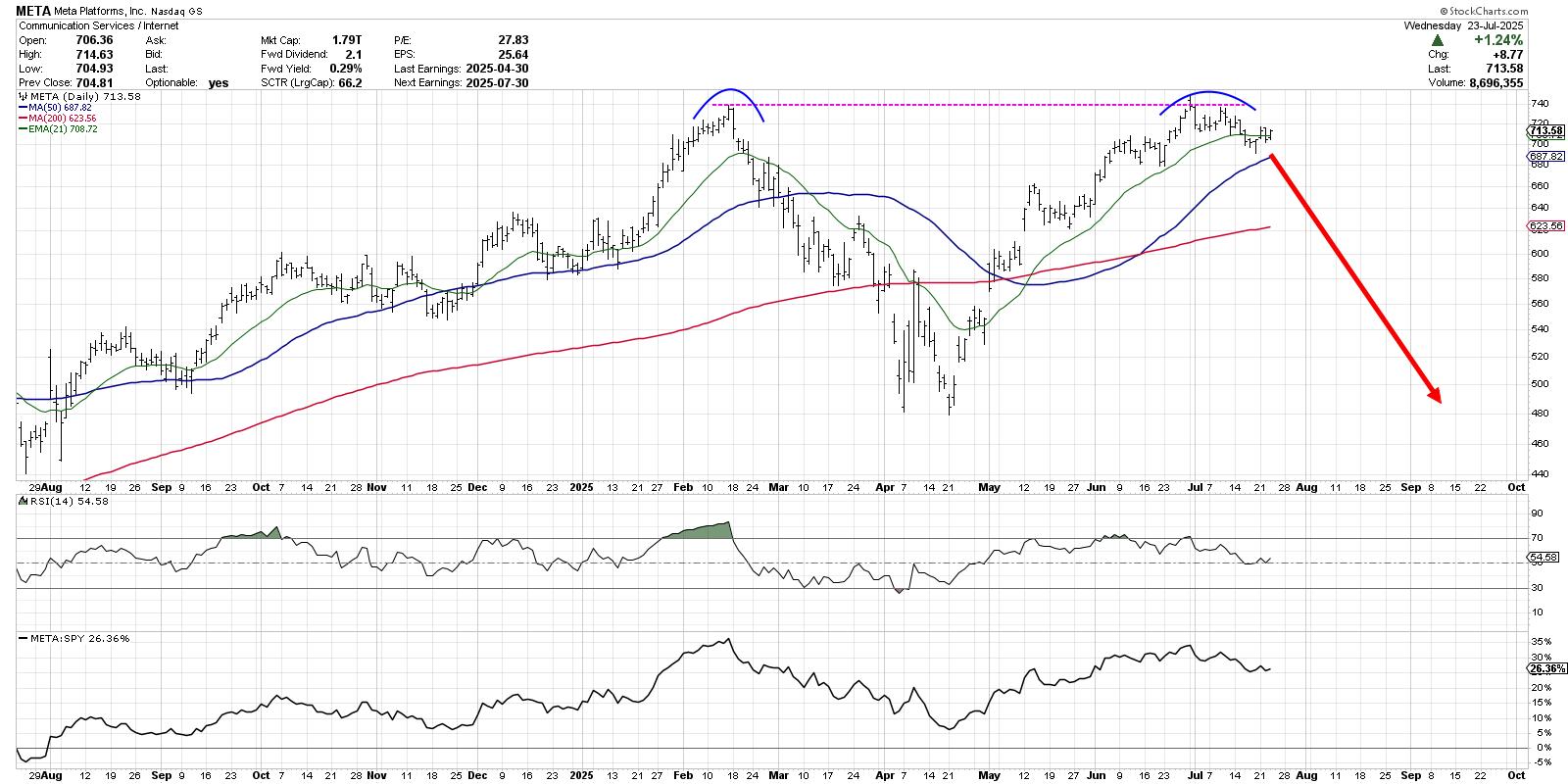
The chart of Meta Platforms, Inc. (META) has completed a roundtrip from the February high around $740 to the April low at $480 and all the way back again.  Over the last couple weeks, META has now pulled back from its retest of all-time highs, leaving investors to wonder what may come next.

Is this the beginning of a new downtrend phase for META?  Or just a brief pullback before a new uptrend phase propels META to new all-time highs?

Today we’ll look at two potential scenarios, including the double top pattern and the cup and handle pattern, and share which technical indicators and approaches could help us determine which path plays out into August.

The double top scenario basically means that the late July retest of the previous all-time high was the end of the recent uptrend phase.  The double top pattern is literally when a major resistance level is set and then retested.  The implication is that a lack of willing buyers means the uptrend is exhausted, and there is nowhere to go but down.

While the 21-day exponential moving average is currently in play for META, I would say that a break below the 50-day moving average could confirm this as the correct scenario.  If that smoothing mechanism does not hold, then the price action would imply less of a pullback and more like the beginning of a real distribution phase.

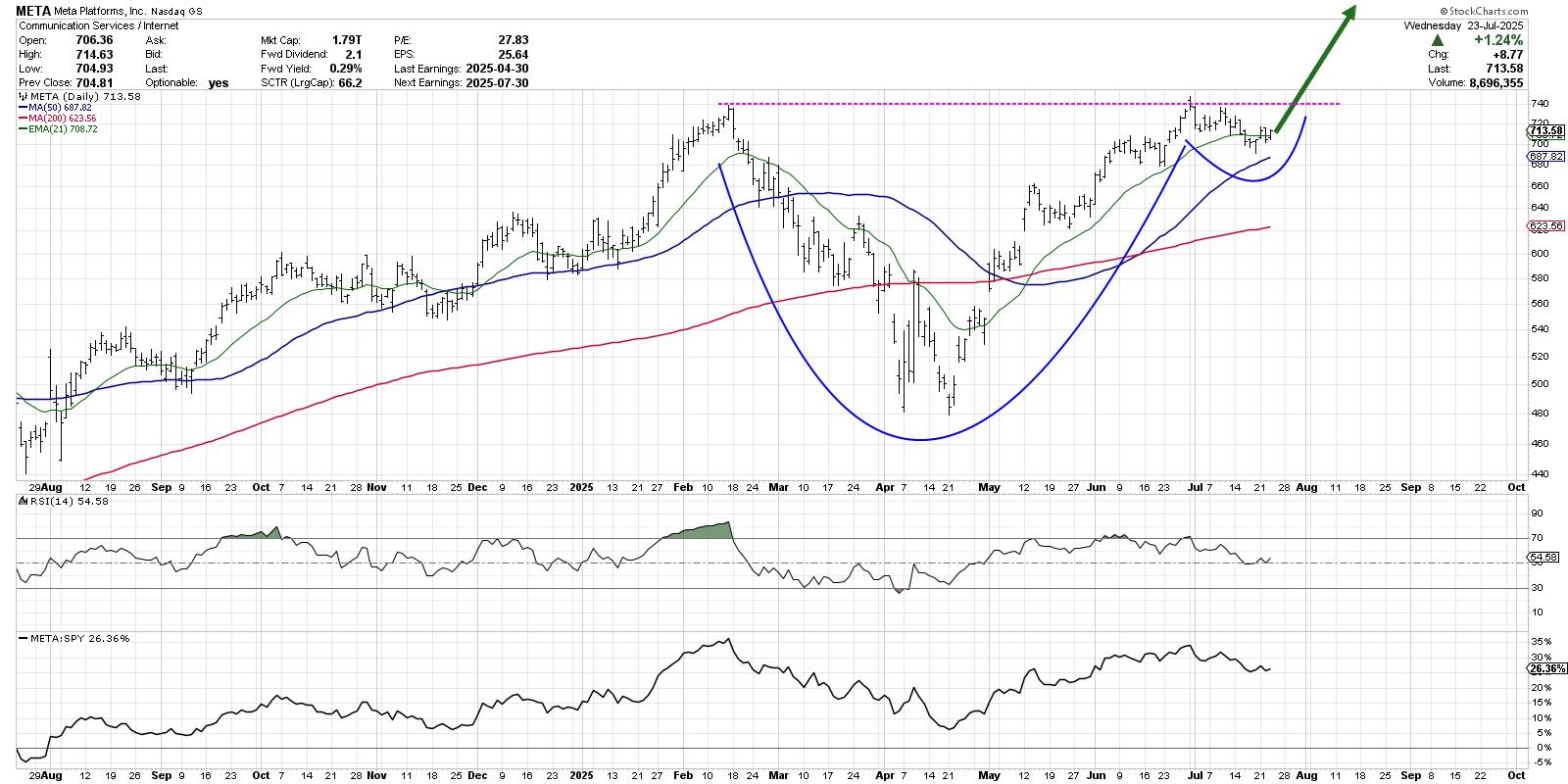
What is META pulls back but then resumes an uptrend phase, leading META to another new all-time high?  That would result in a confirmed cup and handle pattern, created by a large rounded bottoming pattern followed by a brief pullback.  The key to this pattern is the “rim” of the cup, which sits right at $740 for META.

Given the pullback META has demonstrated so far in July, I would say that a break above the $740 level would basically confirm a bullish cup and handle pattern.  That would suggest much more upside potential for META, as the stock would literally go into previously uncharted territory.

So how can we determine which scenario is more likely to play out?  This is where we need to incorporate more technical indicators into the discussion, as a way to further validate and confirm our investment thesis.

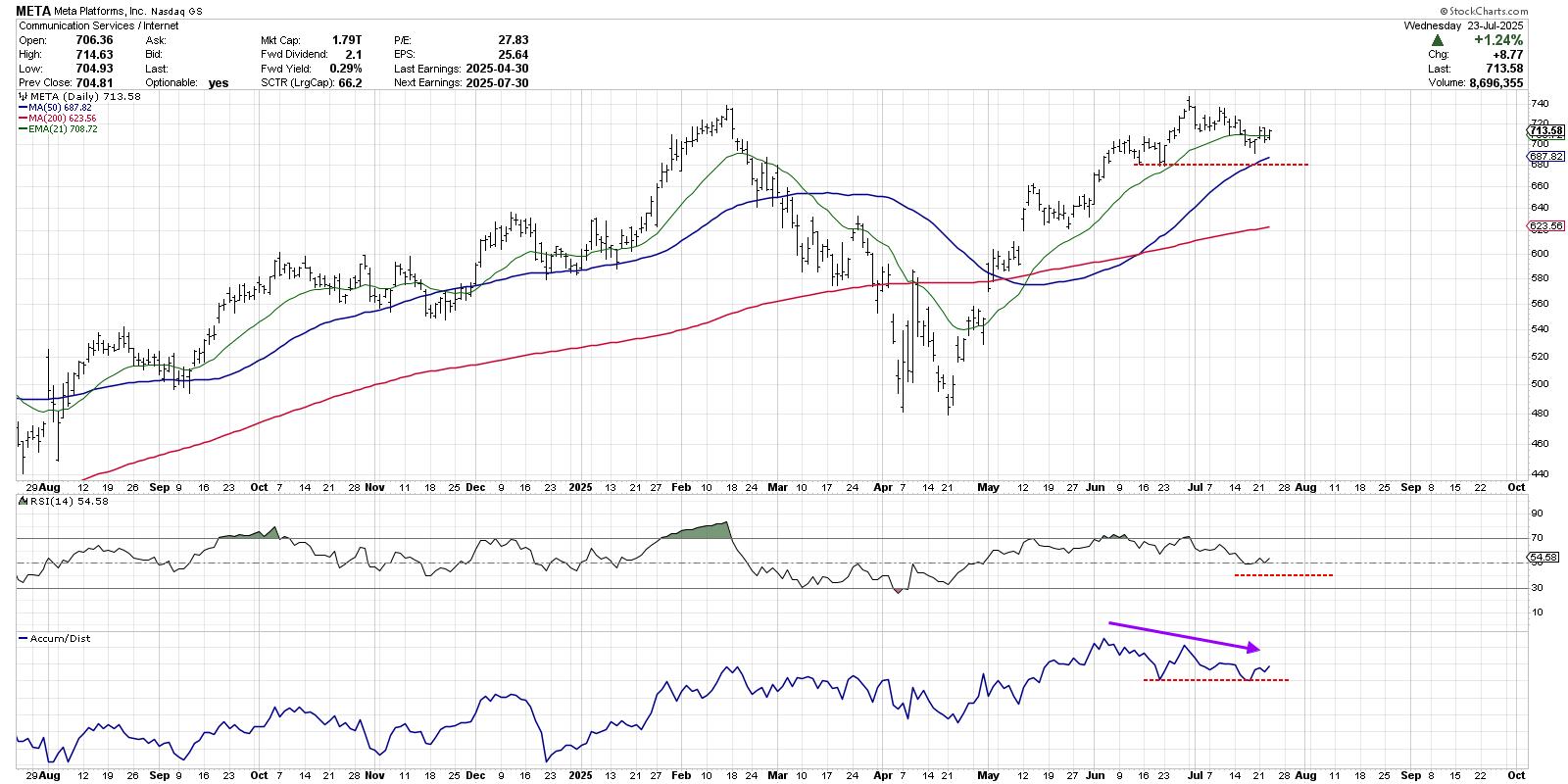
Just to review, I think a break above $740 would confirm a bullish cup and handle pattern.  I would also say that a break below the $680 level, which would represent a move below the 50-day moving average as well as the June swing lows, would basically confirm a bearish double top pattern.

We can also use the Relative Strength Index (RSI) to help determine whether META remains in a bullish trend phase.  During bull phases, the RSI rarely gets below 40, because buyers usually step in to “buy the dips” and keep the momentum fairly constructive.  So if the price would break down, and the RSI would not hold that crucial 40 level, that could mean a bearish outlook is warranted.

Finally, we can use volume-based indicators to assess whether moves in the price are supported by stronger volume readings.  Here I’ve included the Accumulation/Distribution Line, which tracks the trend in daily volume readings over time.  We can see that the high in July resulted in a divergence, as the A/D line was trending lower.  If the A/D line would break below its June and July lows, marked by a dashed red line, that would represent a bearish volume reading for META.

Technical analysis is less about predicting the future, and more about determining the most probable scenarios based on our analysis of trend, momentum, and volume.  I hope this discussion shows how the outlook for META can be easily determined and tracked using the best practices of technical analysis!


RR#6,

Dave

PS- Ready to upgrade your investment process?  Check out my free behavioral investing course!

David Keller, CMT

President and Chief Strategist

Sierra Alpha Research LLC

marketmisbehavior.com

https://www.youtube.com/c/MarketMisbehavior

Disclaimer: This blog is for educational purposes only and should not be construed as financial advice.  The ideas and strategies should never be used without first assessing your own personal and financial situation, or without consulting a financial professional.  

The author does not have a position in mentioned securities at the time of publication.    Any opinions expressed herein are solely those of the author and do not in any way represent the views or opinions of any other person or entity.

Markets don’t usually hit record highs, risk falling into bearish territory, and spring back to new highs within six months. But that’s what happened in 2025.

In this special mid-year recap, Grayson Roze sits down with David Keller, CMT, to show how disciplined routines, price-based signals, and a calm process helped them ride the whipsaw instead of getting tossed by it. You’ll see what really happened under the surface, how investor psychology drove the swings, and the exact StockCharts tools they leaned on to stay objective. 

If you’re focused on protecting capital, generating income, and sleeping well at night while still capturing the upside, this is a must-watch. Discover which charts deserve your attention now, what to ignore, and how to prep for the back half of 2025. 

This video premiered on July 23, 2025. Click on the above image to watch on our dedicated Grayson Roze page on StockCharts TV.


You can view previously recorded videos from Grayson at this link.