Author

admin

Browsing

This week, Joe analyzes all 30 Dow Jones Industrial Average stocks in a rapid-fire format, offering key technical takeaways and highlighting potential setups in the process. Using his multi-timeframe momentum and trend approach, Joe shows how institutional investors assess relative strength, chart structure, ADX signals, and support zones. From Boeing’s triple bottom to Nvidia’s powerful trend, not to mention Microsoft’s key pullback level, this session is packed with insights for traders looking to stay in sync with the market’s leaders and laggards.

Joe has been working with institutional portfolio managers for the past 35 years, and this video shows the type of reads he gives to them during their phone calls.

The video premiered on July 16, 2025. Click this link to watch on Joe’s dedicated page. 

Archived videos from Joe are available at this link. Send symbol requests to stocktalk@stockcharts.com; you can also submit a request in the comments section below the video on YouTube. Symbol Requests can be sent in throughout the week prior to the next show.

From the S&P 500’s pause within a bullish trend, to critical support levels in semiconductors, plus bullish breakouts in Ethereum and Bitcoin, Frank highlights how the market’s recent consolidation may lead to major upside. In this video, Frank explores how to use StockCharts to layer chart annotations, trend indicators, and pattern analysis for stronger evidence-based decisions. He also compares current chart structures to 2020-2021 in order to better understand what could be next.

This video originally premiered on July 16, 2025.

You can view previously recorded videos from Frank and other industry experts at this link.

Unlock the power of automated options trading with Tony Zhang, Chief Strategist at OptionsPlay. In this exclusive training, Tony reveals how the OptionsPlay Strategy Center, integrated with StockCharts.com, transforms the way traders find, analyze, and execute options strategies.

Follow along as Tony illustrates how to use OptionsPlay and StockCharts eliminate manual scans, reduce time spent digging through option chains, and zero in on high-probability trades with real-time, personalized insights. Throughout the video, Tony will explore how you can:

  • Automate strategy selection using technical scans.
  • Identify optimal call and put spreads with the best risk-reward ratios.
  • Generate income through conservative covered calls.
  • Integrate your scans with personalized watchlists and chartlists.

Whether you’re selling credit spreads, buying calls, or seeking income from covered calls, this tool will change the way you trade — forever.

Check out the OptionsPlay plugin for StockCharts here!

This video premiered on July 15, 2025.

Relatively healthy earnings reports from the big banks and a June inflation report that came in line with analyst expectations didn’t give the stock market much of a lift, as the S&P 500 ($SPX) and Dow Jones Industrial Average ($INDU) both ended the day lower. The only major index to shine was the Nasdaq Composite ($COMPQ), which closed at a record high.

Technology stocks were the stars of the show. It wasn’t a blowout rally, but the sector still managed to finish in the green. Why? There were a couple of key developments that gave tech a nice boost.

First, semiconductors got some breathing room. Restrictions on chip sales to China were relaxed, and that gave big names like NVIDIA Corp. (NVDA) and Advanced Micro Devices (AMD) a reason to rally. 

Second, there’s a push from the government to invest in AI and energy initiatives in Pennsylvania. One of the biggest winners was Super Micro Computer, Inc. (SMCI), which jumped 6.9% — the biggest percentage gain in the S&P 500. You can see from the StockCharts MarketCarpet for the S&P 500 stocks that, besides the top-weighted stocks in the index, it was mostly a sea of red.
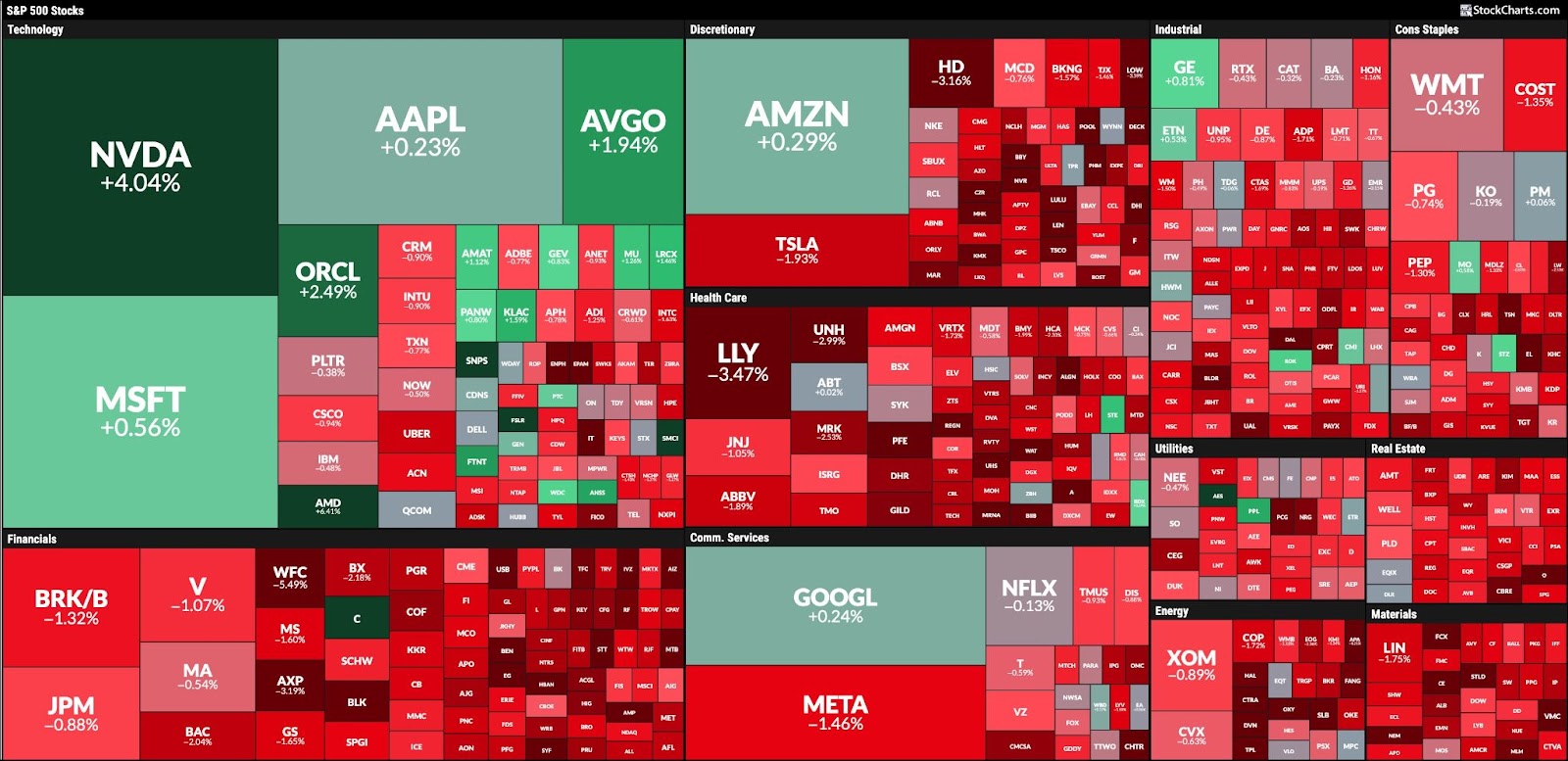
FIGURE 1. MARKETCARPET FOR TUESDAY, JULY 15. Technology was the clear leader, with the largest cap-weighted stocks leading the sector higher.Image source: StockCharts.com. For educational purposes.

Semiconductors Show Strength

If you’ve been watching semiconductors, you may have noticed that the SPDR S&P Semiconductor ETF (XSD) has been on a roll. Since April, the ETF has stayed above its 20-day exponential moving average (EMA). The relative performance of XSD against the SPDR S&P 500 ETF (SPY) has been improving, and its relative strength index (RSI) is at around 62, an indication that momentum is at healthy levels (see chart below). It’s important to note that since May, the RSI has remained above 50, which is supportive of XSD’s upside movement.

Note: StockCharts members can access this chart from the Market Summary page or the Market Summary ChartPack (under US Industries > Bellwether Industries).
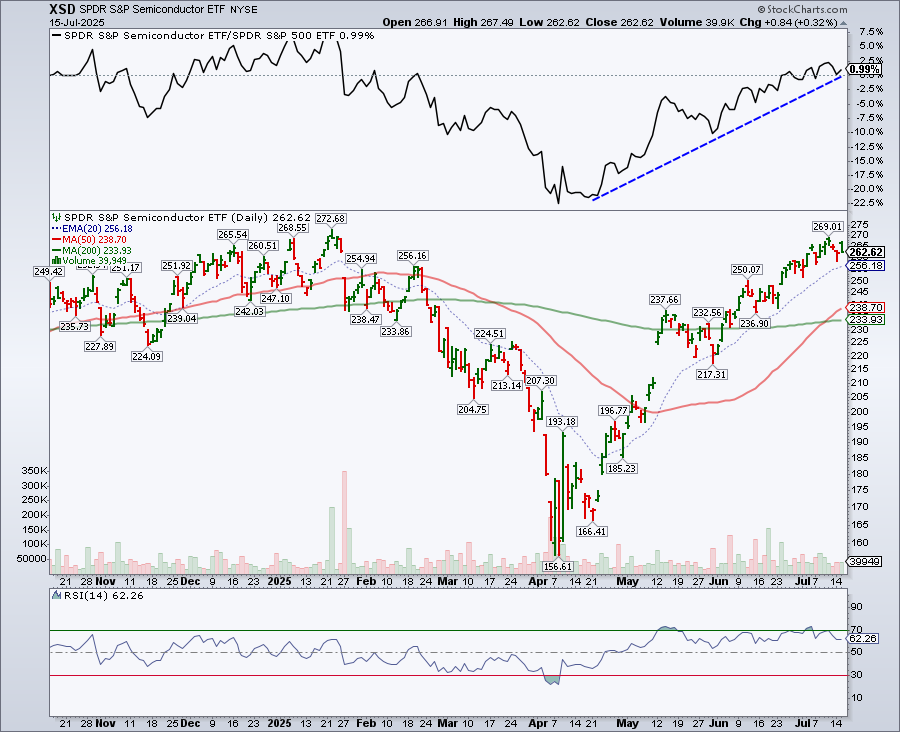
FIGURE 2. DAILY CHART OF XSD. Since April, XSD has been trending higher and is now trading above its 21-day EMA.Chart source: StockCharts.com. For educational purposes.

How to Track Semiconductor Stocks

If the environment for semiconductors remains strong, there could be more upside for stocks in that space. A simple way to keep tabs on the stocks using StockCharts tools is to create a ChartList of semiconductor stocks you’re interested in owning.

  • Begin by heading to the US Sectors panel in the Market Summary page or the Sector Summary page on your Dashboard.
  • Click Sector Drill-Down > Technology Sector Fund > Semiconductors.
  • You’ll see the list of semiconductor stocks that make up the industry group.

From there, I prefer to sort the data by the Universe (U) column, starting with the large caps and then the StockCharts Technical Rank (SCTR) score to find large-cap technically strong stocks. You can then view the charts on the list. If you see a chart that appears to have a favorable risk-to-reward ratio, you can save it to your Semiconductor ChartList.
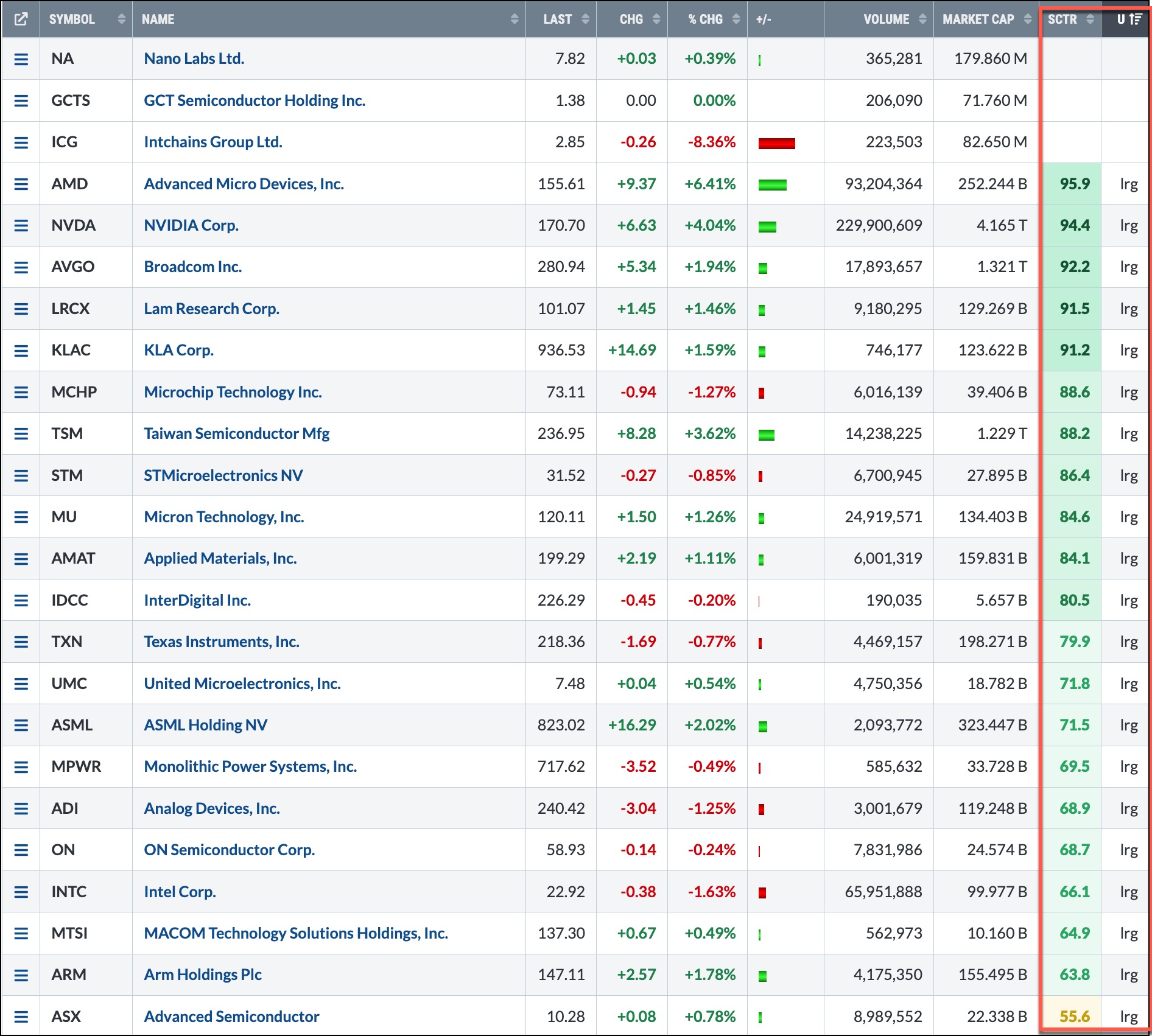
FIGURE 3. SEMICONDUCTOR STOCKS TO REVIEW. The sector drill-down will uncover stocks in leading sectors or industry groups. Scroll down the list to identify charts that meet your investment or trading criteria. Image source: StockCharts.com. For educational purposes.

As you review the charts in your ChartList, you can identify potential support and resistance levels and set alerts to notify you when prices reach your key levels. It’s a great way to stay proactive.

The Bottom Line

This type of top-down analysis helps you stay one step ahead of the market. Start with the broad market, then narrow down to sectors, then industry groups, and then individual stocks. By taking a proactive approach to managing your investments, you’re always preparing for the stock market’s next move.


Disclaimer: This blog is for educational purposes only and should not be construed as financial advice. The ideas and strategies should never be used without first assessing your own personal and financial situation, or without consulting a financial professional.

Join Dave as he reviews three common candle patterns traders can use to identify potential turning points. From bullish engulfing patterns to evening star patterns, Dave gives insights on how to leverage these powerful candle signals to anticipate market shifts. He also shows combining candle patterns with conventional technical analysis tools can help improve success rates.

This video originally premiered on July 14, 2025. Watch on StockCharts’ dedicated David Keller page!

Previously recorded videos from Dave are available at this link.

The Rise of Impact Investing Aligning Profit with Purpose Impact investing is on the rise as more investors seek to align their financial goals with making a positive social or environmental impact. This approach combines traditional investment strategies with socially responsible principles, allowing investors to generate financial returns while also contributing to the greater good. One of the key drivers behind the rise of impact investing is a growing awareness of the need to address pressing global challenges such as climate change, poverty, and inequality. Traditional investments have often been criticized for prioritizing short-term financial gains over long-term sustainability and social responsibility. Impact investing aims to shift this paradigm by incorporating environmental, social, and governance (ESG) factors into investment decision-making. In recent years, impact investing has gained traction across various asset classes, including private equity, venture capital, and fixed income. Impact funds, which specifically focus on investing in companies or projects that have a positive social or environmental impact, have proliferated, offering investors the opportunity to invest in areas such as renewable energy, affordable housing, and healthcare. Moreover, impact investing has the potential to drive innovation and create new market opportunities. By channeling capital towards businesses that prioritize sustainability and social responsibility, impact investors can help stimulate the development of new technologies, products, and services that address pressing global challenges. While impact investing is still a relatively nascent field, its growth and potential impact are undeniable. As more investors recognize the importance of aligning profit with purpose, the rise of impact investing is likely to continue, shaping the future of finance and driving positive change on a global scale.
Green Tech Innovations Attract Venture Capital With the increasing emphasis on sustainability and combating climate change, green technology innovations have become a hotbed for venture capital investment. From renewable energy solutions to smart grid systems, pioneering startups are catching the eye of investors looking to make a positive impact on the environment while also securing profitable returns. One of the key areas driving venture capital interest in green tech is the rise of clean energy sources such as solar and wind power. Companies developing advanced solar panel technology or efficient wind turbines are able to tap into a growing market of consumers and businesses seeking alternatives to fossil fuels. This shift towards renewable energy is not only environmentally beneficial but also economically viable, making it an attractive investment opportunity for venture capitalists. Smart grid technologies are another sector within green tech that is drawing significant funding. By modernizing the infrastructure of energy distribution and consumption, smart grids offer a more efficient and sustainable way of managing electricity. Startups in this space are developing innovative solutions to monitor and control energy usage, leading to reduced waste and lower costs for consumers. As governments and utilities around the world look to upgrade their power grids, smart grid startups are well positioned to capitalize on this growing market. In addition to energy innovations, green tech startups focused on sustainable agriculture and waste management are also finding favor with venture capitalists. Companies creating innovative solutions for water conservation, organic farming, and recycling are not only addressing critical environmental issues but also creating new business opportunities. As the global population continues to grow, the demand for sustainable food production and waste reduction solutions will only increase, presenting a promising market for green tech entrepreneurs. Overall, the trend towards green tech innovations reflects a broader shift towards sustainability and environmental consciousness in the business world. Venture capitalists are increasingly looking to support startups that are not only profitable but also environmentally responsible, recognizing the potential for long-term growth in the green tech sector. As more entrepreneurs continue to develop innovative solutions for a greener future, the flow of venture capital into green tech is likely to accelerate, driving further advancements in sustainable technology.
Stock Market Myths Debunked Separating Fact from Fiction The stock market is often shrouded in mystery and misconceptions, leading many potential investors to believe in myths that can deter them from taking advantage of the opportunities it presents. In this article, we will debunk some common myths surrounding the stock market and provide clarity on what is fact and what is fiction. Myth: Investing in the stock market is just like gambling. Fact: While the stock market does involve risk, it is not the same as gambling. Gambling relies on chance, while investing in the stock market involves informed decision-making and research. By diversifying your portfolio and investing for the long term, you can mitigate risk and increase your chances of positive returns. Myth: You need a lot of money to invest in the stock market. Fact: This is a common misconception. In reality, you can start investing in the stock market with as little as a few hundred dollars. There are many low-cost investment options available, such as index funds and exchange-traded funds, that allow you to begin investing without needing a large sum of money. Myth: Timing the market is key to success. Fact: Trying to time the market by buying and selling stocks based on short-term fluctuations is a risky strategy. It is nearly impossible to predict the market’s movements consistently. Instead, focus on investing in solid companies with strong fundamentals and holding onto your investments for the long term. Myth: Only experts can succeed in the stock market. Fact: While it is true that investing in the stock market requires knowledge and research, you do not need to be a financial expert to succeed. With the wealth of information available online and the guidance of reputable financial advisors, anyone can learn how to invest wisely and achieve financial success in the stock market. By debunking these myths and gaining a better understanding of how the stock market works, you can feel more confident in navigating the world of investing and make informed decisions that will lead to financial growth and stability.
Retail Investors Drive Surge in Stock Market Activity In recent months, retail investors have been making waves in the stock market with their increased participation and trading activity. This surge in activity has been driven by various factors, including the rise of commission-free trading platforms, social media influencers touting stock picks, and the increased availability of information and resources for individual investors. As retail investors continue to pour into the market, they are bringing a new level of excitement and volatility to trading. This has led to sharp price movements in various stocks, with some experiencing rapid rises and falls in value. While this increased activity can present new opportunities for retail investors looking to make quick profits, it also comes with its own set of risks and challenges. One of the key drivers behind this surge in retail investor activity is the democratization of investing. With the rise of commission-free trading platforms like Robinhood, more individuals have access to the stock market than ever before. This has empowered retail investors to take control of their own finances and make investment decisions on their own terms. Another factor contributing to the increase in retail investor activity is the influence of social media influencers and online communities. Platforms like Reddit and Twitter have become popular venues for discussing stock picks and sharing investment ideas. This has created a new form of market speculation, with retail investors banding together to drive up the prices of certain stocks. Overall, the surge in stock market activity driven by retail investors is a testament to the changing landscape of investing. As more individuals enter the market and participate in trading, it will be interesting to see how this trend continues to shape the future of investing.
Construction Firms Adopt AI for Project Management and Safety Monitoring Construction firms are increasingly turning to artificial intelligence (AI) to streamline and enhance their project management and safety monitoring processes. With the rising complexity of construction projects and the growing emphasis on worker safety, AI technology offers a promising solution to help companies stay on schedule and ensure a safe working environment. One of the key benefits of using AI in project management is its ability to analyze vast amounts of data quickly and accurately. By harnessing the power of machine learning algorithms, construction firms can optimize their scheduling, resource allocation, and budgeting decisions to minimize delays and cost overruns. AI can also help project managers identify potential risks and proactively address them before they escalate into larger issues. In terms of safety monitoring, AI-enabled tools can revolutionize how construction sites are monitored for potential hazards. By deploying sensors and cameras equipped with AI algorithms, firms can detect unsafe behaviors, equipment malfunctions, and environmental risks in real-time. This proactive approach to safety management can help prevent accidents and injuries, ultimately saving lives and reducing liability costs for construction companies. Overall, the adoption of AI in construction project management and safety monitoring represents a significant shift towards more efficient and effective construction practices. As technology continues to advance, we can expect to see even more innovative AI solutions being integrated into construction workflows, further transforming the industry for the better.