Author

admin

Browsing

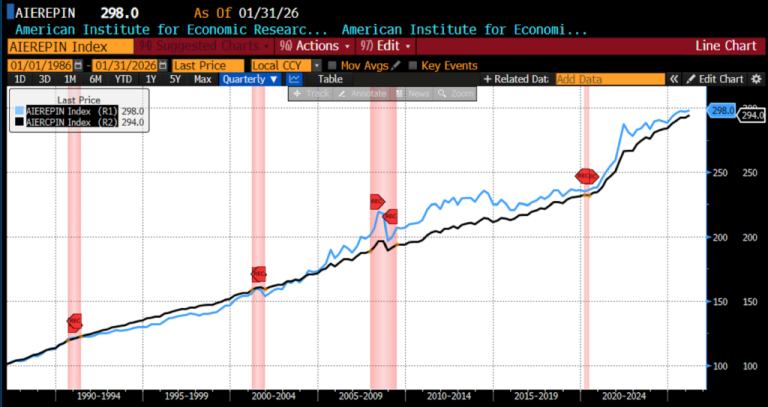
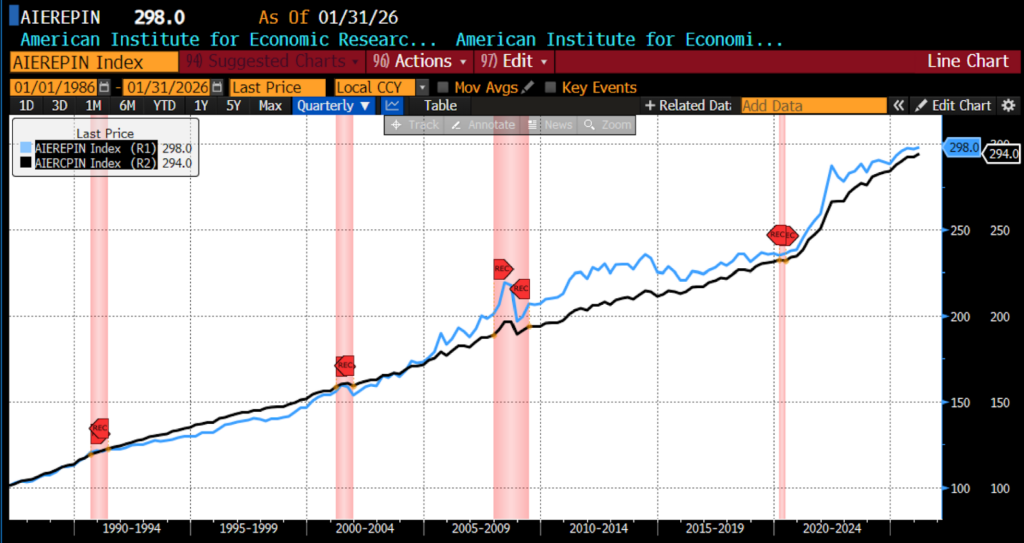
In January 2026 the AIER Everyday Price Index (EPI) rose 0.33 percent to 298.0, starting the year with its largest increase since June 2025. Seventeen of its 24 constituents rose in price in January, with five declining and two unchanged. Pets and pet products, gardening and lawncare services, and housing fuels and utilities saw the largest monthly price increases, while alcoholic beverages at home, personal care products, and intercity transportation saw the largest declines. 

AIER Everyday Price Index vs. US Consumer Price Index (NSA, 1987 = 100)
(Source: Bloomberg Finance, LP)

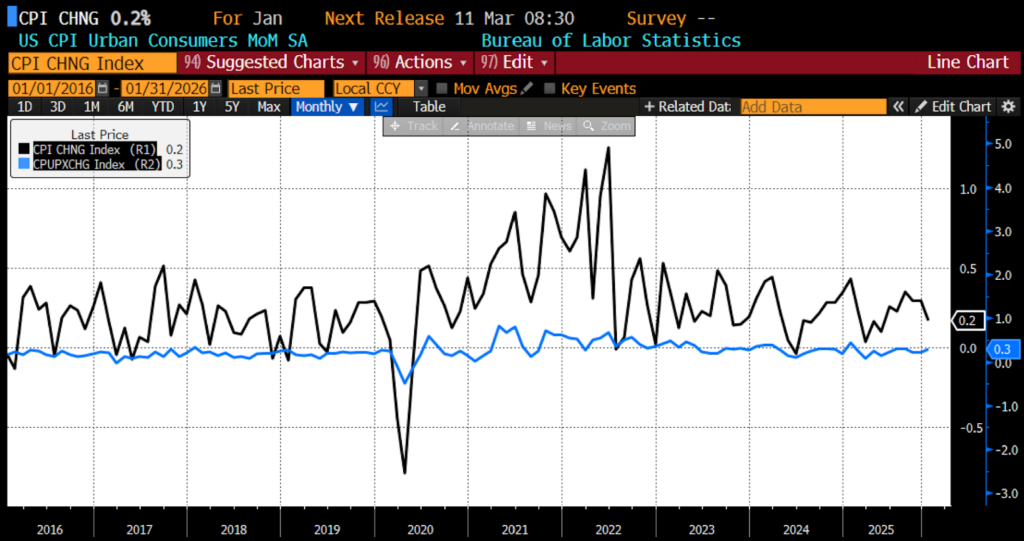
Also on February 13, 2026, the US Bureau of Labor Statistics (BLS) released its January 2026 Consumer Price Index (CPI) data. On the month-over-month side, headline CPI rose 0.2 percent (versus a surveyed 0.3 percent) while core increased the forecast 0.3 percent.

January 2026 US CPI headline and core month-over-month (2016 – present)
(Source: Bloomberg Finance, LP)

Consumer prices in January were driven largely by a moderate rise in core inflation, with the index excluding food and energy increasing 0.3 percent for the month. Price gains were broad-based across services and discretionary categories, including sharp increases in airline fares alongside advances in personal care, recreation, medical care, communication, apparel, and new vehicles. These increases were partly offset by declines in used cars and trucks, household furnishings and operations, and motor vehicle insurance, reflecting ongoing normalization in some durable-goods and insurance-related costs. Within medical care, hospital services and physicians’ services moved higher while prescription drug prices were unchanged, contributing to steady upward pressure in healthcare costs.

Food prices rose 0.2 percent in January, led by gains across most grocery categories, including cereals and bakery products, dairy, meats, nonalcoholic beverages, and fruits and vegetables, while the “other food at home” category declined modestly. Prices for meals away from home edged up 0.1 percent, with increases in limited-service meals offset by flat pricing at full-service establishments. Energy prices, by contrast, fell 1.5 percent over the month, driven primarily by a 3.2 percent decline in gasoline prices and a slight drop in electricity, although natural gas prices increased. Overall, the mix of softer energy costs and firmer core categories left headline inflation shaped by continued resilience in services and selective goods inflation even as energy provided a temporary offset.

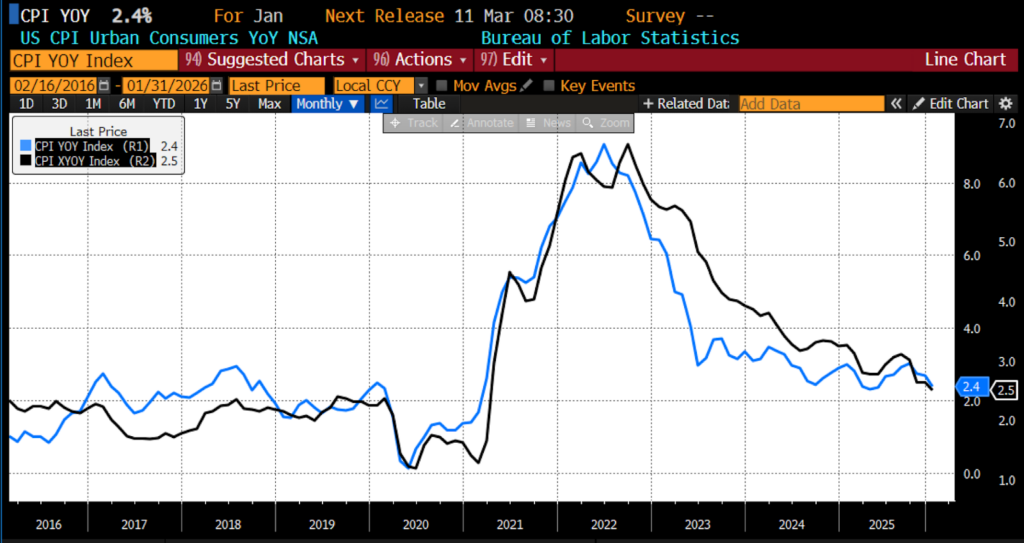
Over the prior 12 months, the headline Consumer Price Indices rose 2.4 percent against an expected 2.5 percent, with core year-over-year rising an expected 2.5 percent from January 2025 to January 2026.

January 2026 US CPI headline and core year-over-year (2016 – present)
(Source: Bloomberg Finance, LP)

Over the 12 months ending in January, food prices continued to firm, with grocery costs rising 2.1 percent on the year as most major categories posted gains. Prices for nonalcoholic beverages led the increase, climbing 4.5 percent, while cereals and bakery products advanced 3.1 percent and meats, poultry, fish, and eggs rose 2.2 percent. The “other food at home” category also increased 2.1 percent, and fruits and vegetables posted a more modest 0.8 percent gain, partially offset by a slight 0.3 percent decline in dairy and related products. Dining out remained a notable source of inflation, with the food away from home index rising 4.0 percent over the year, driven by a 4.7 percent increase in full-service meals and a 3.2 percent rise in limited-service meals.

Energy prices were broadly flat over the year, edging down 0.1 percent overall as a sharp 7.5 percent decline in gasoline prices was largely counterbalanced by sizable increases in electricity and natural gas, which rose 6.3 percent and 9.8 percent respectively. Excluding food and energy, core consumer prices increased 2.5 percent over the past year, with shelter costs advancing 3.0 percent and continuing to anchor underlying inflation. Additional upward pressure came from medical care, household furnishings and operations, recreation, and personal care — the latter posting a notable 5.4 percent gain — even as some goods categories such as used vehicles and certain household items showed signs of cooling.

The January report came in milder than many economists expected — especially for a month that typically runs hot as businesses reset prices at the start of the year. Yet beneath the surface, the inflation story remains uneven. Core goods prices were flat overall, masking a split between rising recreation-related items — such as consumer electronics, sporting goods, and toys — and declines in used vehicles, medical commodities, and some household goods. These crosscurrents reflect several forces at work simultaneously: lingering tariff pass-through in certain goods, AI-driven demand for electronic inputs, regulatory changes holding down medical costs, and fading supply disruptions in groceries. Services inflation, however, continues to run warmer, led by airfares, car rentals, and admission prices for sporting events. Shelter inflation moderated, with both rents and owner-equivalent rents slowing, offering a potential sign that one of the largest drivers of recent inflation is gradually cooling. Notably, prescription drug prices were unchanged — unusual for January — partly due to negotiated Medicare pricing that offset typical annual increases.

Taken together, the report suggests inflation pressures are shifting rather than disappearing. Discretionary services tied to travel, recreation, and wealth-effect spending remain firm, even as goods prices soften and everyday essentials such as energy and groceries show signs of relief. Price increases also became more widespread across categories — a common January phenomenon — but the overall pace was far more restrained than in recent years, hinting that underlying disinflation may dominate in coming months if current trends hold. Financial markets interpreted the data as supportive of potential Federal Reserve rate cuts later this year, though bond-market reactions were mixed given persistent strength in services inflation. For households, the takeaway is that while inflation hasn’t vanished, the early-2026 trend looks less like a renewed surge and more like a gradual cooling — with pockets of stubborn price growth that policymakers will continue to watch closely.


Here’s a quick recap of the crypto landscape for Friday (February 13) as of 9:00 a.m. UTC.

Get the latest insights on Bitcoin, Ether and altcoins, along with a round-up of key cryptocurrency market news.

Bitcoin (BTC) was priced at US$66,633.60, down 1.1 percent over the last 24 hours.

Bitcoin price performance, February 13, 2026.

Bitcoin price performance, February 13, 2026.

Chart via TradingView

Ether (ETH) was priced at US$1,956.57, down by 0.7 percent over the last 24 hours.

Altcoin price update

  • XRP (XRP) was priced at US$1.37, down by 1.4 percent over 24 hours.
  • Solana (SOL) was trading at US$79.62, down by 1.8 percent over 24 hours.

Today’s crypto news to know

Coinbase posts US$667M Q4 loss

Coinbase Global (NASDAQ:COIN) reported a fourth-quarter net loss of US$667 million as falling crypto prices weighed on revenue and the value of its investment portfolio.

Revenue came in at US$1.78 billion, below analyst expectations, and marked a 22 percent decline from a year earlier.

The company attributed much of the loss to a US$718 million drop in portfolio value, largely unrealized, alongside weaker transaction activity. Shares slid ahead of the release and have fallen more than 55 percent over the past six months as crypto markets retreated.

Despite the surprise slide, CEO Brian Armstrong sought to reassure investors, saying the firm remains “deliberately well capitalized” with US$11.3 billion in cash and equivalents.

He added that retail customers are largely holding rather than selling, even as volatility persists.

Bitcoin ETFs lose US$410M

Spot Bitcoin exchange-traded funds saw US$410 million in outflows Thursday, extending a rocky stretch that has drained nearly US$1.5 billion over two weeks.

BlackRock’s (NYSE:BLK) IBIT led the pullback, followed by Fidelity and Grayscale products, as institutional investors recalibrated positions amid macro uncertainty.

Treasury chief pushes Clarity Act as crypto selloff deepens

U.S. Treasury Secretary Scott Bessent urged Congress to pass the Digital Asset Market Clarity Act this spring, arguing it would provide stability to markets rattled by volatility.

Speaking on CNBC and later before the Senate Banking Committee, Bessent said the bill would give “great comfort to the market” and warned that parts of the crypto industry are resisting what he called “very good regulation.”

“There seems to be a nihilist group in the industry who prefers no regulation over this very good regulation,” he told lawmakers, drawing support from Senator Mark Warner.

The legislation has stalled amid disputes over stablecoin yield, DeFi oversight, and token classifications, with critics including Coinbase Global (NASDAQ:COIN) CEO Brian Armstrong raising objections. Bessent cautioned that a bipartisan coalition backing the bill could fracture if Democrats retake the House in November.

Warner, meanwhile, stressed unresolved concerns around illicit finance and national security risks tied to decentralized finance.

Securities Disclosure: I, Meagen Seatter, hold no direct investment interest in any company mentioned in this article.

Securities Disclosure: I, Giann Liguid, hold no direct investment interest in any company mentioned in this article.

This post appeared first on investingnews.com

Thousands of anti-government protesters violently faced off against riot police outside government buildings in Albania’s capital, Tirana, earlier this week, as people called for the resignation of the government following a massive corruption scandal.

The main Albanian opposition party called for people to take to the streets and demand the resignation of Deputy Prime Minister Belinda Balluku after she was indicted by a special prosecutor who alleged she had been improperly influenced in her decision to favor one company in a tender for the construction of a 3.7-mile tunnel in southern Albania.

Albania’s Special Court Against Corruption and Organized Crime suspended Balluku from the government in November, but Prime Minister Edi Rama took the issue to the country’s Constitutional Court, which reinstated Balluku in December.

Balluku denied the allegations, calling the accusations against her amounted to ‘mudslinging, insinuations, half-truths and lies.’ Rama has refused to dismiss her.

The corruption allegations touched off widespread outrage, sparking protests in recent months. 

‘The wave of popular protests in Albania reflects a growing societal backlash against what critics describe as the increasingly autocratic rule of Prime Minister Edi Rama,’ Agim Nesho, former Albanian ambassador to the U.S. and the United Nations, told Fox News Digital.

‘Over more than a decade in power, Rama is accused of centralizing authority and personalizing state institutions, while his government has faced persistent allegations of cooperation with organized crime and the misuse of public funds and public assets for the benefit of politically connected clients,’ Nesho claimed.

The shady circumstances surrounding Rama’s most important ally and the lack of accountability reinforces the sentiment that is pervasive in Albanian society that their government is rife with corruption. With both the incumbent government and opposition figures accused of corruption, public confidence in institutions and the justice system has steadily been eroded.

Albania has a long legacy of government corruption and ranks 91st out of 182 countries in Transparency International’s 2025 Corruption Perceptions Index.

The protests on Tuesday turned violent when supporters of Berisha’s opposition Democratic Party threw rocks and Molotov cocktails at government offices in Tirana. Security forces responded with water cannons and tear gas.

Berisha claims the protests have been peaceful, and people are only voicing their opposition to Rama’s increasing autocratic rule and his attacks of the justice system.

At least 16 protesters were treated for injuries and 13 protesters were arrested, according to The Associated Press. 

Observers of the region believe Berisha, who was prime minister from 2005 to 2013 and faced his own corruption charges, is angling to topple the socialist prime minister and main political rival, Rama, and return to power.

The turmoil in Albania comes as the country has long sought European Union membership, which began in 2014 when it became an official candidate for accession. While the 2025 annual European Commission report stated that Albania made significant strides in judicial reforms and combating organized crime, the latest allegations against Rami’s government will complicate its path to EU membership.

The United States helped implement Albania’s judicial reform process, including the creation of the Specialized Anti-Corruption Structure (SPAK). The State Department’s Bureau of International Narcotics and Law Enforcement Affairs (INL) invested millions to foster democratic progress in Albania and assisted in combating Albania’s struggles with corruption and strengthening its weak institutions.

Nesho warned the U.S. and European Union need to get serious with policy in the Western Balkans and help move Albania closer to European integration.

‘If Washington and Brussels continue to look the other way — failing to enforce the rule of law, restore real checks and balances, and cut the regime’s ties to organized crime and drug trafficking — Albania risks drifting into the orbit of Eastern-style autocracy,’ Nesho said.


This post appeared first on FOX NEWS

Sen. John Fetterman, D-Pa., the lone Senate Democrat to join the GOP to fund the Department of Homeland Security (DHS), accused his colleagues of choosing party over country in their shutdown vote.

Senate Democrats dug their heels in against funding the agency on Thursday in their pursuit of stringent reforms to Immigration and Customs Enforcement (ICE), following the fatal shootings of Alex Pretti and Renee Nicole Good during immigration operations in Minnesota.

But Fetterman believed that Senate Minority Leader Chuck Schumer, D-N.Y., and his party were missing the point.

‘This shutdown literally has zero impact on ICE functionality,’ Fetterman said in a post on X. ‘Country over party is refusing to hit the entire Department of Homeland Security. Democracy demands a way forward to reform ICE without damaging our critical national security agencies.’

Senate Democrats’ refusal to fund DHS this week has made a partial government shutdown affecting only DHS inevitable. The deadline to strike a deal is midnight Friday, and the likelihood of that happening is nearly nonexistent.

That’s because both chambers of Congress quickly fled Washington, D.C., on Thursday, with many in the upper chamber leaving the country altogether for the Munich Security Conference in Germany.

Schumer and his caucus argued that the White House and Republicans weren’t serious about reforms to ICE or Customs and Border Protection (CBP) and contended that the GOP’s counteroffer to their own list of demands didn’t go far enough to earn their votes.

But to Fetterman’s point, shutting down DHS won’t halt the cash flow to immigration operations.

That’s because congressional Republicans last year injected roughly $75 billion into the agency for ICE with President Donald Trump’s marquee ‘big, beautiful bill.’ That money is spread across the next four years, meaning that a shutdown now will have little, if any, effect on ICE’s core functions.

But other functions under DHS’ purview, like TSA, FEMA, the Coast Guard and more, will experience the brunt of the partial shutdown.

Negotiations on striking a deal are expected to continue in the background, and Senate Democrats have signaled that they’re considering offering a counteroffer to the White House in response to the GOP proposal.

Still, a vote to reopen and fund the agency won’t happen until early next week at best.


This post appeared first on FOX NEWS

President Donald Trump’s administration fired a U.S. attorney the same day he was sworn in for the role by a federal court this week.

A board of judges for the U.S. District Court for the Northern District of New York tapped Donald T. Kinsella to serve as U.S. attorney for the Northern District of New York, according to a court announcement that said Kinsella was sworn in on Wednesday. But Kinsella was then booted from the post on Wednesday. 

Deputy U.S. Attorney General Todd Blanche was blunt about the firing in a Wednesday post on X.

‘Judges don’t pick U.S. Attorneys, @POTUS does. See Article II of our Constitution. You are fired, Donald Kinsella,’ Blanche wrote.

In a Thursday statement, the court noted, ‘Yesterday the United States District Court appointed a United States Attorney for the Northern District of New York, a position that was vacant.’ 

‘The Court exercised its authority under 28 U.S.C. § 546(d), which empowers the district court to ‘appoint a United States Attorney to serve until the vacancy is filled.’ The United States Constitution expressly provides for this grant of authority in Article II, Section 2, Clause 2, which states in part: ‘the Congress may by Law vest the Appointment’ of officials such as United States Attorneys ‘in the Courts of Law.’ By the end of the day, Deputy Director of Presidential Personnel, Morgan DeWitt Snow notified Mr. Kinsella that he was removed as the judicially-appointed United States Attorney, without explanation,’ the statement noted.

‘The Court thanks Donald T. Kinsella for his willingness to return to public service so that this vacancy could be filled with a qualified, experienced former prosecutor, and for his years of distinguished work on behalf of the citizens of the Northern District of New York,’ the statement added.

Fox News Digital reached out to the White House for comment on Friday.

Kinsella was tapped to succeed John Sarcone III after a judge declared in January that he was serving in the role of acting U.S. attorney illegally, according to NBC News. 

The outlet said U.S. District Judge Lorna Schofield ruled that the Department of Justice took improper action to keep Sarcone in the role past the 120-day limit for U.S. attorneys who the Senate has not confirmed. He demoted himself to first assistant attorney while awaiting an appeal of the judge’s decision, the outlet added.


This post appeared first on FOX NEWS

With little time and no deal in sight to fund the Department of Homeland Security (DHS), a partial government shutdown by midnight is all but guaranteed.

The battle to prevent the third government shutdown under President Donald Trump in less than six months was lost in the Senate on Thursday. Now, with Congress scattered across the U.S. and several senators headed abroad, there’s no chance that a shutdown will be averted.

Senate Republicans were unable to smash through Senate Minority Leader Chuck Schumer, D-N.Y., and Senate Democrats’ unified front to pass a full-year DHS funding bill, nor were they able to do yet another short-term, two-week extension.

‘The idea of not even allowing us to have an extended amount of time to negotiate this suggests to me, at least, that there isn’t a high level of interest in actually solving this issue,’ Senate Majority Leader John Thune, R-S.D., said.

The final fight on the floor Thursday wasn’t with every lawmaker present, but between Sens. Katie Britt, R-Ala., and Chris Murphy, D-Conn., over giving lawmakers a little more time to keep the agency open while negotiations continue.

Senate Democrats argued that Republicans offered their legislative proposal in the dead of night, giving little time to actually move toward a compromise.

‘We had plenty of time to get a deal in the last two weeks,’ Murphy said. ‘And the lack of seriousness from the White House and from Republicans not getting language until last night has put us in the position we are in today.’

And with the expected shutdown, Democrats’ main targets — Immigration and Customs Enforcement (ICE) and Customs and Border Protection (CBP) — won’t see their cash flow dry up because of billions injected into the agency by Trump’s ‘big, beautiful bill.’

Instead, agencies like TSA, FEMA, the Coast Guard, and several others will suffer the brunt of the shutdown.

‘There is no way that you can’t say we’re working in good faith. We want to continue this conversation,’ Britt said on the Senate floor. ‘But yet you’re penalizing a TSA agent. A TSA agent is going to go without a paycheck. Why? So that you can posture politically? I’m over it.’

‘Everybody on that side of the aisle knows that ICE and CBP will continue to be funded,’ she continued. ‘They’re going to continue to enforce the law just as they should. Who’s going to pay the price?’

The final floor argument was a microcosm of what the week had devolved into. Senate Republicans argued that Democrats had burned too much time producing their list of demands, while Senate Democrats contended that they weren’t given enough time by the White House.

And as is typical during the string of shutdowns in the last several months, it has devolved into a public blame game. When asked about the effects a shutdown would have on the agencies not involved in immigration enforcement, Schumer pointed the finger at the GOP and the White House.

‘Talk to the Republicans, OK? We’re ready to fund everything,’ Schumer said. ‘We’re ready to have good, serious proposals supported by the American people. They’re not; they’re sort of dug in the ground, and they’re not moving forward.’

But neither side is willing to divulge publicly what the exact sticking points are in their ongoing negotiations. And Senate Democrats now appear to be considering a counteroffer to the White House, a sign that negotiations aren’t totally dead in the water.

‘Negotiations will continue, and we will see in the course of the next few days how serious they are,’ Thune said.


This post appeared first on FOX NEWS

Sports betting has become an epidemic, especially among young men. The Guardian recently aggregated some alarming statistics about its prevalence. The story notes:

Somewhere between 60 and 80 percent of high school students reported having gambled in the last year, the National Council on Problem Gambling reported in 2023. A study commissioned by the NCAA found that 58 percent of 18-to-22-year-olds had bet on sports – although it should be said that in most states this is illegal before the age of 21. 

Prediction markets have contributed to the normalization of gambling by blurring the line between investment and gambling. You can now essentially place betting parlays on Robinhood, an app previously dedicated to retail stock trading. 

In order to see why this uptick qualifies as an epidemic, we can use some economics to see how sports betting will necessarily make the average participant poorer. 

Investing vs Gambling 

To see why, it is helpful to contrast gambling with investing. After all, what makes betting on your favorite team different from buying some index funds for retirement? 

Well, first of all, investing has the ability to be a positive-sum game. In other words, when you buy stock, it can be a win-win. If you buy stock in a company, the company receives money today, which it can use to grow, and in exchange, you get equity in a company that grows in value. It’s a potential win-win. If you buy from a broker, this same logic holds, just with more steps between you and the company. 

This ability to have a positive-sum game is why, when individuals diversify into a large number of stocks, their portfolios grow. If someone invests in an index fund like the S&P 500, their money has historically grown at an average of 10 percent annually. This doesn’t require any special insider information or in-depth research. It’s just riding the wave of positive-sum exchanges. 

From the perspective of monetary return, sports betting is not positive-sum. If two people bet against each other on the outcome of a game, one person wins and the other loses. This is an example of a zero-sum game. If Jon and I bet $100 on the Bears-Packers game, one person loses $100, and one gains $100. If you add those gains ($100 and -$100), you get zero. 

Betting on a sports betting platform is even worse for participants. Betting platforms need to make money on the bets as well; so, one way or another, they take out of that $200 pool. This makes the game negative sum as regards monetary return for participants. If Jon and I use a platform to bet and I win, I get $100 minus whatever the platform takes, say $5, and Jon loses $100. In that case, the net return to the bettors is $95 (my return) minus $100 (Jon’s loss). 

If you consider the platform’s $5 gain, it remains zero sum. But after the mandatory house take, the exchange is negative sum for the bettors. This is the first reason why sports betting is financially a bad idea for participants. 

Point Shaving and Efficient Markets 

The downside of gambling can be even further exposed by economic reasoning. In particular, we’re going to talk about the efficient market hypothesis (EMH). 

When economists talk about efficiency, often people scoff. People don’t like the results of markets, and therefore, they believe they can’t be efficient. 

Efficiency doesn’t mean we like the results, though. All efficiency means (for the EMH) is that markets incorporate available information when pricing assets. 

For example, let’s say Apple discovers a way to improve the speed of iPhones by 10x, and this information becomes publicly available. The company plans to implement this technology in the next-generation iPhone, which will be released next year. Let’s further say that this improvement will lead to many Android users switching phones when the new phone comes out. These sales will mean higher profits and, therefore, a higher stock price for Apple. 

Question—will Apple stock prices go up as soon as people discover this, or not until after the new version is released? If investors believe the above information is accurate, they will buy stocks immediately in order to gain from the future improvement in profits. Since everyone rushes to buy the stock today, the information about the future is incorporated into the price today, not when the new version is released. 

For an extreme example, imagine a company publicly announced it would declare bankruptcy next week. Do you think stock prices would wait a week to tumble? Of course not. 

Markets reflect all publicly available relevant information, and this includes betting markets. If a major player for a team gets injured in practice, gamblers will bet against the team in question and shift the odds. 

Since the stock market is positive-sum, others having more information than you may not be a problem. If Apple is in your diversified portfolio, you don’t need to scan headlines to learn about the company’s technological innovations before anyone else does. 

Sports betting, though, is negative sum for bettors. If someone has information that you don’t have, they can exploit that asymmetry to earn money off of you.  

On average, a person betting randomly on sports will lose money because the game is zero sum for bettors. That means in order to make money consistently, you need to have access to knowledge or information that others don’t.

Here’s the thing, the average person cannot have more information than everyone else, by definition. There are people who bet on sports for a living. Does an average Joe have access to more information and prediction tools than industry insiders? It seems very unlikely. Most participants, over the course of their lives, will be net losers in sports betting. 

The best evidence of this can be seen by the onslaught of point-shaving scams being uncovered in college and professional sports. Investigations by federal officers, coach firings, and indictments of players for point shaving saturate recent headlines in the world of college basketball. 

Many people involved in these schemes will get caught, but it seems likely that other insiders either knew about these schemes or learned about them by being close to the industry. When you compete in sports betting, you compete against people with this sort of information.

In other words, the odds in any sports betting situation are set by information that average people don’t have access to. In order to win money, you need to beat those odds. In other words, you need to have better knowledge and information than those who make the odds. 

The implication here seems straightforward. The average person in sports betting loses money. The statistics match the logic. NBC reported on a study that showed: 

…compared with states that did not implement sports gambling, states that did so saw credit scores drop by a statistically significant, though modest, amount, while bankruptcies increased 28 percent and debt transferred to debt collectors climbed 8 percent. Auto loan delinquencies and use of debt consolidation loans also increased, they found. 

The structure of sports betting laws is beyond the control of the average person as well, but personal behavior is not. The personal implications here are clear. Sports betting is bad for your personal finances, and average joes won’t win (even if you think you will). You may know a lot about basketball, but do you know as much as the professional bettor whose cousin happens to be a physical therapist or coach of a team?  

Every time you see a point-shaving headline, it should be a strong reminder. In a zero-sum game, the winners are likely those exploiting information you can’t access.

“Life is like a box of chocolates. You never know what you’re gonna get.” 

The line from Forrest Gump is meant to capture uncertainty in love and life, but every Valentine’s Day, it accidentally describes markets just as well. Chocolate prices rise, products take different shapes, and consumers are surprised once again at the checkout line. The usual explanation immediately turns to corporate greed. Yet what Forrest Gump’s chocolate box really reminds us is that uncertainty, timing, and expectations shape outcomes, and that prices exist to navigate uncertainty, not to exploit it.

Xocolātl, the beverage we now call chocolate, originated in tropical Mesoamerica, across what is today Mexico to Costa Rica. Before it became a sweet confection, xocolātl was a bitter mixture of cacao beans, water, and spices, cultivated, traded, and consumed for elite, ceremonial, and everyday uses. Only after 1492, through the “Columbian Exchange,” a term coined by Alfred W. Crosby, did cacao enter the wider Atlantic economy, where ingredients, capital, and know-how recombined across continents. New World cacao met Old World sugar, dairy, and manufacturing, and the modern chocolate industry was born.

Although centuries removed from the Maya and Aztec civilizations, chocolate remains a symbol of affection today. The transatlantic transformation of cacao into chocolate, combined with medieval courtship traditions, helped produce Valentine’s Day as we know it. Last year, among the cards, flowers, and jewelry, Americans bought 75 million pounds of chocolate or roughly the weight of 15,000 elephants. For 2026, the National Retail Federation and Prosper Insights & Analytics project record spending: “Consumer spending on Valentine’s Day is expected to reach a record $29.1 billion…surpassing the previous record of $27.5 billion in 2025.” Record spending, however, is often mistaken for evidence of record prices. When prices rise, many are quick to draw back their bow and let their arrow fly even when the true source of higher costs lies elsewhere. 

Rising prices around holidays are often attributed to a familiar story of corporate tricks, rather than treats, known as “greedflation.” Supermarkets and chocolate companies are accused of exploiting a sentimental holiday, padding margins under the cover of romance. In recent years, this narrative has resurfaced almost reflexively whenever grocery prices rise. However, retailers do not set prices in a vacuum; they respond to constrained supply and higher input costs. To understand why chocolate costs more, we need to look past the supermarket aisle to the governments and growing conditions that shape the cocoa market itself.

The International Cocoa Organization notes that roughly 70 percent of cocoa is produced in Africa, with Côte d’Ivoire and Ghana leading output at about 1,850 and 650 thousand tons, respectively, in 2025. Cocoa is central to both economies, accounting for about 15 percent of Côte d’Ivoire’s GDP and seven percent of Ghana’s GDP. In 2018, the two nations formed the Côte d’Ivoire–Ghana Cocoa Initiative (CIGCI), informally referred to as “COPEC.” Its stated aim is to correct perceived market failures by raising prices: “Without correcting the many market failures, the cocoa economy is destined to become a counter-model of sustainability.”

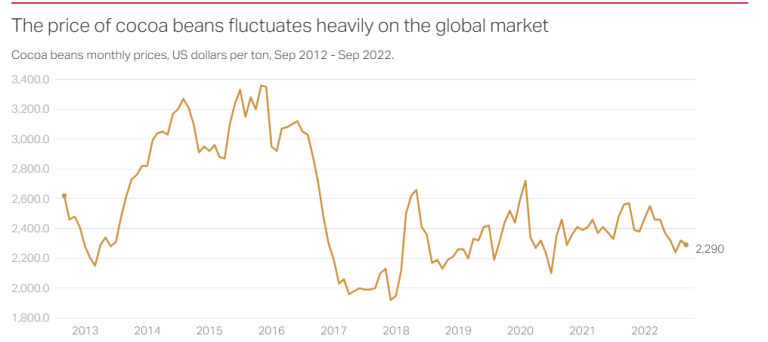
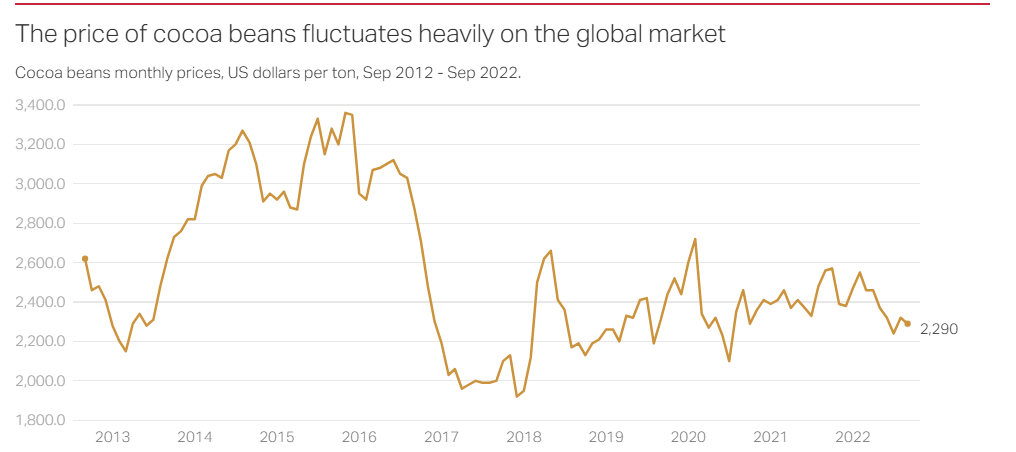
Switzerland’s national broadcaster, SWI, documents a sharp price movement beginning in early 2018, coinciding with the cartel’s creation, suggesting that coordinated policy had immediate market effects.

According to World Finance, COPEC may also have served domestic political goals, with promises of higher prices timed around election cycles to win farmer support. Regardless of motivation, both countries have announced higher prices for the 2025/26 crop season. Côte d’Ivoire will raise prices by 39 percent, which pales in comparison to Ghana’s 63 percent price increase. 

These administratively set prices add to a system already strained by corruption within Ghana’s Cocoa Board (COCOBOD) and black-market activity in Côte d’Ivoire. Highlighting growing smuggling operations, Ivorian authorities last year seized 110 shipping containers, about 2,000 metric tons, of cocoa beans falsely declared as rubber, worth $19 million. ¨The tax on this shipment should have been 19.5 percent, including the 14.5 percent tax on cocoa exports and the five percent registration tax. In that case, the Ivorian state would have collected 2.9 million pounds in taxes. Meanwhile, the tax on rubber exports is only 1.5 percent.¨

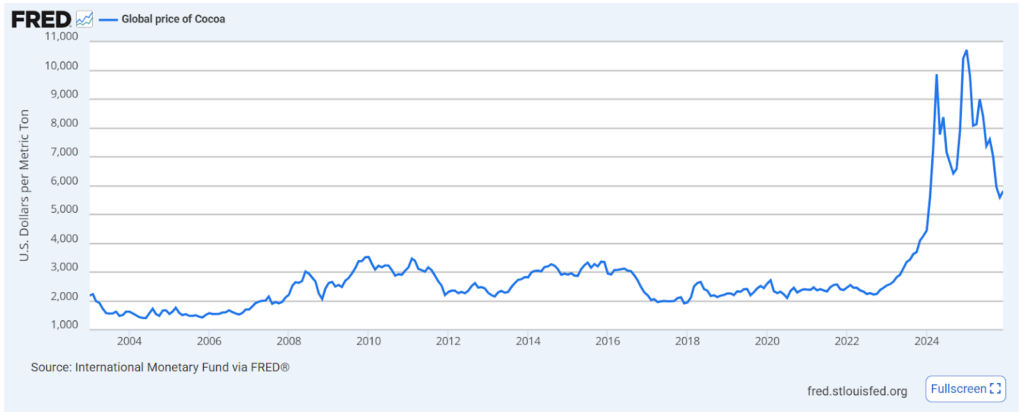
Needless to say, Côte d’Ivoire and Ghana have constructed a highly interventionist system around their most important export. Compounding these policy distortions, the 2025/26 crop season is expected to see a 10 percent fall in output due to “shifting weather patterns, ageing tree stocks, disease, and destructive small-scale gold mining.” This shortage has intensified pressure in an already volatile cocoa market. According to FRED, cocoa prices have risen by more than 70 percent in the last five years. 

Last year, North America’s largest chocolate producer, Hershey, announced price increases across household names such as Reese’s, Kit Kat, and Kisses: “It reflects the reality of rising ingredient costs, including the unprecedented cost of cocoa.” In the earnings Q&A call on February 5, 2026, CEO Kirk Tanner stated, “Our actions…are anchored in consumer insights and the brands remain affordable and accessible. Seventy-five percent of our portfolio is still under $4.” Tanner framed their strategy as keeping products as affordable and accessible as possible despite rising cocoa costs.

Given cocoa price volatility, Hershey’s effort to keep chocolate affordable, and supermarket margins of just one to three percent, “greedflation” melts away like a chocolate kiss on Valentine’s Day — leaving scarcity and policy, not corporate greed, as the real culprits. The bitterness in chocolate prices comes from constraints and institutions, not from greed.

Albemarle (NYSE:ALB) is raising its long-term lithium demand outlook after a breakout year for stationary energy storage, underscoring a shift in the battery materials market that is no longer driven solely by electric vehicles.

The US-based lithium major reported fourth quarter 2025 net sales of US$1.4 billion, up 16 percent year-over-year, with adjusted EBITDA rising 7 percent to US$269 million.

For the full year, Albemarle delivered US$5.1 billion in revenue and US$1.1 billion in adjusted EBITDA, results that CEO Kent Masters said were supported by “strong growth in energy storage and significant cost and productivity improvements.”

But the most consequential update came in the company’s demand outlook.

“We are seeing a diversification of lithium end markets, with stationary storage becoming an increasingly significant demand driver,” Masters told investors during a February 12 conference call, adding that Albemarle has increased its 2030 global lithium demand forecast by 10 percent to a range of 2.8 million to 3.6 million metric tons.

Storage steps into the spotlight

Global lithium demand reached 1.6 million metric tons in 2025, up more than 30 percent year-over-year and in line with Albemarle’s prior projections. Demand growth outpaced supply, tightening inventories and lifting prices into year-end.

For 2026, Albemarle now expects global lithium demand to rise to between 1.8 million and 2.2 million metric tons — growth of 15 to 40 percent — driven by both EV adoption and accelerating deployments of stationary energy storage systems (ESS).

While global EV sales climbed 21 percent in 2025, energy storage was the standout. ESS demand surged more than 80 percent year-over-year, with strong growth across China, North America and Europe.

China, which accounted for roughly 40 percent of ESS shipments, saw demand rise 60 percent. North American shipments jumped 90 percent, reflecting grid stability needs and rising electricity consumption linked to data centers and artificial intelligence. European shipments more than doubled as countries expanded renewables and sought greater energy security.

Demand outside the three major regions grew 120 percent and represented more than 20 percent of global ESS shipments, with Southeast Asia, the Middle East and Australia emerging as key growth markets.

The shift is already visible in Albemarle’s financials. In 2025, energy storage volumes reached 235,000 metric tons of lithium carbonate equivalent, up 14 percent year-over-year and above the high end of the company’s guidance range.

Fourth quarter energy storage net sales rose 23 percent from a year earlier, while segment EBITDA climbed 25 percent, supported by higher lithium pricing and cost improvements.

CFO Neal Sheorey said Albemarle’s updated 2026 scenarios reflect both pricing and operational gains.

Cost discipline, portfolio reset

After weathering a sharp downturn in lithium prices over the past two years, Albemarle has focused on strengthening its balance sheet and lowering its cost base.

In 2025, the company delivered approximately US$450 million in run-rate cost and productivity improvements and is targeting an additional US$100 million to US$150 million in 2026.

Albemarle also announced it will idle operations at its Kemerton lithium hydroxide plant in Western Australia, citing a structural cost gap between Western and Chinese conversion assets.

“There is a gap there between China and the West,” Masters said, pointing to higher labor, power and waste management costs in Australia. Idling the plant is expected to improve adjusted EBITDA beginning in the second quarter, with no impact on sales volumes.

At the same time, Albemarle is streamlining non-core assets.

The company closed the sale of its stake in the Eurocat joint venture in January and expects to complete the sale of a majority stake in its refining catalysts business in the first quarter. Together, the transactions are expected to generate approximately US$660 million in pre-tax proceeds.

“We are committed to maintaining our investment-grade credit profile,” Masters said, adding that deleveraging and disciplined capital allocation remain priorities.

Growth with limited new capital

Despite pulling back on large-scale capital spending, Albemarle expects to deliver a five-year compound annual growth rate of roughly 15 percent in energy storage sales volumes, building on a 25 percent CAGR over the past four years.

Incremental expansions at the Greenbushes mine in Australia, yield improvements at the Salar de Atacama in Chile and higher utilization at the Wodgina joint venture are expected to support growth with minimal additional capital.

Looking ahead, Masters said the company is better positioned to navigate lithium’s still-maturing cycle.

“We’ve been through two cycles since the advent of EVs,” he said, describing the market as early in its development from a commodity perspective.

With stationary storage now emerging as a second structural demand pillar alongside EVs, Albemarle’s revised outlook suggests the lithium market’s next phase will be shaped as much by grid resilience and energy security as by transportation electrification — broadening the base of demand for years to come.

Lithium prices rebound sharply in early 2026

Lithium prices have surged since the start of 2026, underscoring the market’s renewed volatility.

According to Fastmarkets, spot battery-grade lithium carbonate on the seaborne market climbed from about US$11 per kilogram in early December to more than US$16 per kilogram by early January, a jump of nearly 50 percent in a matter of weeks.

The rally has been driven by tightening supply, including delays to the reopening of CATL’s (SZSE:300750,HKEX:3750) Jianxiawo lepidolite mine and maintenance at other production facilities, alongside aggressive restocking tied to long-term contract negotiations.

Speculative buying has amplified the move, with bullish sentiment and geopolitical risk adding to momentum. At the same time, thin spot liquidity reflects a cautious market, as buyers and sellers hesitate to commit amid rapid price swings.

Spodumene prices have followed suit, rising above US$2,000 per metric ton in January, levels not seen since October 2023. The rebound has improved margins for Australian producers, many of whom curtailed output when prices fell below US$900 per metric ton. Sustained pricing at current levels could prompt a wave of mine restarts, potentially easing supply tightness later this year.

Still, Fastmarkets cautioned that prices may be running ahead of fundamentals.

“Lithium prices appear to have moved ahead of the fundamentals, propelled by speculative buying, bullish sentiment and a backdrop of heightened geopolitical risk,” wrote Paul Lusty. “The key takeaway is to brace for more volatility.”

Securities Disclosure: I, Georgia Williams, hold no direct investment interest in any company mentioned in this article.

This post appeared first on investingnews.com

TSX-V: WLR

Frankfurt: 6YL

 Walker Lane Resources Ltd. (TSXV: WLR,OTC:CMCXF) (Frankfurt: 6YL) (the ‘Company’) announces that the Company continues to work diligently toward the completion and filing of the Company’s annual audited financial statements and management’s discussion and analysis for the fiscal year ended September 30, 2025 (the ‘Required Filings’). The Company is actively working on various strategies that they expect will resolve the preparation of the Required Filings as quickly as possible.

Walker Lane Resources Ltd. logo (CNW Group/Walker Lane Resources Ltd)

The Required Filings are due to be filed by March 30, 2025. In connection with the anticipated delays in making the Required Filings, the Company made an application for a Management Cease Trade Order (‘MCTO‘) under NP 12-203 to the BC Securities Commission, as principal regulator for the Company, and the MCTO was issued on January 29, 2026. The MCTO restricts all trading by the Company’s CEO and CFO in securities of the Company, whether direct or indirect. The MCTO does not affect the ability of persons who are not directors, officers or insiders of the Company to trade their securities. The MCTO will remain in effect until the Required Filings are filed or until it is revoked or varied.

The Company expects to proceed with the filing of its interim first-quarter financial statements shortly after the Required Filings have been completed and submitted.

The Company confirms that it intends to satisfy the provisions of the alternative information guidelines described in NP 12-203 by issuing bi-weekly default status reports in the form of a news release until it meets the Required Filings requirement. The Company has not taken any steps towards any insolvency proceeding and the Company has no material information relating to its affairs that has not been generally disclosed.

About Walker Lane Resources Ltd.

Walker Lane Resources Ltd. is a growth-stage exploration company focused on the exploration of high-grade gold, silver and polymetallic deposits in the Walker Lane Gold Trend District in Nevada and the Rancheria Silver District in Yukon/B.C. and other property assets in Yukon. The Company intends to initiate an aggressive exploration program to advance its projects through drilling programs with the aim of achieving resource definition in the near future.

For more information, please consult the Company’s filings, available at www.sedarplus.ca.

ON BEHALF OF THE BOARD OF DIRECTORS

Kevin Brewer
President, CEO and Director
Walker Lane Resources Ltd.

Forward Looking Statements

This news release contains certain statements that constitute ‘forward looking information under Canadian securities laws (‘forward-looking statements’). The use of words such as ‘anticipates’, ‘expected’, ‘projected’, ‘pursuing’, ‘plans’ and similar expressions identify forward-looking statements. Forward-looking statements in this news release include statements regarding the application for the MCTO and the completion of the Required Filings and the timing thereof. Since forward-looking statements address future events and conditions, by their very nature they involve inherent risks and uncertainties. Many factors could cause actual future events to differ materially from the forward-looking statements in this press release. The forward-looking statements included in this news release are expressly qualified by this cautionary statement. The forward-looking statements and information contained in this news release are made as of the date hereof and the Company undertakes no obligation to update publicly or revise any forward-looking statements or information, whether as a result of new information, future events or otherwise, unless so required by applicable laws. The reader is cautioned not to place undue reliance on forward-looking statements.

SOURCE Walker Lane Resources Ltd

Cision View original content to download multimedia: http://www.newswire.ca/en/releases/archive/February2026/13/c0056.html

News Provided by Canada Newswire via QuoteMedia

This post appeared first on investingnews.com