Author

admin

Browsing

Not long ago, the notion of trillions belonged either to the furthest cosmic reaches of the universe or the submicroscopic world of atoms. These numbers describe galaxies in the observable universe, roughly two trillion, or, at the opposite extreme, the picosecond — one trillionth of a second — is used to measure molecular motion and chemical reactions. Until recently, magnitudes denominated in trillions were almost entirely confined to the theoretical hinterlands of astronomy, physics, and schoolyard exaggeration.

Today, trillion-dollar quantities have become commonplace in economic and financial life. At least 12 American companies boast trillion-dollar market capitalizations, with Apple approaching $5 trillion. BlackRock now manages more than $15 trillion in assets. The largest technology firms, cumulatively, measure their investments in the trillions as they build data centers, semiconductor capacity, and power systems on an unprecedented scale. SpaceX’s 2026 initial public offering valued the company at more than $1.7 trillion, and its subsequent surge briefly pushed Elon Musk’s paper wealth above $1 trillion.

Billionistan opened its gates in 1901, when JP Morgan assembled US Steel into the world’s first billion-dollar corporation. Perhaps it surrendered statehood on January 13, 2016, the day Powerball offered the first billion-dollar lottery jackpot. After ten more, Billionistan moved from a numerical destination to a waypoint. We now inhabit Trillionistan.

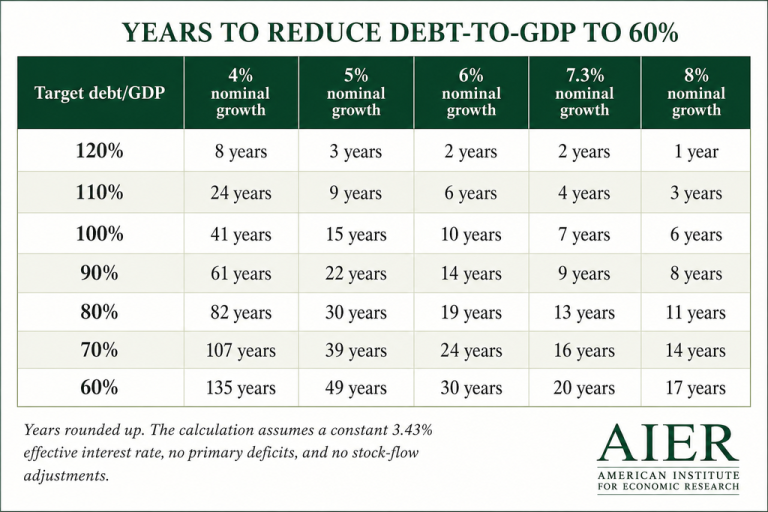
Governments, unsurprisingly, were early movers; they frequently are. Trillion-dollar economic figures first appeared during the great hyperinflations of the twentieth century. In the United States, the national debt crossed $1 trillion in October 1981, inaugurating an era in which ever-larger fiscal quantities gradually lost their capacity to shock. Annual deficits now exceed the entire national debt of 45 years ago, while America’s current indebtedness — as measured by the fiscal gap — extends into the hundreds of trillions.

Public finance is only one province of Trillionistan. The larger phenomenon is the steady upward drift of nominal magnitudes — and our tendency to mistake financial scale for real, truly productive achievement. Prices rise, credit and money supplies balloon, economies grow, markets deepen, and expected future earnings are capitalized across ever-longer horizons. Each process quietly extends the number of zeroes layered onto economic life.

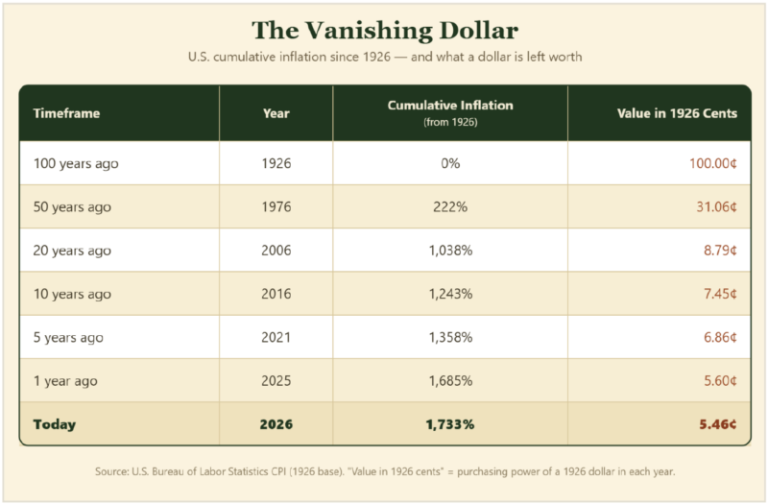
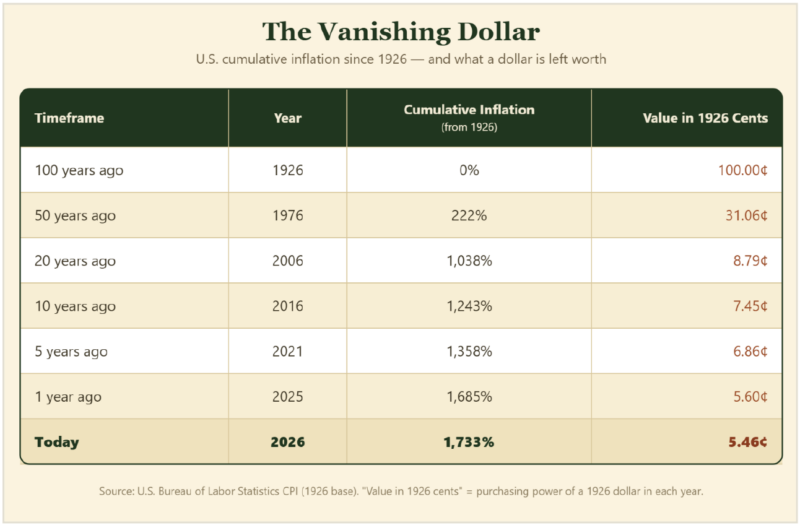
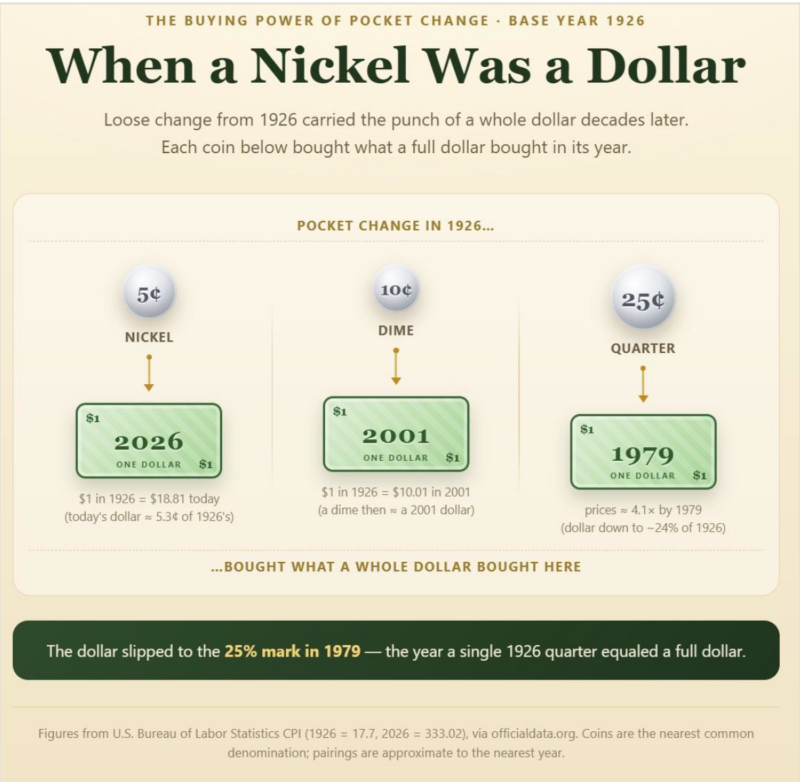
Inflation is plainly part of the explanation. A dollar simply buys far less than it once did. Even if nothing real changed — if no new factories were built, no technologies discovered, and no improvement in living standards achieved — the same collection of assets would be priced higher over time as each dollar lost purchasing power. Nominal dollar records are easier to achieve than real value-driven ones.

But inflation alone cannot explain Trillionistan. The economy has also become larger, richer, more technologically sophisticated, and more global. Companies now serve billions of customers, software scales almost without cost, and intellectual property can generate extraordinary returns worldwide. Genuine wealth creation and monetary depreciation are operating simultaneously, both enlarging the nominal quantities around us. But it’s difficult for most observers to distinguish between a trillion dollars of productive assets, a trillion dollars of debt, a trillion-dollar market cap, a trillion-dollar spending bill, and a trillion dollars of future pension liabilities.

Sound economics cautions against confusing abstract money prices with the goods, services, productive capacities, and human satisfactions to which those prices refer. Additional wealth is not created merely because accountants add zeros to balance sheets, central banks expand the money supply, or financial assets are quoted at higher prices. Yet neither are such price changes meaningless. Money is a messenger: prices may reflect changes in scarcity, expected earnings, risk, preferences, credit conditions, monetary supply, or some combination of them. Wealth is created when entrepreneurs discover more valuable ways to arrange scarce resources, including capital and labor, to satisfy human wants. Market prices signal judgments about those uses, but they are not themselves the value being created.

Viewed through that lens, a trillion-dollar company is less alarming, and perhaps more inspiring. A trillion-dollar market capitalization is not a warehouse containing a trillion dollars; it is the market’s continuously revised estimate of future earning power (see the price trend in SpaceX since the IPO for confirmation of that phenomenon). Stock prices condense millions of judgments about technology, competition, consumer demand, production costs, and risk into a single signal of likely value. That estimate — whether it proves accurate or wildly optimistic — is a wager, a priced forecast of the future, rather than an inventory of existing riches.

Like the trillions now being committed to AI infrastructure, some investments will transform productivity; others will become expensive monuments to extrapolation. Entrepreneurship has always involved speculation. The more important question is whether monetary policy choices have the effect of systematically warping entrepreneurial judgment and promoting malinvestment. Persistently easy credit and artificially suppressed interest rates do more than raise prices generally. They encourage longer-duration projects, inflate the present value of distant earnings, and allow financial valuations to outrun the economy’s underlying productive capacity. 

Certainly not every trillion dollar valuation is a bubble. Monetary distortion and genuine innovation frequently coexist. Railroads truly transformed nineteenth-century Millionistan — the impressive Mohawk and Hudson Railroad was built for just $600,000 — though many fortunes disappeared in speculative railroad manias. The internet continued to power our economy well after the collapse of the dot-com bubble. Artificial intelligence may likewise reshape civilization while simultaneously destroying vast quantities of invested capital. Entrepreneurial ventures, especially at the cutting edge of technology, are entrepreneurial wagers. Profit and loss exist precisely because no one knows the outcome beforehand.

Life in Trillionistan has rewired our perceptions. Large numbers anesthetize. A million dollars once represented unimaginable wealth; a billion eventually replaced it; today even the billion is becoming commonplace. As each numerical frontier becomes familiar, it commands less wonder and less scrutiny. We experience reflexive suspicion of individuals who command great fortunes, but slip into complacency toward inflation, debt, and public liabilities. In both cases, the magnitude obscures the institution that produced it.

Not all trillions are created equal. A trillion accumulated through entrepreneurial discovery differs fundamentally from a trillion generated through monetary expansion, leverage, or habitual political can-kicking. Most modern trillions contain elements of both: genuine productive achievement expressed through a steadily depreciating unit of account. The trillion has migrated from cosmology and quantum mechanics into ordinary economic discourse because the economy has genuinely grown, but also because the monetary unit has contracted precipitously.

The important question, then, is not whether another company, fortune, industry, or balance sheet will cross the trillion-dollar threshold. Many will. The more interesting and relevant question is what kind of trillion it will be: one representing genuine wealth creation, one reflecting the capitalization of future possibilities, one inflated by monetary expansion, or some unstable mixture of all three. In Trillionistan, the zeros hint at the scale, but they do not tell us the actual story. And even as we acclimate ourselves to the trillion, the foundations of Quadrillionistan are quietly being laid. 

Taxing billionaires has become one of the most politically appealing ideas in American politics. As policymakers search for new ways to finance expanding public spending, calls for a direct tax on accumulated wealth have moved from the margins of policy debate to the political mainstream. Nowhere is that shift more evident than in California, where a proposed ballot initiative would impose a one-time five percent tax on the wealth of the state’s billionaires.

On June 17, the proposal qualified for the November ballot after state officials verified the required petition signatures. If approved, supporters estimate the measure would raise roughly $100 billion for healthcare, education, and social programs. Yet sound economic policy should be judged not by its intentions but by its consequences. The real question is not whether billionaires can afford to pay more, but whether a wealth tax can generate the promised revenue without driving away the investment, entrepreneurship, and innovation that created that wealth in the first place.

Why Wealth Taxes Don’t Work

The appeal of a wealth tax is easy to understand. Asking a handful of billionaires to finance public spending may sound politically attractive, but history suggests the economics are far less convincing. Unlike income taxes, wealth taxes target accumulated assets—not annual earnings — including business equity, investments, real estate, and intellectual property. Because most billionaire wealth is invested in productive businesses rather than sitting idle in bank accounts, taxing it discourages investment, entrepreneurship, and innovation while encouraging capital to flow to more competitive jurisdictions. 

International experience reinforces this point. An OECD report finds that wealth taxes discourage entrepreneurship and risk-taking, weakening innovation and long-term economic growth. These findings help explain why the number of countries levying wealth taxes fell from 12 in 1996 to just five today, as many governments abandoned them after they generated little revenue while imposing high economic and administrative costs. Even where they remain, they have historically raised only about 0.2 percent of GDP while discouraging investment and weakening long-term economic growth.

The existing tax burden makes this case even harder to justify. America’s wealthiest taxpayers already face one of the world’s most progressive tax systems, with a combined state, local, federal, and international tax rate of 59 percent. Recent research also found that US billionaires pay higher effective tax rates than their counterparts in the Netherlands, Sweden, Norway, and France and, contrary to the common narrative, pay the highest tax rates among all Americans. California is particularly vulnerable because it already relies heavily on a small number of high-income taxpayers to finance its budget. 

The proposal is also exceptionally difficult to administer. Much of the wealth it targets — private businesses, artwork, intellectual property, and real estate — has no clear market value, making annual valuations costly, subjective, and prone to dispute. California would compound these challenges by imposing steep penalties on taxpayers and appraisers whose valuations differ from those of state authorities, increasing compliance costs and creating legal uncertainty for investors and entrepreneurs.

Finally, the proposal ignores a basic economic reality: capital is mobile. Before France repealed its wealth tax in 2018, an estimated 10,000 wealthy individuals with €35 billion in assets had already left the country. California is already experiencing a similar trend, losing more wealthy individuals to outmigration than any other state and recording a net loss of 1.6 million residents to interstate migration over the past decade. A wealth tax would likely accelerate that exodus, forcing some entrepreneurs whose wealth is tied up in their companies to sell shares or dilute ownership simply to pay the tax, weakening founder control, discouraging long-term investment, and undermining California’s position as a global center of innovation.

California’s Billionaire Tax Is Already Backfiring

If California’s billionaire tax is intended to raise the projected $100 billion from the state’s wealthiest residents, early evidence suggests it may already be backfiring. Even Governor Gavin Newsom, who opposes the proposal, has warned that it risks driving high-income taxpayers out of the state. Rather than waiting to see whether voters approve the measure, many of California’s wealthiest entrepreneurs and investors have already begun relocating to lower-tax states, shrinking the very tax base the proposal seeks to capture.

Among those reported to have left California or moved to lower-tax states are Google co-founders Larry Page and Sergey Brin, PayPal co-founder Peter Thiel, venture capitalist David Sacks, financier Don Hankey, and film producer Steven Spielberg. Meta founder Mark Zuckerberg has also reportedly acquired property in Florida. Their departures demonstrate that taxpayers often express their preferences with their feet as much as with their votes.

The fiscal outlook is even bleaker than supporters anticipate. A Stanford University Hoover Institution study estimates the proposal would raise only about $40 billion, not the promised $100 billion, after accounting for billionaire departures and correcting flaws in its revenue projections. It also finds that just six publicly confirmed departures removed roughly $536 billion — nearly 30 percent of the proposed tax base — leaving the measure with a projected net fiscal loss of about $25 billion once future income tax losses are included.

Even if voters reject the measure, the damage may not end there. Investors and entrepreneurs respond not only to enacted policies but also to the broader political climate, and the prospect of recurring wealth taxes could discourage long-term investment, startup formation, and business expansion while encouraging more high-income residents to relocate.

California’s proposal reinforces a lesson repeatedly demonstrated around the world: wealth taxes rarely fail because taxpayers refuse to pay—they fail because taxpayers adapt. In an increasingly mobile economy, governments cannot assume that capital will remain in place as tax burdens rise. By the time Californians vote in November, much of the wealth the proposal seeks to tax may already have left the state, taking investment, jobs, innovation, and future tax revenue with it.

A common narrative from politicians on the right is that immigration is economically disastrous. President Trump has argued that “immigration costs our country billions and billions of dollars each year.” In an interview, Vice President JD Vance went further, arguing that under former President Biden “all net job creation — you heard me right, 100 percent of net job creation under the Biden administration — has gone to the foreign-born.”

Trump’s Commerce Secretary Howard Lutnick has called the H-1B visa system “a scam that lets foreign workers fill American jobs.” But despite the fairly consistent narrative on immigration’s economic impacts from elected Republicans, most Americans think immigration has positive economic benefits. And new data continues to bear this out.

Nearly 50 percent of Fortune 500 companies in 2025 (231 out of 500) were founded by immigrants or their children. In fiscal year 2024, “these 231 Fortune 500 companies generated $8.6 trillion in revenue — an amount that, if compared with national GDPs, would rank as the third-largest economy globally.” What’s more, immigrants are founding not just industry giants but also some of the most dynamic and innovative companies, too — startups.

According to an analysis by National Foundation for American Policy, “[i]mmigrants have founded or co-founded 59 percent (455 of 775) of America’s privately held startup companies valued at $1 billion or more.” And even startups that aren’t founded by immigrants often have immigrants in key leadership roles. The analysis found that nearly 80 percent of America’s unicorn companies (privately held, billion-dollar companies) were either founded by an immigrant or have an immigrant in a key leadership role, like vice president of engineering. 

Take a specific immigrant population as an example. Indian immigrants to the United States have, alone, founded 96 billion-dollar startups. 

Today, there are approximately 3.2 million Indian immigrants in the United States. That means about one in every 30,000 Indian immigrants has founded a billion-dollar startup. And each of these billion-dollar startups creates 833 jobs, on average.

Now, one response to these statistics is that Americans could just as easily create these startups, but a 2025 study from the National Bureau of Economic Research puts that into question. The study’s analysis of nearly 91,000 US startups found that companies with mixed founder teams (immigrants and US-born entrepreneurs) grow faster, employing 20 percent more people than US native-only ventures three years after launch. They also raise larger funding rounds and are more likely to be acquired or go public.

The researchers suggest these benefits stem from immigrants’ broader access to global talent networks, cross-border capital, and foreign markets. Compared to native-only startups, native-migrant startups hire higher quality workers (using internal and external promotions as a proxy for labor quality). By drawing from a larger labor pool, startups that incorporate immigrants simply have better, higher-quality labor. That same dynamic shows up in startup financing and market access. Immigrant-founded firms are not just producing more than twice as many patents; they are also more likely to patent abroad, suggesting that immigrant founders are often better positioned to draw on international capital networks and reach customers beyond the US market.

While there is a debate to be had about low-skilled immigration (and particularly, illegal immigration), the Trump Administration is going after immigration broadly — including high-skilled immigration. New screening requirements, tougher vetting, and higher costs are also affecting people seeking to come to the US legally for work or study. Last year, Trump signed a proclamation overhauling the H-1B visa program, one of the most common pathways for highly skilled foreign workers, by imposing a new $100,000 application fee (which is in effect, though under appeal, at time of writing). The Trump Administration is also subjecting green card applicants to “anti-Americanism” screening, while student visa applicants must now undergo social media vetting. A special visa for STEM PhDs and startups passed the House of Representatives in 2022, but Senator Grassley blocked its inclusion in the CHIPS and Science Act.

And there’s a good chance these additional barriers mean that the US could be missing out on our next billion-dollar startup.

Take the newly added barriers on student visas: almost one in four US billion-dollar companies — 24 percent — was founded by someone who first came to America as an international student. These companies have generated an average of 1,123 jobs each. Together, US billion-dollar companies with international-student founders are valued at $3.5 trillion — or more than $4 trillion when including unicorns that have gone public since 2016.

Interestingly, while Republican politicians continue to make high-skilled immigration more difficult, Republican voters — though skeptical of immigration generally — are broadly in favor of high-skilled immigration. A 2025 poll from the Manhattan Institute, for instance, found that only nine percent of Republican voters think high-skilled immigration should be decreased.

The Trump Administration’s policies, unfortunately, will almost certainly decrease high-skilled immigration going forward. 

“President Trump has reduced illegal entries since Inauguration Day in January 2025, but … his administration has reduced legal entries far more,” David Bier writes for Cato. Confirming that trend, two indicators of high-skilled immigration — student visas and H-1B visas — are significantly down. Visas for international students were down by 40 percent in the summer of 2025, with high rates of refusal. And H-1B visas are likely down by at least 25 percent.

These policies are not just making the country less welcoming to high-skilled immigrants; they are weakening US prosperity, reducing future innovation, and almost certainly worsening the federal fiscal picture. More importantly, they expose the central misconception about the Trump Administration’s immigration agenda. This is not simply an effort to stop illegal immigration. It is a broader campaign to restrict immigration across the board, including the very forms of legal immigration that have helped make the United States the world’s leading destination for talent, entrepreneurship, and economic dynamism. As Americans debate what immigration policy should look like, that reality should be impossible to ignore.

Executive Summary

There are two main theories of corporate governance: the shareholder theory and the stakeholder theory. The former, which originated in the earliest corporate law decisions of courts of equity in the nineteenth century, requires directors to manage the corporation for the long-term benefit of its shareholders. The latter, which is largely the creation of academics, holds that directors should balance the interests of all corporate stakeholders, including employees, customers, suppliers, creditors, and the communities in which the corporation operates. In an age of climate change, the class of stakeholders may expand to include all human beings now living or to be born in the future. 

Delaware law adheres to the traditional shareholder theory, and Delaware’s continuing dominance of the market for corporate charters, especially for public companies, has made the practical influence of stakeholder theory negligible. Nevertheless, the theory retains an academic following and enjoys episodic popularity in wider corporate governance circles, as happened in the recent, short-lived ESG movement. This paper traces some of this history, as well as the enactment in many states in the 1980s of so-called corporate constituency statutes that, on their face, allowed managers to consider the interests of non-shareholder constituencies in making business decisions, but were really intended to help managers thwart takeover offers that would pay shareholders large premiums but likely cost managers their jobs. 

The paper then argues that stakeholder theory is essentially vacuous. While the theory requires directors to balance the competing interests of various stakeholders, it utterly fails to explain which interests of which stakeholders are cognizable, much less how benefits to some stakeholders are to be traded off against harms to others. Unlike shareholder theory, which employs the concepts of financial economics to determine which of various alternatives available to directors maximizes value for shareholders, stakeholder theory has never integrated any concepts from economic theory (including welfare economics, which would seem to be the natural choice) and so offers no way to determine whether one distribution of value among stakeholders is any better or any worse than any other. Most tellingly, this point has been conceded even by leading stakeholder theorists, who expressly admit that stakeholder theory must be supplemented with any of various additional normative premises, which might range from utilitarianism to a Rawlsian theory of justice to Thomistic natural law to radical feminism to critical race theory. Stakeholder theory is thus best viewed as an empty placeholder, an unfulfilled promise of an alternative to the traditional shareholder theory. In any event, stakeholder theory cannot be regarded as a serious theory of corporate governance. 

Key Points

  1. The two main theories of corporate governance are shareholder theory, which requires directors to manage the corporation for the benefit of its shareholders, and stakeholder theory, which requires directors to manage the corporation for the benefit of all those affected by its operations, including, besides shareholders, such other corporate constituencies as employees, customers, creditors, suppliers, the communities in which the corporation operates, and, if effects of greenhouse gas emissions and climate change are taken into account, all human beings now living or to be born in the future. 
  2. Shareholder theory originated in the earliest corporate law decisions of English and American courts of equity, whose judges viewed the corporation as an arrangement in which some people (the shareholders) entrusted other people (the directors) with the management of some of their assets. The judges thus analogized corporate directors to trustees and so imposed on them a fiduciary duty to use the powers of their office exclusively for the benefit of the corporation’s shareholders. 
  3. This never meant, however, that directors were required to extract as much value as possible, by all means possible, from all parties with whom the corporation dealt. For one thing, directors were always required to operate the corporation within the law, even if breaking the law would produce profits for shareholders. For another, even the earliest decisions in this area recognized that directors could cause the corporation to deal fairly and even generously with third parties if they believed that such dealings would maximize value for shareholders in the long term (e.g., paying employees bonuses not legally required in order to incentivize them to work harder in the future). This traditional rule remains the law in Delaware, the dominant jurisdiction in corporate law in the United States. 
  4. The underlying rationale for shareholder theory is that, assuming other laws (such as environmental laws, product safety laws, employment laws, and so on) protect the legitimate interests of third parties (in economic terms, prevent the corporation from externalizing its costs onto such parties), then managing the corporation to maximize value for shareholders simultaneously maximizes value for society. This is, in essence, Smith’s invisible hand argument. 
  5. In the 1980s, many states (but, of course, not Delaware), enacted so-called corporate constituency statutes that, on their face, allowed managers to consider the interests of non-shareholder constituencies in making business decisions. Nevertheless, as everyone at the time understood very clearly, these statutes were never intended to safeguard the interests of non-shareholder constituencies. Rather, they were designed to help managers thwart takeover offers that would pay shareholders large premiums but likely cost managers their jobs. 
  6. Stakeholder theory makes shareholders unambiguously worse off. Stakeholder theorists claim that, under their theory, directors should take into account the interests of all stakeholders, including shareholders, and will benefit sometimes this group of stakeholders and sometimes that group of stakeholders, depending on what they judge to be best overall in the circumstances, which makes it sound as if each group of stakeholders, shareholders included, will win some and lose some, producing an overall basically fair result. That, in fact, is not the case. The reality is that all stakeholders other than shareholders have fixed claims against the corporation (whether under contracts, statutes, or both) that the corporation must honor. Under shareholder theory, whatever is left after these fixed claims are paid belongs to the shareholders; under stakeholder theory, some of this value may be directed to other stakeholders. Whenever stakeholder theory prescribes a result different from that prescribed by shareholder theory, value is diverted from shareholders to some other stakeholders. The inverse is legally impossible. Hence, shareholders are often worse off, and are never better off, under stakeholder theory. 
  7. The fatal difficulty with stakeholder theory is that it is theoretically vacuous. To say that directors should balance the competing interests of various stakeholders is to say literally nothing about which interests of which stakeholders are cognizable or how benefits to some stakeholders are to be traded off against harms to others. Stakeholder theory offers no way at all to determine whether one distribution of value among stakeholders is any better or any worse than any other. This point has even been conceded by leading stakeholder theorists, who expressly admit that, to guide business decisions by directors, stakeholder theory must be supplemented with any of various additional normative premises, which might range from utilitarianism to a Rawlsian theory of justice to Thomistic natural law to radical feminism to critical race theory. Stakeholder theory is thus best viewed as an empty placeholder, an unfulfilled promise of an alternative to the traditional shareholder theory. In any event, stakeholder theory cannot be regarded as a serious theory of corporate governance. 

1. The Central Debate Over Corporate Purpose

Directors manage corporations, but for whose benefit should they manage them? The traditional answer is that directors should, within the law, manage corporations for the benefit of their shareholders; that is, in making a business decision, the directors should consider the legally permissible alternatives available to them, and they should choose the alternative they honestly believe will produce the most value for shareholders in the long term. This view, which may be called the shareholder theory, has been part of corporate law from the beginning, and it is still the law today in Delaware, the preeminent corporate law jurisdiction in the world, where most of the nation’s public companies are incorporated. There is, however, another view, the stakeholder theory, according to which directors should manage the corporation for the benefit of all its stakeholders, meaning not just its shareholders, but also its customers, employees, creditors, and suppliers, as well as the communities in which the corporation operates. In an age of climate change, when the operations of the corporation are thought to affect conditions globally, the class of stakeholders may expand to include everyone alive today or to be born in the future. 

The difference between the theories emerges when the board is considering an action that would confer a benefit, not otherwise legally due, on some group of stakeholders other than the shareholders, in circumstances in which conferring the benefit would not also result in a net benefit to the shareholders, even in the long run — in other words, an action that simply transfers wealth from the shareholders to some other stakeholders on a net basis. On the shareholder theory, directors may not take such actions, for the value in question belongs by right to the shareholders; on the stakeholder theory, directors may take such actions, and in some cases, presumably, are even required to do so. 

Although there are some intimations of stakeholder theory in earlier writers, the classic statement of the position emerged in a famous exchange between Adolph Berle of the Columbia Law School and Merrick Dodd of the Harvard Law School in the Harvard Law Review for 1932.[2] Both Berle and Dodd recognized that established principles of corporate law reflected the shareholder theory, but Dodd argued that the law should be changed to reflect what we today would call stakeholder theory, whereas Berle defended the traditional view. For many reasons, including Delaware’s steadfast adherence to the shareholder theory, stakeholder theory has never had much effect on actual practice, but it has always retained a strong following in academia, albeit under different names in different eras. Harold Bowen’s book on The Social Responsibility of Businessmen[3]
published in 1953 generated much discussion, as did John Kenneth Galbraith’s book on The New Industrial State, published in 1967.[4] 

In that era, stakeholder theory went under the moniker of corporate social responsibility (CSR) and eventually prompted Milton Friedman’s famous retort in an essay in The New York Times that the only social responsibility of a business is to increase its profits,[5] a classic restatement of shareholder theory. In the 1980s, Edward Freeman’s book Strategic Management: A Stakeholder Approach[6] popularized the term stakeholder theory, which Freeman went on to elaborate in a series of articles well-known in business schools and management circles. Among legal practitioners, the legendary corporate lawyer Martin Lipton has advocated for stakeholder theory for decades, most recently under the rubric of The New Paradigm,[7] which was adopted by the World Economic Forum in 2017. More recently, stakeholder ideas coalesced into the environmental, social, and governance (ESG) movement, which led Business Roundtable in 2019 to jettison its prior endorsement of the shareholder theory and adopt the stakeholder theory.[8] Since 2022, however, the tide has turned dramatically against the ESG movement, with corporations dismantling ESG programs, institutional investors losing interest in ESG proposals, and investors generally fleeing funds dedicated to ESG investing. 

This white paper first explains how the shareholder theory arose from the decisions of courts of equity in both England and the United States at the dawn of corporate law early in the nineteenth century. It then explains how, under shareholder theory, directors are permitted to consider the legitimate interests of other stakeholders under appropriate legal limits. This white paper then turns to stakeholder theory, explaining how, as part of an effort to protect incumbent managers from the takeover wave of the 1980s, many states (though of course not Delaware) enacted statutes that replaced traditional shareholder principles with stakeholder ones. This white paper then examines stakeholder theory and argues that the theory is not so much wrong as vacuous — that is, on the key issue of what makes one business decision by directors better or worse than another, the theory has literally nothing to say. It is not so much a bad theory as a non-theory that could not be implemented in practice in any rational manner. Astonishingly, some leading advocates of stakeholder theory in the academy have expressly conceded this point. To my mind, that should close the matter permanently, but history suggests that, like the grotesque villain of a successful horror movie franchise, stakeholder theory is never really dead. Sooner or later, it will appear again, in new garb and with a new name but still dedicated to the key claim that directors ought to direct value away from shareholders in order to benefit members of other corporate constituencies. 

2. The Origin of the Shareholder Theory in the Courts of Equity

Prior to the middle of the nineteenth century, a corporation came into being only when a sovereign body, such as Parliament in the United Kingdom or a state legislature in the United States, acted to create one. Usually, this happened only at the request of wealthy and well-connected individuals. Furthermore, besides the usual characteristics that we today associate with the corporate form (such as legal personality and limited liability for shareholders), corporations created in this way were often granted other special rights as well, such as a legal monopoly on some line of business. The British East India Company, for example, was established in 1600 with a monopoly on British trade east of the Cape of Good Hope and west of the Straits of Magellan. 

Changing economic conditions in the early decades of the nineteenth century, however, required new modes of economic organization and led to one of the most beneficial advances in human history: the general corporate enabling statute. This law allowed anyone to form a corporation merely by completing a filing with a government agency and paying a nominal fee. The first true general enabling statute was the Companies Act of 1844 in Britain,[9] but, within a decade or two, all of the states in the United States had comparable statutes. Under these laws, not only could anyone create a corporation, but the corporations created had no special or monopoly rights either. This effectively democratized corporate law. As Mises might have said, it helped anyone to challenge the vested interests of anyone else. Most importantly, the modern corporate form made possible the aggregation of immense amounts of capital and its investment and reinvestment under professional managers, which in turn made the second industrial revolution possible (think railroads, steel, petroleum, electricity) and the consequent astonishing increase in the production of goods and services that define economic conditions in the modern world. When, in 1911, Nicholas Murray Butler said, “The limited liability corporation is the greatest single discovery of modern times,” he might not have been exaggerating.[10]

Even before the advent of the general enabling statutes, courts occasionally had to deal with cases involving corporations and their directors, but the passage of the enabling statutes and the consequent increase in the number of corporations resulted in a great increase in the number of such cases. In particular, the law had to decide how it would regulate the relationship between the directors who controlled the corporation and the shareholders who had invested in it. In both the United Kingdom and the United States, this problem was solved when judges in both countries reached the basic insight that, in the corporate form, some people (the shareholders) entrust other people (the directors) with the management of some of their assets (whatever the shareholders have invested in the corporation in exchange for their shares). The courts of equity, which traditionally had jurisdiction over trustees of cestui que trusts to ensure that they managed the trusts properly, saw the obvious analogy between corporations and trusts, and so judges on these courts stepped in and asserted equity jurisdiction over corporate directors. Recognizing that directors, if not exactly like trustees of a trust, are very similar to them, the courts of equity imposed fiduciary duties on corporation directors for the benefit of the corporation and its shareholders. In 1855, the United States Supreme Court explained the key doctrines in Dodge v. Woolsey, which quickly became the leading American case: 

It is now no longer doubted, either in England or the United States, thatcourts of equity, in both, have a jurisdiction over corporations, at theinstance of one or more of their members [i.e., stockholders]; to applypreventive remedies by injunction, to restrain those who administerthem from doing acts which would amount to a violation of charters, orto prevent any misapplication of their capitals or profits, which mightresult in lessening the dividends of stockholders, or the value of theirshares, as either may be protected by the franchises of a corporation, if the acts intended to be done create what is in the law denominated abreach of trust.[11]

This captures the essence of the fiduciary duty of loyalty, which is that the one on whom the duty is imposed must act honestly for the exclusive purpose of benefiting the party to whom the duty runs. Hence, in making a business decision, the fiduciary duty of a director is to aim honestly and exclusively to the benefit of the corporation’s shareholders. In modern times, former Chief Justice Leo Strine of the Delaware Supreme Court has called this obligation to act in good faith for the exclusive benefit of the shareholders the core demand of the fiduciary duty of loyalty.[12] It follows immediately from this basic principle that directors may not aim at other purposes, such as benefiting themselves or third parties. That directors may not hijack their power to manage the corporation to benefit themselves is obvious and disputed by no one. The fact that directors are not permitted to manage the corporation for the benefit of third parties, however, takes us directly to the question of the corporation’s relationships with non-shareholder stakeholders, such as employees, customers, creditors, and suppliers.

3. Other Stakeholders in Shareholder Theory

The key point about non-shareholder stakeholders is that, in their dealings with the corporation, such stakeholders typically have a wide array of legal protections unrelated to corporate law. Employees, customers, creditors, and suppliers are all in contractual relationships with the corporation, and the rights they have against the corporation under the relevant contracts are legally enforceable. When such stakeholders are themselves sophisticated commercial parties (e.g., banks lending to the corporation), they hardly need any additional protections. When such stakeholders are not sophisticated commercial parties, the law protects them in numerous ways. For employees, there are social security laws, minimum wage laws, fair labor standards laws, health and safety regulations, antidiscrimination laws, and ERISA and pension laws, as well as protections under union contracts for unionized workers. For customers, there are consumer protection statutes, warranty laws, products liability laws, fair trade and advertising regulations, and mandatory disclosure and warning laws. Stakeholders who are not in contractual relationships with the company are people who might involuntarily be injured by the corporation’s operations, and they are protected by tort laws, environmental regulations, and public nuisance law. When we say, therefore, that, under the stakeholder model, directors are required to manage the corporation within the law for the benefit of the shareholders, that qualification is very significant. The directors must give all stakeholders everything they are legally due, whether under a contract with the corporation, under the common law, or under any statute or regulation. 

Beyond all that, however, stakeholder theorists sometimes forget the important fact that managing the corporation for the benefit of the shareholders is certainly not the same as managing the corporation in the manner of Ebenezer Scrooge: 

But he was a tight-fisted hand at the grindstone, Scrooge! a squeezing, wrenching, grasping, scraping, clutching, covetous, old sinner! Hard and sharp as flint, from which no steel had ever struck out generous fire; secret, and self-contained, and solitary as an oyster![13]

That is, directors are certainly not required to seek at every turn to extract as much value as possible, by all means possible, from every employee, customer, supplier, creditor, or other party with whom the corporation deals in order to benefit the shareholders. They are not required to do this precisely because, as anyone involved in business knows, managing a business in this manner is manifestly self-destructive; it is bad for business in the long run. Businesses are entirely dependent on their ability to contract with other parties, and no one wants to contract with a Scrooge. This is why businesses, whether small sole proprietorships or multinational corporations, are never run like the Scrooge & Marley Counting House. 

The nineteenth century judges of the courts of equity, who often had tremendous insight into business and market realities, understood this perfectly. Thus, in 1864, in Taunton v. Royal Insurance Co.,[14] an insurer paid some claims by policyholders even though the losses incurred were excluded from the policies and the company had no legal obligation to pay the claims. A shareholder sued the directors, alleging that they were giving away corporate assets, but the court held for the directors, because the directors had concluded that “by paying these small losses, rather than risk the character of the company and the loss of these or other customers,”[15] they had “designed to secure to the Company the largest possible amount of profits in its own proper business.”[16] In 1876, in Hampson v. Price’s Patent Candle Co.,[17] a corporation had paid a gratuitous, year-end bonus of a week’s wages to its employees. Again a shareholder sued the directors, and again the court held for the directors, for the directors had concluded that “giving this gratuity to workmen in a prosperous year [will] induce the workmen . . . to work better — to carry on the factory in a better way in future,”[18] thus maximizing profits for shareholders in the long term. And in 1883, in Hutton v. West Cork Railway Co.,[19] Lord Bowen explained the doctrine at length as follows:

It seems to me you cannot say the company has only got power to spend the money which it is bound to pay according to law, otherwise the wheels of business would stop, nor can you say that directors . . . are always to be limited to the strictest possible view of what the obligations of the company are. They are not to keep their pockets buttoned up and defy the world … Most businesses require liberal dealings. The test there again is not whether it is bona fide, but whether, as well as being done bona fide, it is done within the ordinary scope of the company’s business, and whether it is reasonably incidental to the carrying on of the company’s business for the company’s benefit. Take this sort of instance. A railway company, or the directors of the company, might send down all the porters at a railway station to have tea in the country at the expense of the company. Why should they not? It is for the directors to judge, provided it is a matter which is reasonably incidental to the carrying on of the business of the company, and a company which always treated its employees with Draconian severity, and never allowed them a single inch more than the strict letter of the bond, would soon find itself deserted — at all events, unless labour was very much more easy to obtain in the market than it often is. The law does not say that there are to be no cakes and ale, but there are to be no cakes and ale Shareholders and Stakeholders in Corporate Law except such as are required for the benefit of the company … [T]hat sort of liberal dealing with servants eases the friction between masters and servants, and is, in the end, a benefit to the company. It is not charity sitting at the board of directors, because as it seems to me charity has no business to sit at boards of directors qua charity. There is, however, a kind of charitable dealing which is for the interest of those who practise it, and to that extent and in that garb (I admit not a very philanthropic garb) charity may sit at the board, but for no other purpose.[20]

In other words, directors may direct value to corporate stakeholders other than shareholders, such as employees or customers, if they do so for the purpose of benefiting the shareholders in the long term. 

This became the orthodox view in corporate law, and it remains law in Delaware, where most American public companies are incorporated. As explained by the Delaware Court of Chancery, 

In the standard Delaware formulation, fiduciary duties run not only to the corporation, but rather to the corporation and its shareholders. The conjunctive expression captures the foundational relationship in which directors owe duties to the corporation for the ultimate benefit of the entity’s residual claimants. It is, of course, accepted that a corporation may take steps, such as giving charitable contributions or paying higher wages, that do not maximize corporate profits currently. They may do so, however, because such activities are rationalized as producing greater profits over the long-term. Decisions of this nature benefit the corporation as a whole, and by increasing the value of the corporation, the directors increase the quantum of value available for the residual claimants [i.e., the shareholders]. Nevertheless, Delaware case law is clear that the board of directors of a for-profit corporation . . . must, within the limits of its legal discretion, treat stockholder welfare as the only end, considering other interests only to the extent that doing so is rationally related to stockholder welfare.[21]

Put yet another way, directors may act as fair and honorable businessmen — fair and honorable, because they sometimes give more to the parties with whom the company deals than the law requires, but still businessmen because they do this not out of disinterested charity (they have no right to give away the shareholders’ money in disinterested charity) but because dealing fairly and even generously with employees, customers, suppliers, creditors and others tends to maximize the profits of the business in the long-run. 

Often it is clear how treating non-shareholder stakeholders generously can create value for shareholders, but sometimes the mechanisms are more subtle. For instance, a corporation that takes steps to ensure that workers employed in foreign countries by companies in its supply chain are paid well and have safe working conditions (as, for example, Walmart does extensively),[22] may do so to avoid bad publicity and capture the goodwill of consumers in its home jurisdiction. For Ben & Jerry’s Ice Cream, supporting left-leaning causes may well be an effective (i.e., profitable) form of advertising and branding. When senior managers direct charitable contributions from the corporate treasury to their preferred rich-person charities (Texaco sponsored the Metropolitan Opera for sixty-three years until it was acquired by Chevron), this amounts to just another form of executive compensation, and in a competitive market for executive talent, it results in lower cash or equity compensation for executives. Gary Becker points out that a firm may keep on older workers beyond the age at which their productivity is sufficiently high to justify their salaries because doing so helps the company attract and retain younger workers at lower wages because these younger workers expect that they too will not be let go when they get long in the tooth.[23]

From an economic point of view, when a corporation treats members of a non-shareholder constituency generously in this fashion, the corporation is making an investment not fundamentally different from spending money on researching and developing new products, in investigating new business opportunities, or lobbying government officials for favorable changes in the law. In each case, the directors cause the company to expend money today in the hope that the company will make more money in the future. Under traditional principles of corporate law, as long as the directors honestly believe that the expenditures they authorize will benefit the shareholders in the long run, they act properly. 

4. The Underlying Rationales for Shareholder Theory

The economic rationales for the shareholder theory have always been compelling. As Professors Hansmann and Kraakman have stated, 

All thoughtful people believe that corporate enterprise should be organized and operated to serve the interests of society as a whole, and that the interests of shareholders deserve no greater weight in this social calculus than do the interests of any other members of society. The point is simply that now, as a consequence of both logic and experience, there is convergence on a consensus that the best means to this end (that is, the pursuit of aggregate social welfare) is to make corporate managers strongly accountable to shareholder interests and, at least in direct terms, only to those interests.[24]

The basic argument is that, provided that the corporation obeys applicable laws and honors its contracts with third parties, the corporation will not externalize any significant portion of its costs. Hence, whatever maximizes value for the corporation and its shareholders maximizes value for society generally. 

Perhaps unsurprisingly, some stakeholder theorists argue that inadequate regulations do permit corporations to externalize a significant portion of their costs, but such a claim is highly implausible. The modern corporation, including its shareholder model of governance, came into existence almost simultaneously with the immense improvement in living conditions in the developed nations that began about two centuries ago. Although it would be a simplification to attribute that improvement solely to the corporate form and shareholder theory (rather, these are two important factors among others), this observation does suffice to show that corporations operating under the shareholder theory do not cause widespread net harms to non-shareholders. If the activities of corporations were not making us better off on a net basis, our standard of living would not have risen so spectacularly above that of our great-grandparents. 

There are other factors favoring the shareholder model that arise naturally in competitive markets. For example, if directors do not manage the corporation to maximize shareholder value, then the price of the company’s shares tends to fall. Historically, this invited hostile takeover attempts, which are the ultimate discipline for lax managers.[25] Nowadays, the more likely result is that the company will become a target for activist shareholders, hedge funds whose investment strategy involves identifying underperforming companies, taking a significant position in their stock (though less than a controlling interest), and pushing for changes that will increase shareholder value. Sometimes, activists will find some incumbent directors are already sympathetic to their concerns. Sometimes, the board will resist the activist’s efforts, and in that case the activist may launch a proxy contest to replace some of the directors with individuals sharing the activist’s point of view. In such cases, the ultimate arbiters will usually be the large institutional investors who collectively hold 70 percent to 80 percent of the shares of most public companies. 

Moreover, if a company operates in a competitive market and incurs costs not justified by resulting benefits, it will lose market share to its rivals. This is the primary reason that union membership in the private sector has been declining for decades: unionized labor costs more than ununionized labor without producing offsetting benefits. From the point of view of its customers, a unionized firm offers more expensive but no better products than its ununionized competitors. Hence, over time the unionized company will lose market share to its ununionized rivals. Exactly the same thing happens if managers direct value to any other non-shareholder stakeholders without producing a net benefit for the corporation and its shareholders. The public companies of the European Union provide a clear example of this. Because of differences in law and corporate culture, the directors of such companies do not manage them for the benefit of their shareholders in anything like the way directors of American companies do, and as a result the European companies have become relatively smaller compared to American companies over time. This is one reason the total market capitalization of all public companies in Germany is less than the market capitalization of Apple. 

5. Stakeholder Statutes of the 1980s

In the 1980s, many states other than Delaware passed statutes changing the traditional rule and allowing (and, in some cases, requiring) directors to consider the interests of non-shareholder stakeholders. For example, the Pennsylvania statute (in its current form) provides that, in discharging their duties, directors “may, in considering the best interests of the corporation, consider to the extent they deem appropriate … [t]he effects of any action upon any or all groups affected by such action, including shareholders, members, employees, suppliers, customers and creditors of the corporation, and upon communities in which offices or other establishments of the corporation are located.”[26] Nowadays, approximately 29 states have some form of these so-called other constituency or stakeholder statutes

All of these statutes were conceived in sin. Appearances to the contrary notwithstanding, the people who advocated for them and the legislatures that enacted them had no interest at all in protecting non-shareholder stakeholders. Or, more accurately, they were intensely interested in protecting one and only one particular group of non-shareholder stakeholders, and that was incumbent managers. Indeed, these stakeholder statutes were almost universally enacted as parts of larger legislative changes designed to protect incumbent managers from hostile takeovers — that is, transactions that the company’s shareholders favored (because the bidder was offering a significant premium to market for their shares) but that incumbent managers resisted, for, if the transaction was successful, the managers would likely lose their jobs. 

Some background makes this clear. In the 1960s, many large American corporations purchased other companies in unrelated lines of business in order to become conglomerates. The theory was that, by owning an array of unrelated businesses, the company could reduce risk through diversification. By the mid 1970s, however, it was clear that this strategy was failing. For one thing, the reduction of trading commissions and the rise of mutual funds made it much cheaper for investors to capture the benefits of diversification at the shareholder level (i.e., with the investor holding a diversified portfolio of securities) than for the company to capture such benefits at the corporate level (i.e., with the company holding a diversified portfolio of businesses). Even worse, running disparate businesses under a single roof was inefficient. It destroyed value, and as a result the shares of many conglomerates were trading below the per-share value for which their assets could be sold piecemeal. Responsible managers responded by selling or spinning off business units to concentrate on those lines of business in which they had real competence. Irresponsible managers did not do this and sought to maintain their corporate empires, which made them targets for hostile takeovers. With the conglomerate’s shares trading at a discount from the value of their assets, corporate raiders like Ron Perelman or Carl Icahn could afford to purchase the company at a premium to market, separate the various business units, sell them off one at a time, and make tremendous profits. Many of the great takeover battles of the 1980s fit precisely into this pattern. 

Incumbent managers who wanted to hold on to their jobs and perquisites resisted such takeover attempts however they could. This effort played out differently in Delaware and in other states. In Delaware, the Delaware Supreme Court afforded directors significant but limited leeway to defend against hostile takeovers, but only in a way that ultimately resulted in a system that largely ensured that a determined bidder willing to pay a premium price would eventually prevail. In other states, however, the key developments were legislative and much more protective of incumbent managers. The reason for this was that, although a large majority of public companies are incorporated in Delaware, almost none are headquartered there. As a result, although Delaware cares intensely about having corporate laws to attract and keep incorporations, no one company has significant influence with Delaware politicians. Delaware’s interest, therefore, lies in pleasing the market as a whole, not any particular segment of it. All other states, however, have only a handful of public companies incorporated under their laws, and those companies are commonly also headquartered in those states, which means that these companies usually have significant influence with state legislators and governors. They are thus well-placed to seek protective legislation. In one especially notorious episode, the chief executive officer of the Norton Company, a Massachusetts corporation faced with a hostile takeover attempt by BTR, prevailed on the governor to call the legislature into an emergency session over a weekend to pass a statute that made the takeover virtually impossible to accomplish. 

The upshot of this political dynamic was that, as conglomerates came under attack in the 1970s and 1980s, many states passed statutes designed to protect their hometown companies against hostile takeovers. These so-called antitakeover statutes took many forms, but they commonly included a stakeholder statute. The rationale was that, under the traditional rule, directors had a fiduciary obligation to do what maximized value for shareholders, and, very often, when the directors received an unsolicited takeover, it certainly seemed that maximizing value for shareholders would require accepting the proposal (or, at least, opening negotiations with the potential acquirer to get an even better offer). Indeed, these proposals were often at such large premiums to market that it was difficult to imagine that the shareholders would ever receive as much value if the current managers continued to operate the company. For example, when Revlon’s shares were trading at $40.14 per share in June of 1985, Ronald Perelman offered to acquire the company at $47.50, later raising his bid to $58.00 per share. Hence, when the board received such an offer, the directors worried that they would be sued for breaching their fiduciary duty if they turned it down. This seemed especially likely after the Delaware Supreme Court held in Revlon v. MacAndrews & Forbes, once a board decides to sell the company, even the instrumental consideration of non-shareholder constituencies normally permissible becomes impermissible and the directors must make obtaining the best price for the corporation’s shareholders their sole objective.[27]

It was to protect the directors against such suits — in other words, to license the directors to turn down offers that they knew to be in the best interests of the shareholders — that states passed stakeholder statutes. With the stakeholder statute in place, the directors needed only to identify some stakeholders or others who would be adversely affected by the takeover — say, employees whose jobs might be eliminated in a breakup of the company or bondholders whose bonds might trade at lower prices when the acquirer leveraged up the company. Looking to the interests of these stakeholders rather than those of the shareholders, the directors could, under the stakeholder statute, conclude that the takeover proposal was not in the interest of the corporation’s stakeholders and so they could reject it, while remaining safe against suits by outraged shareholders. 

Everyone at the time understood perfectly well what the true purposes of these stakeholder statutes were. Thus, in 1990, in criticizing these statutes, the Corporation Law Committee of the American Bar Association noted that in enacting the stakeholder statutes state “legislatures intended to provide some support to directors seeking to thwart unwanted offers,”[28] and so stakeholder statutes “seem designed to protect directors against claims of breach of duty if they choose to take into account interests other than those of shareholders.”.[29] As one knowledgeable practitioner put it, “Opponents of hostile takeovers apparently felt that by giving directors a wider range of factors upon which to base a rejection of a takeover offer, they would help protect directors from liability and thus encourage them to resist takeover offers.”[30] Moreover, although these statutes allow directors to consider the interests of other stakeholders, they do not confer on these stakeholders any right to sue the directors for breach of fiduciary duty. That right remains exclusively with the shareholders. If the true purpose of the statute were to ensure that directors protect the legitimate interests of non-shareholder stakeholders, then surely when directors fail to do this, the non-shareholder stakeholders ought to have a legal remedy. Under none of the existing stakeholder statutes, however, is this the case. The reason is obvious: the purpose of the statutes was never to protect the interests of non-shareholder stakeholders but to allow management to reject, without fear of litigation, takeover proposals that maximized value for shareholders. 

6. Shareholders Under Stakeholder Theory

Stakeholder theory clearly makes shareholders worse off than they are under shareholder theory, but it may not be readily apparent just how true this is. Stakeholder theorists tend to obscure this issue, arguing that, under their theory, the board of directors will take into account the interests of all stakeholders, including shareholders, and will benefit sometimes this group of stakeholders and sometimes that group of stakeholders, depending on what they judge to be best overall in the circumstances. This makes it sound as if each group of stakeholders, shareholders included, will win some and lose some, producing an overall basically fair result. That, in fact, is not the case. The reality is that, in any business decision that a board of directors might make under the stakeholder theory, the shareholders either do no better than they would have under the shareholder theory or else they do worse. In other words, shareholders never do better under stakeholder theory than they would have under shareholder theory. The only question is how much worse off they will be under stakeholder theory. 

The reason for this is that every group of stakeholders other than shareholders has certain legally enforceable rights against the corporation, either because they have rights under contracts with the corporation (as with employees, creditors, and suppliers) or because they have rights under statutes (such as the environmental laws) or the common law (such as tort victims), or some combination of these. Whether the directors like it or not, therefore, these stakeholders have claims against the corporation that, short of bankruptcy, the corporation is legally obligated to pay. These claims thus place a floor under what the corporation owes these stakeholders; legally, they have to receive at least these amounts. Under the shareholder theory, as we have seen, the directors may direct additional value to non-shareholder stakeholders over and above what these stakeholders are legally due, if by doing so the shareholders will be better off in the long term. Indeed, if directing value to a non-shareholder group increases shareholder value in the long term, stakeholder theory holds that directors are required to do this. Stakeholder theory thus differs from shareholder theory only when, going further than this, the board confers even more value on some group of non-shareholder stakeholders — that is, confers value on some group of non-shareholder stakeholders in a manner that does not benefit the shareholders, even in the long term. That value, however, cannot come at the expense of other groups of non-shareholder stakeholders, at least not in the sense of these other groups getting less than what they are legally entitled to receive from the corporation. Therefore, the additional value being conferred on any non-shareholder stakeholders always comes at the expense of the shareholders. Therefore, any business decision that stakeholder theory permits but shareholder theory forbids involves diverting value from shareholders to non-shareholder stakeholders. 

Equivalently, it never happens under stakeholder theory that the shareholders get more than they would have received under shareholder theory. The board may not, for example, conclude that shareholder returns have been too low in recent years and so elect to pay more in dividends to shareholders by skipping an interest payment to the bondholders, or not paying suppliers for goods or services they have provided, or not paying employees wages they have earned. Similarly, the directors may not conclude that the environmental laws are too burdensome and so cause the corporation to stop complying with them in order to increase the corporation’s profits for the benefit of the shareholders. Stakeholder theory sometimes requires that shareholders get less in order that other stakeholders get more, but it never requires — indeed, it never permits — that other stakeholders get less in order that shareholders get more. Stakeholder theory is an emphatically one-way ratchet: to the extent that it differs from shareholder theory, stakeholder theory always works to the benefit of other stakeholders and to the detriment of the shareholders. 

7. The Theoretical Vacuity of Stakeholder Theory

Happily, the damage that the stakeholder theory can do in practice is limited. Most importantly, even in jurisdictions in which the law reflects the stakeholder model, directors are elected only by shareholders, and directors can be sued for breaches of fiduciary duty only by shareholders. As a result, directors have strong incentives to please shareholders — that is, to manage the corporation for their benefit. In addition, as noted above, underperforming managers invite hostile takeovers and activist attacks, and underperforming firms tend to lose market share over time to their higher-performing competitors. Taken together, these factors ensure that, in practice, stakeholder theory has little practical effect. 

Significant empirical evidence supports this view. In a study involving more than a hundred acquisitions by private equity buyers of companies incorporated in stakeholder jurisdictions (that is, exactly the kind of transaction at which stakeholder statutes were aimed), Lucian Bebchuk and his co-authors found that directors, who would have discretion under the applicable stakeholder statutes to negotiate for benefits to all groups of stakeholders, virtually never used that discretion to negotiate for benefits to stakeholders other than shareholders, directors, and managers (i.e., they did not negotiate for benefits to employees, customers, creditors, suppliers, or the communities in which the companies operated).[31] In those few cases in which some protections were included for such other stakeholders, these “were generally cosmetic and practically inconsequential.”[32]
In other words, the empirical evidence confirms what economic theory predicts. 

But although it probably does little damage in practice, stakeholder theory is fatally flawed on the theoretical level. The essential problem is that, although stakeholder theorists all agree that: 

  1. in making business decisions, directors should consider the interests of all the corporation’s stakeholders (whether the class of stakeholders is defined narrowly to include, besides shareholders, the corporation’s employees, customers, creditors, and suppliers, or whether it is defined broadly to include everyone affected by the corporation’s operations), and 
  2. with only de minimis possible exceptions, every possible decision will benefit some stakeholders and harm others, 

nevertheless, 

  1. no stakeholder theorist has ever explained what it means to say that one business decision is, according to stakeholder theory, better or worse than any other. 

That is, while acknowledging that a given business decision benefits some stakeholders but harms others, stakeholder theorists commonly say that the decision is better for all stakeholders collectively or on balance or all things considered or overall or something else along those lines. As a result, these expressions — collectively or on balance or whatever — are doing all the important intellectual work. Until the stakeholder theorists explain what it means to say that one alternative is better for stakeholders collectively or on balance than another, they have not defined the key term in the theory. And, in fact, no stakeholder theorist has ever articulated what any of these phrases mean in the context of stakeholder theory.[33]

It is important to see how fundamental this problem is. Stakeholder theory is intended to guide directors in making business decisions. It is intended to provide them with a criterion whereby they can determine which of two alternatives available to them is better and thus which of all available alternatives is best. If the theory cannot do this, then it fails its essential purpose. The problem with stakeholder theory is that it cannot even explain what it means to say that one alternative is better than another — much less provide a reason for thinking that one alternative is better than another. As far as stakeholder theory is concerned, all alternatives are equally good and equally bad. Therefore, as a theory of corporate governance, stakeholder theory fails as completely as any theory possibly could. 

Consider, again, the stakeholder statutes passed in the 1980s, which were designed to allow managers to reject hostile takeover offers, even when they were manifestly in the interests of the company’s shareholders. Accepting a takeover offer, like virtually any other business decision, will affect various stakeholders differently. Even if shareholders holding a large supermajority of the shares want to accept the offer, not all shareholders will want to do so; hence, if the board agrees to a merger, the shareholders in favor will get their way and be benefited, but the shareholders opposed will be cashed out against their will and will be harmed. To be sure, employees who subsequently lose their jobs will be harmed, but employees who are retained will likely work for a financially healthier company and have better opportunities for advancement, and so they will be benefited. Assuming the acquirer intends to lever up the company, existing bondholders of the company will likely be harmed because their bonds will decline in value — unless, that is, the bonds include protective provisions (as many bonds do, nowadays) that require the company to redeem the bonds at a premium, in which case the bondholders will be benefited by the transaction. Similar things will be true for other groups of stakeholders. Under the stakeholder theory, should the directors accept the offer or reject it? Surely, it cannot be that the directors should accept the offer merely because it benefits some stakeholders; that is true of virtually any possible business decision. Equally surely, it cannot be that the directors should reject the offer merely because it harms some other stakeholders; that, too, is true of virtually any possible business decision. If stakeholder theory is to guide the directors’ conduct, if it is to provide them a rule of decision, if it is to give them a criterion whereby to determine whether accepting the offer is better than rejecting it or vice versa, then stakeholder theory, at a minimum, has to explain why, when virtually every decision benefits some stakeholders and harms others, one decision is better than — or ought to be preferred to — another. But although stakeholder theory tells directors to consider the effects of a transaction on all stakeholders, it never tells them how these effects tend to make one decision better or worse than another. 

This problem with stakeholder theory is glaringly obvious. If I tell you, for example, that you should divide a million dollars among the ten possible recipients, considering the interests of each possible recipient in doing so, I have obviously told you nothing at all about how to divide the money among them. Assuming dollars are indivisible, there is an astronomically large number of ways of dividing a million dollars among ten recipients,[34] but for all I have told you, each of these ways is as good as any other. It would thus be natural to think that stakeholder theorists would have confronted the problem and supplemented their theory in order to address it. Shockingly, however, even though stakeholder theory has been discussed in the literature for almost a century, no prominent stakeholder theorist has done anything to address this problem. 

Indeed, stakeholder theory has made no significant intellectual progress since it first appeared in the Berle-Dodd debate in 1932. Back then, Dodd formulated the stakeholder position by declaring, “Those who manage our business corporations should concern themselves with the interests of employees, consumers, and the general public, as well as of the stockholders,” and should “take into consideration the welfare of employees and consumers.”[35] In 1953, in the Social Responsibilities of the Businessman, Bowen [36] wrote that “businessmen … [are] obligated to consider social consequences when making their private decisions,” “have social responsibilities that transcend obligations to owners or stockholders,” and should “follow those lines of action which are desirable in terms of the objectives and values of our society.[37] True, he then provided a “tentative list of goals” he considered socially desirable, such as a high standard of living, economic growth, equity in the distribution of income, freedom, community improvement, national security and personal integrity,[38] but he also conceded that these goals may be “mutually conflicting in the sense that the attempt to achieve one of them may be at the sacrifice of another,” and so “in applying these goals we are necessarily faced with compromises.” Galbraith said similar things in 1967 in The New Industrial State. It was no doubt this lack of intellectual development of stakeholder theory led Manne to say in 1971 that “corporate social responsibility … has not had a distinguished intellectual history in America,” for the theory “has never been integrated in any systematic manner into either traditional or more contemporary modes of economic theory.”[39] Nor did things get better after that. In 1984, in his highly influential book on Strategic Management: A Stakeholder Approach, Freeman wrote that the point of stakeholder theory “is in some sense to chart a direction for the firm. Groups that can affect that direction and its implementation must be considered in the strategic management process,”[40] and “if business organizations are to be successful in the current and future environment then executives must take multiple stakeholder groups into account.”[41] Writing in 1990, the Corporate Law Committee of the American Bar Association concluded that the views of stakeholder theorists in the 1980s were “virtually identical” to those expressed by Dodd in 1932.[42]

Although stakeholder theorists are well aware of these criticisms, they have never effectively replied to them. Rather, ignoring the criticisms, they continue saying essentially the same things. For example, Margaret Blair and Lynn Stout are among the most influential advocates of stakeholder theory in the legal academy,[43] and in a widely cited article published in 1999 they offered what they called a new theory of the corporation — the “team production” theory — but it did not differ in essentials from what all the stakeholder theorists before them had said. They say, for example, that directors should “serve the joint interests of all stakeholders who comprise the corporate ‘team’”[44] and should “balanc[e] the competing interests of the many stakeholders who comprise the firm. [45] As to how this balancing should be done, or what would make one way of balancing these interests better than another, however, Blair and Stout have nothing to say. Similarly, in a widely anthologized article, Freeman says that managers must “look after the health of the corporation, and this involves balancing the multiple claims of conflicting stakeholders,” and although stakeholder theory “does not give primacy to one stakeholder group over another,” “there will be times when one group will benefit at the expense of others” and “management must keep the relationships among stakeholders in balance.”[46] Lipton’s New Paradigm, versions of which he has espoused for many decades, requires that “consideration should be given [by managers and directors] not only to shareholders, but also to the corporation’s broader group of stakeholders, including employees, suppliers, customers, creditors and the community,”[47] which makes the paradigm anything but new. The Business Roundtable’s Statement on Corporate Purpose in 2019 declared that the executives signing the statement “share a fundamental commitment to all of our stakeholders,” including customers, employees, suppliers, the communities in which their companies operate, and shareholders.[48] In a particularly unilluminating formulation, the British Academy’s Principles for Purposeful Business declares that “the purpose of business is to solve the problems of people and planet profitably, and not profit from causing problems.”[49]

Colin Mayer, perhaps the leading stakeholder advocate of the day, says very similar things.[50] In his view, “the private incentives of the pursuit of profit” under the shareholder theory of corporate governance conflict with “the public interest in human and natural world flourishing and prosperity,” and so corporate law should be amended to “address that defect through requiring the adoption of appropriately formulated corporate purposes.”[51] Hence, the law should “permit of commitment to objectives beyond the pursuit of the success of the company for the benefit of its members [i.e., shareholders] … through committing to the interests of others” to “ensure the alignment of the corporation’s incentives with individual, societal, and planetary interests.”[52] As Marcel Kahan and Edward Rock point out, this is a change from the traditional stakeholderism of Dodd in that now non-shareholder stakeholders are not just employees, customers, creditors, and suppliers, but everyone now living or to be born in the future — a position Kahan and Rock call direct social welfarism.[53] Expanding the number of stakeholders, however, merely increases the number of individuals whose interests need to be considered; it does not explain how they are to be balanced or how conflicts between those interests are to be resolved. This just makes the problem harder. 

At this point, it is helpful to contrast stakeholder theory with shareholder theory. Under shareholder theory, one alternative is better than another if and only if it produces more value for shareholders. In the typical case, the directors will have before them a set of alternatives, each of which involves the corporation making certain investments (i.e., cash outflows) in the hopes of receiving in the future certain returns (i.e., cash inflows). For example, one alternative may require that the corporation invest $1 million today and another $1 million a year from now in order to receive an expected $2.4 million a year after that. Another alternative may require the corporation to invest $1.5 million today in order to receive an expected $1.85 million next year. If we leave the problem at an intuitive level, it is very hard to say which alternative generates more value for shareholders; indeed, it is even hard to explain what it means to say one alternative generates more value for shareholders. But shareholder theory does not leave these problems at the intuitive level; rather, it has integrated the concepts of financial economics precisely to answer such questions. Applying those concepts, we can compute the net present value of each investment, at least if we have certain additional information, such as the betas of the two investments, the risk-free rate, and the equity risk premium. Once we know the net present value of each investment, we know which produces the greater value for shareholders. [54] This is why, in making business decisions, directors and managers at large corporations have for decades routinely used discounted cashflow analyses, the Capital Asset Pricing Model, and other concepts of financial economics. By adopting and applying these concepts, shareholder theory can determine, subject only to empirical uncertainty, whether any alternative action is better than, worse than, or equal to another in terms of its effect on shareholder value. Stakeholder theory has never done anything analogous.

8. Stakeholder Theory Can be Given Actual Content by Any Normative Theory

The argument so far has shown that stakeholder theory, in any of its current formulations, utterly fails of its essential purpose of guiding directors in making business decisions because stakeholder theorists have no way of explaining, in terms available within their theory, even what it means to say that one alternative available to the directors is better than another. The only way to salvage this dismal situation is by adding additional assumptions to stakeholder theory — assumptions that can give a coherent meaning to such assertions. Of course, since the purpose of adding these assumptions is to tell us which alternatives are better than others, those assumptions will have to be normative in character, and it will be these assumptions that do all the real work in the supplemented theory. 

And therein lies the problem, for virtually any normative theory can be adapted to the task. The most obvious choice would be some form of utilitarianism. We have been thinking of stakeholder theory as evaluating alternative actions that the directors might take by considering the effects of these alternatives on the various stakeholders of the corporations: each action benefits some stakeholders and harms others. If we think utilitarianism is the correct moral theory, then we could have the directors apply some form of utilitarian calculus to their business decisions: one business decision would be better than another if it produces greater utility for all stakeholders collectively. In particular, if we assume that the preferences of the individual stakeholders involved should determine which alternative is best overall (assumption commonly called welfarism), then we could apply the concepts of welfare economics to give stakeholder theory definite content.[55]
Unfortunately for stakeholder theory, however, problems internal to welfare economics almost certainly doom such efforts.[56]

Or we could have a deontological version of stakeholder theory, with the directors applying the Kantian categorical imperative to discover which business decisions they should make.[57] Then again, we could have an Aristotelian stakeholder theory, adapting the concepts of contemporary virtue theory in order to determine which business decisions are better than which. Or we could have a Thomistic, natural-law version of stakeholder theory, or we could have a Lockean version. We could have a version of stakeholder theory based on the moral intuitionism of G.E. Moore or on the moral emotivism of C.L. Stevenson or the moral prescriptivism of R.M. Hare. We could have a Rawlsian version of stakeholder theory, a feminist version, a communist or fascist one, or even one based on critical race theory. For that matter, if we adopt a Chicago School account of normativity, stakeholder theory collapses back into shareholder theory. Even shareholder theory is thus a version of stakeholder theory, a version that holds that, in some robust normative sense, non-shareholder stakeholders ought to get what they are legally entitled to receive, plus whatever else results in net benefits to shareholders, and no more. 

In other words, since stakeholder theory is a theory in search of premises that will give meaning to the word should in claims that one business decision should be preferred to another, any normative theory — any account of what people should do — can be used to supplement stakeholder theory and give it some definite meaning. There will be as many stakeholder theories as there are normative theories. 

Lest the reader think I exaggerate, it turns out the leading academic stakeholder theorist has come to precisely this same conclusion. Freeman writes, 

The stakeholder theory can be unpacked into a number of stakeholder theories, each of which has a “normative core,” inextricably linked to the way corporations should be governed and the way managers should act. So, attempts to more fully define, or more carefully define, a stakeholder theory are misguided.[58]

In other words, stakeholder theory just by itself means nothing. What matters is the “normative core” we add to it which gives it some definite meaning. Freeman continues,

A “normative core” of a theory is a set of sentences that includes among others, sentences like:


(1) Corporations ought to be governed …


(2) Managers ought to act …,


where we need arguments or further narratives which include businessand moral terms to fill in the blanks.[59]

And there it is: the leading stakeholder theorist admits that stakeholder theory does not tell us how corporations ought to be governed or how managers ought to act. To answer those questions, we need a “normative core,” which is just a fancy way of saying additional assumptions, to supplement stakeholder theory. 

Freeman next explains that there are many possible “particular normative cores,”[60] with one being based on “private property rights plus the other institutions of political liberalism” (a Rawlsian version), another on “a feminist standpoint” that would “restructure ‘value-creating activity’ along principles of caring and connection,” and yet another on “ecological principles.”[61] But, of course, there is no reason to stop with these three obvious possibilities. As the argument above shows, any normative theory can be poured into the stakeholder theory’s empty core, with the result that there will be as many versions of stakeholder theory as there are normative accounts of how human beings should live. Indeed, I suggested above that even the normative assumptions underlying Friedman’s shareholder theory fit the bill, and Freeman admits this too, conceding that “Friedman’s maximizing shareholder value” — perhaps the most forceful statement of the shareholder theory ever articulated — “is compatible with the stakeholder theory.”[62] When one and the same theory can mean utterly incompatible things, that theory, by itself, does not mean anything. A theory that can mean anything is a theory that means nothing. 

9. Reconsidering Corporate Purpose

All this makes stakeholder theory something of a mystery in the sociology of knowledge. It is not difficult to see that the theory lacks any definite content. No serious person would deny that, in making decisions, we should consider the effects of our actions on the people affected by them. Apply that true but banal assertion to the corporate context and you get stakeholder theory: in making business decisions, directors should consider the effects of their actions on stakeholders of the corporation. But to say that we should consider the effects of our actions on everyone affected by them tells us nothing about which effects matter and which do not, which interests of other people should be respected and which need not be respected, and so on, and of course it is these questions that will matter in deciding what we should do. So it was obvious, or it should have been obvious, to any reasonable observer that stakeholder theory never said anything of consequence. No doubt this is the main reason that the theory has never had any significant practical effect in the world. 

But why has the theory remained such a force in academic, legal, and management circles for such a long time? If the theory’s leading academic exponent has expressly conceded that the theory, standing alone, lacks definite content, how is it that we are still talking about it? The answer must lie in psychology, not law, economics or philosophy. Mises suggests that, despite the immense material benefits people living in capitalist economies enjoy because of capitalism, many of them suffer from an anti-capitalist mentality because capitalism is a form of meritocracy (those who please the market win, and those who fail to do so lose), and many people find it difficult to accept that their lack of economic success lies in their own failure to produce goods or services that others value highly.[63] Psychologically, it is easier to think something must be amiss in the capitalist system. Perhaps something similar is going on here. On a stakeholder view, those aggrieved by the success of companies run on the shareholder model can tell themselves that such success is predicated on these companies profiting illicitly by violating the rights of their other stakeholders — e.g., exploiting workers, duping consumers, destroying the planet, dooming future generations. I do not insist on this view, however, for even abject envy seems to me an inadequate explanation for the continuing vitality of a theory of corporate governance that has so little to recommend it.


End Notes

[1] Allison and Dorothy Rouse Chair in Law and Professor of Law, Antonin Scalia Law School, George Mason University; Fellow and Co-Director of the Program on Organizations, Business and Markets at the Classical Liberal Institute, New York University School of Law; Adjunct Fellow, Manhattan Institute. Parts of this article derive from Professor Miller’s articles on How Would Directors Make Business Decisions Under a Stakeholder Model, 77 Bus. Law. 773 (2022); Delaware Law Requires Directors to Manage the Corporation for the Benefit of its Stockholders and the Absurdity of Denying It, 48 J. Corp. L., 32 (2023); Stakeholder Theory and the Challenge of Welfare Economics, 51 J. Corp. L. (2026, forthcoming); and Interpretations of Stakeholder Theory: Economic, Philosophic and Political, J. Morality & Markets (2026, forthcoming). ps://oui.doleta. gov/unemploy/solvency.asp. 

[2] A. A. Berle, Jr., Corporate Powers as Powers in Trust, 44 Harv. L. Rev. 1049 (1931); E. Merrick Dodd, Jr., For Whom Are Corporate Managers Trustees?, 45 Harv. L. Rev. 1145 (1932); A. A. Berle, Jr., For Whom Corporate Managers are Trustees: A Note, 45 Harv. L. Rev. 1365 (1932). 

[3] Harold R. Bowen, Social Responsibilities of the Businessman (1953). 

[4] John Kenneth Galbraith, The New Industrial State (1967). 

[5] Milton Friedman, The Social Responsibility of Business Is to Increase Its Profits, N.Y. TIMES MAG. (Sept. 13, 1970). 

[6] R. Edward Freeman, Strategic Management: A Stakeholder Approach (1984). 

[7] Martin Lipton, The New Paradigm A Roadmap for an Implicit Corporate Governance Partnership Between Corporations and Investors to Achieve Sustainable Long-Term Investment and Growth, available at https://www.wlrk.com/webdocs/wlrknew/AttorneyPubs/WLRK.25960.16.pdf [hereinafter, The New Paradigm]. 

[8] Statement on Corporate Purpose, Bus. Roundtable (August 19, 2019), https://www.businessroundtable.org/business-roundtable-redefines-the-purpose-of-a-corporation-to-promote-an-economy-that-serves-all-americans (“Each of our stakeholders is essential. We commit to deliver value to all of them, for the future success of our companies, our communities and our country”). 

[9] Limited liability was added only eleven years later, in 1855. 

[10] Nicholas Murray Butler, “Politics and Economics,” Address to the 143rd Annual Banquet of the Chamber of Commerce of the State of New York (November 1911), available at https://babel.hathitrust.org/cgi/pt?id=coo.3192409310566 0&view=1up&seq=59. 

[11] Dodge v. Woolsey, 59 U.S. 331, 339, 341 (1855) (emphasis added). 

[12] Leo Strine et al., Loyalty’s Core Demand, 98 Geo. L. J. 629, 641-643 (2009). 

[13] Charles Dickens, A Christmas Carol, at Stave I (1843). 

[14] Taunton v. Royal Ins. Co. (1864) 71 Eng. Rep. 413. 

[15] Taunton v. Royal Ins. Co. (1864) 71 Eng. Rep. 413, 415. 

[16] Id. 

[17] Hampson v. Price’s Patent Candle Co. [1876] 34 LT 711. 

[18] Hampson v. Price’s Patent Candle Co. [1876] 34 LT 711, 712. 

[19] Hutton v. W. Cork Ry. Co. [1883] 23 Ch D 654. 

[20] Hutton v. W. Cork Ry. Co. [1883] 23 Ch D 654, 672–73 (emphasis added) (footnote omitted). 

[21] Frederick Hsu Living Tr. v. ODN Holding Corp., No. 12108, 2017 WL 1437308 at *17 (Del. Ch. Apr. 25, 2017) (omission in original, citations and internal quotation marks omitted); see also Unocal Corp. v. Mesa Petrol. Co., 493 A.2d 946. 955 (Del. 1985) (referring to “the basic principle that corporate directors have a fiduciary duty to act in the best interests of the corporation’s stockholders”); Revlon v. MacAndrews & Forbes Holdings, Inc., 506 A.2d 173, 182 (Del. 1986) (stating, “Although such considerations [regarding non-shareholder constituencies] may be permissible, there are fundamental limitations upon that prerogative. A board may have regard for various constituencies in discharging its responsibilities, provided there are rationally related benefits accruing to the stockholders.”). In a minor academic scandal, some law professors who repeat in their academic and popular writings that Delaware law is unclear or unsettled in this regard and might actually follow stakeholder rather than the shareholder theory. At best, this is self-deluded wishful thinking. See Robert T. Miller, Delaware Law Requires Directors to Manage the Corporation for the Benefit of its Stockholders and the Absurdity of Denying It, 48 J. Corp. L. 32 (2023). 

[22] Product Supply Chain Sustainability, Walmart, Inc. (May 14, 2025), https://corporate.walmart.com/purpose/esgreport/environmental/product-supply-chain-sustainability. 

[23] Gary S. Becker, Do Corporations Have a Social Responsibility Beyond Shareholder Value? Becker-Posner Blog (July 24, 2005), https://www.becker-posner-blog.com/2005/07/ do-corporations-have-a-social-responsibility-beyond-stockholder-value-becker.html. 

[24] Henry Hansmann and Reinier Kraakman, The End of History for Corporate Law, 89 Geo. L.J. 439, 441 (2001). As might be suggested by their title, the authors were writing before the rise (and the more recent fall) of the ESG movement and its concomitant impetus to stakeholder theory. Their basic economic points remain as sound today as when they made them twenty-five years ago. 

[25] Henry G. Manne, Mergers and the Market for Corporate Control, 73 J. Pol. Econ. 110 (1965). 

[26] 15 Pa. Code. 515(a)(1). 

[27] Revlon, Inc. v. MacAndrews & Forbes Holdings, Inc., 506 A.2d 173, 182 (Del. 1986) 

[28] Committee on Corporate Laws, American Bar Association, Other Constituencies Statutes: Potential for Confusion, 45 Bus. Law. 2253, 2262 (1990). 

[29] Committee on Corporate Laws, American Bar Association, Other Constituencies Statutes: Potential for Confusion, 45 Bus. Law. 2253, 2266 (1990). 

[30] James J. Hanks, Jr., Non-Stockholder Constituency Statutes: An Idea Whose Time Should Never Have Come, 3 Insights 20 (Dec. 1989). 

[31] Lucian A. Bebchuk, Kobi Kastiel & Roberto Tallarita, For Whom Corporate Leaders Bargain, 94 So. Cal. L. Rev. 1467 (2021). 

[32] Id. at 1467. For more evidence on similar issues, see Lucian A. Bebchuk, Kobi Kastiel & Roberto Tallarita, Stakeholder Capitalism in the Time of COVID, 40 Yale J. Reg. 60 (2023). 

[33] To be clear, explaining what a sentence means and determining whether it is true are different things. When I say, “The number of blades of grass in Harvard Yard on Commencement Day in 1903 was even,” it is perfectly clear what that sentence means, even though determining whether it is true or false may be beyond human abilities. Similarly, when I say, “Investing in new equipment has positive net present value,” the meaning is clear (at least if we use the concepts of financial economics), but knowing whether the sentence is true or false may depend on knowing empirical matters difficult or impossible to ascertain in practice. Meaningfulness is one thing; our ability to know whether a meaningful assertion is true or false is another. 

[34] This is a classic stars-and-bars problem: for n1 + … + ni = S with each n being a non-negative integer, the number of possible solutions is given by S+i-1!S!i-1!. With i = 10 and S =1,000,000, there are about 2.75×1048 different ways of dividing the million dollar among the ten recipients. 

[35] E. Merrick Dodd, Jr., For Whom Are Corporate Managers Trustees?, 45 Harv. L. Rev. 1145, 1156 (1932). 

[36] This is Harold R. Bowen, an American academic and sometime president of the University of Iowa, not to be confused with Lord Bowen, the English judge whose opinion in Hutton v. W. Cork Ry. Co. [1883] 23 Ch D 654, was discussed above. 

[37] Harold R. Bowen, Social Responsibilities of the Businessman (1953). 

[38] Id. at 8-12. 

[39] First Lecture, at 1, Henry G. Manne & Henry C. Wallich, Rational Debate: The Modern Corporation and Social Responsibility 1 (1972). 

[40] R. Edward Freeman, Strategic Management: A Stakeholder Approach 46 (1984). 

[41] Id. at 52. 

[42] Committee on Corporate Laws, American Bar Association, Other Constituencies Statutes: Potential for Confusion, 45 Bus. Law. 2253, 2261 (1990). 

[43] Margaret M. Blair & Lynn A. Stout, A Team Production Theory of Corporate Law, 85 Va. L. Rev. 247 (1999). 

[44] Id. at 288-89. 

[45] Id. at 305-06. 

[46] R. Edward Freeman, A Stakeholder Theory of the Modern Corporation, at 44, in T. Donaldson, et al., eds., Ethical Issues in Business (2002). 

[47] Martin Lipton, The New Paradigm A Roadmap for an Implicit Corporate Governance Partnership Between Corporations and Investors to Achieve Sustainable Long-Term Investment and Growth, available at https://www.wlrk.com/ webdocs/wlrknew/AttorneyPubs/WLRK.25960.16.pdf at 8. 

[48] Business Roundtable, Statement on the Purpose of a Corporation (2019) (emphasis added). 

[49] British Academy, Principles for Purposeful Business 8 (2019). 

[50] See generally, Colin Mayer, Prosperity 2018. 

[51] Colin Mayer, What is Wrong with Corporate Law? The Purpose of Law and the Law of Purpose? European Corporate Governance Institute – Law Working Paper No. 649/2022 (June 15, 2022). 

[52] Id. 

[53] Marcel Kahan and Edward Rock, Corporate Governance Welfarism, 15 J. Leg. Analysis 108, 112 (2023). 

[54] More precisely, we compute the profitability index (net present value per dollar invested) of each alternative and select alternatives in the order of the profitability indices, beginning with the highest, until we run out of capital to invest. See Richard A. Brealey, Steward C. Myers & Alan J. Marcus, Fundamentals of Corporate Finance 248-250 (2012). 

[55] I consider how this might be done, and the extremely serious problems any such program would encounter, in Robert T. Miller, Stakeholder Theory and the Challenge of Welfare Economics, 51 J. Corp. L. (forthcoming, 2026), available at https://papers.ssrn.com/sol3/papers.cfm?abstract_ id=5139793. 

[56] See id. 

[57] E.g., William M. Evan & R. Edward Freeman, A Stakeholder Theory of the Modern Corporation: Kantian Capitalism in Norman E. Bowie & Tom L. Beauchamp, eds., Ethical Theory and Business (2000). 

[58] R. Edward Freeman, A Stakeholder Theory of the Modern Corporation, at 44, in T. Donaldson, et al., eds., Ethical Issues in Business (2002). 

[59] Id. at 45 (ellipses in original). 

[60] Id.

[61] Id.

[62] R. Edward Freeman et al., Stakeholder Theory: The State of the Art, at 12 (2010). 

[63] Ludwig von Mises, The Anti-Capitalist Mentality (1956).

The journalist Henry Hazlitt started his widely read Economics In One Lesson with the claim that “Economics is haunted by more fallacies than any other study known to man.” This may indeed be true, but entrepreneurship should be a close second. 

A common but erroneous belief about entrepreneurship is that success is a property of the entrepreneurial idea itself. Sometimes described as an “opportunity” that was out there waiting to be discovered and exploited, all it took for the successful entrepreneur was to come up with the “right” idea at the right time. Henry Ford’s success wasn’t just the automobile, but the idea of an affordable automobile. Walmart is the result of Sam Walton having the idea of a low-cost retail store. The success of Sears was based on Richard W. Sears’ idea of using a catalog combined with shipping instead of physical stores. Mark Zuckerberg’s Facebook was the idea of putting the common student photo directory online to make it searchable. And so on.

Many of my students majoring in entrepreneurship suffer from believing in this myth: that it is the idea that makes the business and their success. Consequently, they seek that one great idea that will make them rich and successful. And when they find it, they therefore want to keep their idea secret and not tell anyone about it before launching the business. 

In stark contrast, practically all experienced entrepreneurs have the opposite view. Instead of keeping their ideas secret, they test their ideas in practice as soon and as often as they can. What matters is how the rubber hits the road, not the idea of a tire, so to speak. Experienced entrepreneurs seek feedback, not secrecy. Investors similarly put their money not on those amazing ideas that will “automagically” bring in the big bucks, but because they invest in the the person’s or team’s ability to build a successful business.

Certainly, a good idea helps. But it is not what makes a successful business.

As students learn in class, and entrepreneurs are forced to learn in practice, it is a common and often necessary entrepreneurial practice to pivot. Pivoting means “fundamentally changing the strategic direction or core aspects of a business.” If it is so common for entrepreneurs to change course mid-journey, then the great idea they supposedly pursued must not have been a sure thing. Rather, the outcome was uncertain.

In fact, entrepreneurship is often defined as uncertainty-bearing for the simple reason that the value of what is created can only be known after the fact. The expectation of value created is what justifies the entrepreneur’s decisions — including the strategy and costs of production. Experienced entrepreneurs include intended customers early in the start-up process and seek feedback.

This also suggests the oft-repeated truth in entrepreneurs’ and investors’ circles: that execution is king. The idea, core to the entrepreneurship myth, is in reality of very little import if the execution — how the product is positioned, presented, and provided — is not good enough. Similarly, an old and not even exciting idea that is executed as a unique and better positioning, presentation, and provision can be golden. It is not the thing that is sold that matters, but the totality of the customer experience. Or, simply put, the value in the customer’s eyes.

In other words, it often makes sense to not be the first mover but rather learn from the mistakes made by previous attempts — and instead find a better and more valuable positioning. Just like Pfizer had the idea for, and even developed the first-generation, but failed the entrepreneurial endeavor to create Ozempic, the success stories above — Ford, Walton, Sears, and Zuckerberg — excelled in their execution. Neither one of them was first or discovered an original grand idea for entrepreneurship. But all of them took product or business ideas that already existed and made them significantly better. 

As these examples also show, the entrepreneurs not only built from what already existed but they also did not succeed with the idea as it was originally conceived. Instead, they responded to feedback, learned from the market, and repositioned their offering — the value proposition — to be of as great value as possible to the intended customers. They pivoted, recognized their mistakes and failures, and tried again — using what they had learned. 

The myth is therefore the very opposite of real entrepreneurship. It is not the idea that makes a business or even an innovation. The idea is not unimportant, but what matters first and foremost is to be of service to customers. Because they are the ones who decide the value of what the entrepreneur has created. 

Entrepreneurship is rooted in humility rather than power; it’s about being of service to others rather than attempting to shape the world according to one’s own views.

The sooner we realize this true nature of entrepreneurship, the better we can understand the driving forces of market economies and the nature of our prosperity.

The AIER Everyday Price Index (EPI) fell to 312.8 in June 2026, down from 316.0 in May. The 1.02 percent monthly decline reversed part of May’s sharp energy-driven increase and brought the index down by roughly 3.2 points. Fifteen EPI categories rose, eight declined, and no indicator was unchanged, but the sizable drop in motor fuel more than offset price increases elsewhere.

The largest monthly decline came from motor fuel, which fell 9.6 percent in June. Other notable declines included movie and theater admissions, tobacco and smoking products, and purchase, subscription, and video rentals. The largest increases came from gardening and lawncare services, intracity transportation, personal care services, and fuels and utilities. Food away from home and food at home also rose, but not by enough to counteract the decline in gasoline-related costs.

AIER Everyday Price Index vs. US Consumer Price Index (NSA, 1987 = 100)

(Source: Bloomberg Finance, LP)

Also on July 14, 2026, the US Bureau of Labor Statistics (BLS) released the June 2026 Consumer Price Index (CPI) data. Headline CPI fell 0.4 percent on a seasonally adjusted basis in June after rising 0.5 percent in May; this was the largest one-month decline since April 2020. Core CPI, which excludes food and energy, was unchanged in the month after increasing 0.2 percent in May.

June 2026 US CPI headline and core month-over-month (2016 – present)

(Source: Bloomberg Finance, LP)

Consumer prices in June were driven overwhelmingly by a reversal in energy costs. The energy index fell 5.7 percent after rising 3.9 percent in May, 3.8 percent in April, and 10.9 percent in March. Gasoline prices declined 9.7 percent on the month, both seasonally adjusted and before seasonal adjustment, making energy the largest contributor to the decline in the all-items CPI. Electricity fell 1.0 percent, while utility gas service rose 0.5 percent.

Food prices continued to rise, though moderately. The food index increased 0.2 percent in June, as did food at home and food away from home. Within groceries, meats, poultry, fish, and eggs rose 0.6 percent, with eggs up 4.3 percent. Dairy and related products increased 1.2 percent, cereals and bakery products rose 0.3 percent, and other food at home increased 0.5 percent. Offsetting those gains, nonalcoholic beverages fell 1.5 percent, helped by a 2.0 percent decline in coffee prices, while fruits and vegetables slipped 0.2 percent.

Core inflation softened notably. The index for all items less food and energy was unchanged in June, with several categories declining outright. Motor vehicle insurance fell 2.0 percent, communications declined 1.5 percent, apparel fell 0.6 percent, medical care slipped 0.1 percent, and used cars and trucks declined 0.2 percent. Shelter rose only 0.1 percent, its smallest monthly increase since January 2021. Rent of primary residence rose 0.1 percent, owners’ equivalent rent increased 0.2 percent, and lodging away from home fell 2.3 percent.

Over the twelve months ending in June 2026, headline CPI rose 3.5 percent, down from 4.2 percent in May. Core CPI increased 2.6 percent over the year, following a 2.9 percent annual increase in May.

June 2026 US CPI headline and core year-over-year (2016 – present)

(Source: Bloomberg Finance, LP)

From June 2025 to June 2026, food inflation remained moderate but persistent. Food at home rose 2.7 percent over the year, while food away from home increased 3.4 percent. Fruits and vegetables rose 5.3 percent, other food at home increased 2.4 percent, meats, poultry, fish, and eggs rose 2.6 percent, nonalcoholic beverages advanced 2.9 percent, and cereals and bakery products increased 2.4 percent. Dairy prices were nearly flat, rising only 0.4 percent over the year.

Energy remained the dominant annual inflation story despite June’s monthly pullback. The energy index increased 15.7 percent over the twelve months ending in June, with gasoline prices still up 26.7 percent from a year earlier. Electricity rose 4.0 percent and utility gas service increased 3.0 percent over the same period. Thus, while June brought meaningful short-term relief at the pump, energy costs remained substantially higher than a year earlier.

Core inflation was less dramatic but still broad enough to matter. Prices excluding food and energy rose 2.6 percent over the year. Shelter increased 3.3 percent, continuing to anchor underlying inflation, while medical care rose 2.0 percent, recreation increased 2.8 percent, and household furnishings and operations advanced 2.5 percent. Airline fares remained one of the most striking annual increases, rising 26.5 percent from June 2025, even as they eased modestly on the month.

The June CPI report provided the clearest evidence yet that the spring 2026 energy shock is beginning to reverse. After gasoline and other fuel costs drove inflation sharply higher in March through May, June brought falling gasoline prices, a lower headline CPI reading, and a decline in AIER’s EPI. For consumers, this was particularly significant because gasoline is among the most visible and psychologically influential prices they face. Even so, affordability remains strained as shelter, dining out, and many service-sector prices continue to rise, leaving June looking more like a pause in an energy-driven inflation surge than the end of the inflation problem.

The report also reshaped the Federal Reserve’s near-term outlook. Chair Kevin Warsh has emphasized that restoring price stability remains the Fed’s overriding priority, but the softer June inflation data reduce the urgency for another rate hike while allowing policymakers to maintain a hawkish tone. Markets responded by substantially lowering the probability of a near-term increase in interest rates, suggesting the Fed can afford to wait for additional evidence from future inflation reports, labor-market conditions, and energy prices before deciding whether further tightening is warranted.

That patience, however, comes with risks. June’s improvement depended heavily on lower gasoline prices, leaving inflation vulnerable to renewed geopolitical disruptions, higher oil prices, tariffs, or continued AI-related investment pressures that could reignite cost increases. While the Fed cannot produce more oil or resolve supply shocks, it must remain alert to the possibility that temporary increases in energy costs become embedded in inflation expectations, wage demands, and business pricing decisions. The result is a delicate balancing act: avoiding an unnecessary policy response to what may prove to be a temporary supply shock while ensuring that inflation does not become entrenched once again.

The overall rate of inflation declined sharply in June, the Bureau of Labor Statistics reported this week. The Consumer Price Index fell 0.4 percent last month, a sharp reversal from the 0.5 percent increase in May. On a year-over-year basis, headline inflation eased to 3.5 percent from 4.2 percent, reversing three straight monthly increases in the annual rate and pulling it back from its highest reading in more than a year.

Core inflation cooled as well. Excluding volatile food and energy prices, CPI was flat in June, down from a 0.2 percent increase in May. On a year-over-year basis, core inflation eased to 2.6 percent from 2.9 percent.

As in recent months, much of the headline story came down to energy, but this time in reverse. The energy index fell 5.7 percent in June, its largest monthly decline since April 2020, and was, according to the BLS, “the largest contributor to the monthly all items decrease, more than offsetting increases in other indexes including those for shelter and food.” Gasoline prices fell 9.7 percent over the month, though they remain up 26.7 percent over the past year. The broader energy index is still up 15.7 percent, a reminder of how far energy prices had climbed during the oil shock tied to the conflict involving Iran and the disruption to shipping through the Strait of Hormuz.

But the cooling was not confined to energy. Services excluding energy were flat in June, core goods prices fell 0.1 percent, and shelter rose just 0.1 percent, its smallest monthly increase since January 2021. That breadth distinguishes the June report from earlier months, when softer core readings often coexisted with persistent pressure in major service categories.

The recent trend confirms the price moderation. Over the three months through June, headline CPI rose at a 2.8 percent annualized rate, well below its 3.5 percent year-over-year pace. Core CPI rose at a 2.4 percent annualized rate over the same period, also below its 2.6 percent year-over-year rate. For the first time in months, recent momentum in both headline and core inflation is running cooler than the annual figures, not hotter.

Although the Federal Reserve officially targets the personal consumption expenditures price index, CPI data remain a timely and relevant gauge for policymakers. The June report clearly moved expectations. At the time of writing, the CME Group’s FedWatch tool put the probability that the Fed would raise rates at its meeting later this month at roughly 16 percent, down from 42 percent before the release. A hold is now the clear baseline expectation, pushing the debate over further tightening into the fall.

The labor market has lost some momentum as well. Employers added just 57,000 jobs in June, and the BLS revised April and May payrolls down by a combined 74,000. The unemployment rate fell slightly to 4.2 percent, average hourly earnings rose 0.3 percent on the month and 3.5 percent over the past year, and labor-force participation slipped to 61.5 percent.

With workforce growth held down by an aging population and reduced immigration, even soft payroll gains need not signal a weakening economy. Indeed, June’s increase was roughly in line with the average over the prior year. But the combination of slower hiring and cooler prices marks a clear change from where things stood just a few months ago.

The case for tightening rested on inflation that was drifting higher and on the risk that the energy shock would spread to broader prices. That case has weakened. The June data offer the first meaningful sign that price pressures are abating rather than broadening.

Still, one month does not make a trend, and the deeper question is whether demand is moderating. A one-time oil shock changes relative prices. By itself, it cannot sustain inflation year after year; that requires nominal spending to continue outpacing the economy’s capacity to produce. The advance estimate of second-quarter GDP, due at the end of the month, will provide the first comprehensive reading on whether nominal spending has begun to slow. If it has, June’s report will look like the start of genuine disinflation. If it does not, the month may prove an energy-driven reprieve rather than a turning point.

For now, the Fed has little reason to change rates in July. The case for an increase, which markets took seriously only weeks ago, has faded. But inflation remains above target, and the labor market, though softer, is not weak enough to demand a cut.

As Social Security reaches its ninety-first anniversary this August, it’s running out of room for evasion. The 2026 Trustees Report projects Old-Age and Survivors Insurance (OASI) trust fund will be depleted by the fourth quarter of 2032, after which dedicated revenue would only cover 78 percent of scheduled benefits. On a combined basis with Disability Insurance, reserves would run out in late 2034, with 83 percent payable then and 65 percent by 2100.

The current schedule and financing cannot survive under existing law. That is the setting for Romina Boccia and Ivane Nachkebia’s Reimagining Social Security. Nearly a year after its release, the book is more relevant than ever.

The authors argue that Social Security should return to the program’s original purpose: old-age poverty protection. As President Roosevelt warned, “We can never insure one hundred percent of the population against one hundred percent of the hazards and vicissitudes of life.” Yet the program has become both a redistribution and a public pension promise for nearly everyone, making it politically untouchable.

The book draws lessons from Canada, Germany, New Zealand, and Sweden. Its reform menu includes a higher retirement age, a flatter benefit, automatic balancing mechanisms, and expanded private saving. Cato’s reform hub frames the problem clearly: promises exceed dedicated financing, and delay makes the eventual adjustment larger.

The book’s strongest point is that solvency and purpose are separate questions. Congress could close the gap through higher payroll taxes, benefit cuts, borrowing, heavier taxation of benefits, a higher retirement age, or some combination. None of those prescriptions answers what Social Security is for. If the goal is old-age poverty prevention, a flat benefit makes sense. If the goal is an earnings-related federal pension, higher taxes become harder to avoid.

Recent work sharpens the case. Boccia and Krit Chanwong argue that the low fertility assumptions used by the Trustees report raise the long-term shortfall from roughly $33 trillion to $35 trillion or $36 trillion. The warning is clear: pay-as-you-go systems are hostage to demography.

Social Security Data. Image from The Federal Budget in Pictures

The trust-fund question receives similar care both in the book and on Cato’s visual feature on Social Security’s financial crisis, which rightly rejects the idea that the trust fund is a pile of saved payroll-tax contributions. Social Security is mostly pay-as-you-go. When costs exceed non-interest income, redeeming trust-fund securities requires Treasury financing. The bonds are legal obligations; the issue is who pays.

From Cato’s visual feature Social Security’s Financial Crisis

A flat benefit would bring Old-Age Insurance back to its original promise of “some measure of protection” against end-of-life poverty while making redistribution more explicit. Low earners would be protected. Middle- and high-income workers would rely more on private saving and receive less than scheduled benefits.

A higher retirement age has similar appeal and danger. Longer lifespans support later eligibility in the aggregate, but averages conceal workers with shorter life expectancy, manual jobs, disability risk, or weak late-career attachment. This is the greatest challenge for reformers.

Without a sustainable transition, political backlash can unravel any reform. The 2007 AIER Bulletin “What You Need to Know About Social Security” warned that current retirees and near-retirees have planned around specific benefits. Reducing them, especially for middle and high earners, will feel like a rug pull deserving of political punishment. Reformers should, therefore, keep cohort politics at the center of any proposal.

I hope the next phase of this project tackles cohort differentiation. Simply put, this involves separating citizens by age group and applying different changes to each cohort. Retirees and near-retirees could remain in the current system, while COLA adjustments, transitions to flat benefits, and switches to private savings accounts phased in for succeeding generations. Here I am a bit more hopeful than Boccia that Trump Accounts and Trump IRAs can help create the universal savings account off-ramps to Social Security’s crisis.

The book’s savings account proposal is attractive for younger workers, myself included, because it promises ownership, portability, and flexibility. Yet voluntary accounts may suffer from low take-up, while automatic enrollment moves toward compulsion. That tension is unavoidable. Retirement policy operates amid inertia, liquidity constraints, and imperfect foresight.

Reimagining Social Security asks whether Social Security should remain an expansive public pension promise or become a clear floor against old-age poverty. The latest Trustees Report makes that question urgent. Boccia and Nachkebia’s answer is a smaller, more candid system: protect seniors at the bottom, honor reliance interests among current retirees, and stop pretending payroll taxes can finance promises demographic change has already undermined.

As Social Security rapidly approaches the fiscal cliff, Reimagining serves as an important starting point for a national conversation about the program’s future — one that can no longer be deferred.

How can one sign a contract before birth? That question can’t be answered by President Bill Clinton, who said “we mustn’t break the solemn compact between generations,” in a 1998 address on Social Security. 

Such a speech constructs Social Security as a contractual mandate in need of protection rather than an insurance and redistribution program. Grand national “contracts” should face significant scrutiny, as they borrow the moral force of a contract without the requirements that define one.

No national contract language appeared in the Social Security Act when Franklin D. Roosevelt signed it in 1935. The argument was about insurance, protection against unemployment, and poverty among the elderly. The original New Deal case for Social Security was that the federal government had a responsibility to create a system of economic security against the hazards of modern life. Contrast that with the contract framing of Social Security. Social Security becomes a question of sacred duty and obligation, not policy. Altering the program, a necessity given the debt, would seem to be a generational betrayal.

But for contracts to be legally enforceable, at a minimum, both parties must be capable of consent. 

Legally, the four requirements of a contract are offer, consideration, acceptance, and an intention to create legal relations. A person not yet born cannot be offered a contract, consider it in any manner or ask for compensation, accept it in any way, or intend legal relations. By any measure, Social Security cannot be a legal contract.

True, some contracts allow you to consent in ways other than signature. John Locke’s ideas of Social Contract Theory hold that paying taxes and participating in the democratic process constitute a valid contract with the government. Even this type of contract, however, needs clear parties and justification for the consent. Social Security cannot meet this most basic criterion, as the Social Security contract relies on the participant before they are alive. To highlight this absurdity: I was born in 2005, and Social Security relied on my payments to beneficiaries long before I existed. I supposedly entered a contract decades before I, in any meaningful sense, existed. This is not a minor technicality but a central contradiction. A contract is, at root, an agreement between two parties; Social Security is neither an agreement nor between two parties.

The defender of Social Security may object that this is too literal. “Generational contract” is a mere metaphor. Such a notion creates a dilemma: if the phrase is only metaphorical, Social Security cannot carry the moral duty of an actual contract. Following that claim, younger workers are not morally bound by the choices of prior political actors. But Clinton clearly intended us to be so bound. If the phrase is meant to carry moral force and contractual obligations, then we are entitled to ask the basic questions: Who agreed? When did they agree? What were the terms? And how could people who were not consulted be said to have consented?

The metaphor survives by morphing into a form that is most convenient. When challenged, it is a metaphor. When used politically, it is an obligation — specifically (at least) 30 trillion in unfunded obligations over the next 75 years.

Once demographic realities are taken into account, relying on future generations of unborn contributors becomes less a matter of social contract than one of program solvency. Social Security is largely financed on a pay-as-you-go basis. Taxes from current workers fund benefits for current retirees. This system can only work if the number of workers is sufficient to pay for the number of retirees. That is not a timeless contract but gambling the future on unknown, and unknowable, demographic trends.

If fertility falls, immigration slows, the worker-to-beneficiary ratio declines, wage growth disappoints, or longevity increases faster than expected, the supposed contract becomes harder to honor. Retirees are told after a lifetime of payroll taxes that they will have secure funding, but the actual financing of that compact depends on workers yet unborn — workers who may never exist in sufficient numbers.

If the number of workers is insufficient, few remedies are available, and each has significant drawbacks. In short, options are limited to cutting benefits, raising taxes, or taking on still more national debt. All violate some of the system’s promises. Contracts don’t work under these conditions. A contract does not normally depend on a party that never consented, may not exist in sufficient numbers, and can have its obligations rewritten by future legislation. Yet this is exactly the structure of Social Security’s “generational bargain.”

To be clear, this is not a critique of Social Security for failing to predict the future perfectly. No government program can foresee every war, recession, pandemic, fertility decline, or demographic shift. The fault is not that Social Security lacks omniscience. The fault is that the pay-as-you-go system needs omniscience to function. Every time history turns, benefits and taxes need to be rewritten. Policymakers need to know the demographics of the far-off future to ensure the budget remains balanced. While year-to-year Social Security can survive without knowing the future, it is impossible in the long term to avoid repeated tax increases, benefit reductions, or new borrowing. All allow policymakers to retroactively alter the deal, while conscripted participants can only pray it isn’t altered further.

Social Security’s defenders should say what they mean and mean what they say. If the program is redistributive, defend the program as redistribution. If it is an anti-poverty policy, defend it as such. If it is forced retirement saving, defend forced saving. If it is social insurance, defend social insurance. Each of those claims may have merit, but it is in no shape or form a contract. 

It is a great disservice to the American people that a program as massive as Social Security, a program that takes 6.2 percent (often twice as much) of every paycheck, is so poorly argued for, and its rationale is murky and drifting. 

Justice requires that a program of this magnitude have clearly articulated goals and functions. Unfortunately, Social Security does not. A contract requires intent and consent. Unfortunately, Social Security mocks them. Even taxation requires the consent of the governed, and representation of the taxed, to distinguish itself from tyranny, extortion, and abuse. Unfortunately, Social Security defies that standard.

In director Richard Linklater’s early ’90s classic Dazed and Confused, high school teacher Ms. Stroud (Kim Krizan) tells her class, right before dismissing them into the summer of 1976, that they should be skeptical of the incoming bicentennial hoopla they’re likely to encounter. She tells them that what everyone around them will really be celebrating is “the fact that a bunch of slave-owning, aristocratic, white males didn’t want to pay their taxes.”  

That particular phrasing may be fictional, but it is not hard to imagine a young high school teacher, fresh out of college in the era of radical politics, delivering such a verdict to her teenage charges in the mid-1970s. And such lessons have only become more common over time. The left-wing contempt for our founding values has, by this point, acquired a long pedigree of its own, from Howard Zinn’s A People’s History of the United States (1980) to James Loewen’s Lies My Teacher Told Me (1995) and beyond.  

It is often said that any work of history reveals as much about the time in which it is written as it does the period on which it is ostensibly focused. While that is true of historical works in general, it seems virtually guaranteed to be true of a new book whose topic is the semiquincentennial of the signing of the Declaration of Independence. 

After 250 years of conflict and compromise, the Declaration is still considered essential US political theory and the starting point for arguments about which sort of country we have, and which sort we should have. Richard Reinsch’s new edited collection of essays — The Civitas Collection 250 — certainly fits into that tradition.

A student of US history approaching debates over the American Founding for the first time might not see this immediately. Many of the essayists spend most of their time in the eighteenth century, or before. The writings of Thomas Jefferson, John Adams, and John Dickinson get plenty of attention, as do familiar names like John Locke, Thomas Hobbes, and Montesquieu, and famous precedent documents like the Declaration of Right (1689), Petition of Right (1628), and Magna Carta (1215). But first impressions can be deceiving. 

Is Kody Cooper’s essay on the sources of liberty in the Declaration of Independence, for example, just about the development of law and philosophy prior to the American founding? He certainly covers writers ranging from Cicero and Tacitus to Richard Hooker and Locke, but he also moves forward in time to contrast the founding principles of the Declaration to much later interpreters. Arguing for a universalist view of the rights proclaimed in 1776, Cooper writes “Contrary to exclusive interpretations advanced by later jurists like Justice Roger Taney and his successors among the critical race theorists, the word ‘men’ did not mean merely white men.”  

In the blink of an eye, the discussion zoomed past the ancient philosophers and early modern legalists to The 1619 Project and Ibram X. Kendi. The contributors to The Civitas Collection are all serious scholars with much to say about the founding era, but it is also clear they have contemporary battles to wage with their interpretation of what our founding documents really say. With the Declaration functioning, in the famous words of the late historian Pauline Maier as “American scripture,” it seems inevitable that most combatants in US politics will want to claim the document’s mantle for their own preferred ideological strain. 

Some of these conflicts are longstanding and easily recognizable ones, between political theorists of the right and the left. Cynicism about the motives and beliefs of the founding generation, for example, is not new. 

Anti-hagiographies of the Revolutionary generation are so common they’ve inspired their own subgenre of anti-anti-founding fathers publishing, including books like Thomas West’s Vindicating the Founders (1997), Larry Schweikart and Michael Allen’s A Patriot’s History of the United States (2004), and Brion McClanahan’s The Politically Incorrect Guide to the Founding Fathers (2009). 

Those left-versus-right debates continue to be timely and there’s plenty of scholarship in the present volume to illuminate them further. But perhaps more interesting are the fights, more often flying under the radar, that are happening within the center-right segment of the political spectrum. Not between conservatives and Marxists, but between nationalists, libertarians, classical liberals, new whigs, and whatever else the non-leftists of America are calling themselves these days.     

Adam Lebowitz, for example, laments early in his essay that a “broadly libertarian reading [of the Declaration] has hardened into something like conventional wisdom.” Rather than being fearful of executive authority and a strong government because of the negative example of King George III, Lebowitz argues that our founders thought of the Declaration as “a warrant for a stronger, more energetic government, grounded in democratic sovereignty and endowed with plenary powers.”  

The argument that the spirit of the Declaration was consistent with a strong executive and a federal government of essentially unbounded authority obviously has implications for how the powers of the presidency are practiced and circumscribed in the age of Donald Trump. High-profile debates over immigration and deportation, National Guard deployments, and the bombing of Iran are directly relevant to whether our nation’s founders are perceived to have been wary and concerned about dictatorial executive power or in favor of its wide exercise.  

Even more pointed is the contribution of former deputy attorney general John Yoo, who writes, “We should not mistake…the colonists’ frontal attack on tyranny for a rejection of the idea of executive power,” stating plainly that “the Declaration of Independence itself is not a rejection of executive power.” Yoo documents the history of the Articles of Confederation and the rapidly evolving state constitutions of the 1780s, which initially favored a very weak (often plural) executive, but were quickly reformed to establish offices of more effective leadership. Yoo’s previous scholarship and policy advocacy for a maximalist view of the president’s war powers during the George W. Bush administration are clearly relevant here.    

Beyond the specific powers of the federal government — the kind that can be parsed in a decision of the Supreme Court, for example — contributors also take on the wider cultural understanding of the Declaration. Wilfred McClay, for example, considers the contemporary divide “between creed and culture.” He asks whether being an American is defined more by embracing the universal propositions of the Declaration’s famous second paragraph (about all men being created equal) or whether our Americanness has as much, or more, to do with the unique heritage of our geographical homeland.   

This question could, of course, not be more timely. One of the hottest debates in the second Trump administration has been over the birthright citizenship doctrine of the Fourteenth Amendment, and whether it is just and reasonable to gatekeep US citizenship based on racial, religious, ethnic, or other criteria. Are we all equal as Americans because of the doctrine of the Declaration, or are some Americans with longer North American lineages, so-called “Heritage Americans,” entitled to more deference and privileges? And if not formal legal privileges, some ask, are they at least able to credibly claim to be “more American” than someone who took the oath of citizenship yesterday?  

Contributors to The Civitas Collection 250 also take on that other great cause of the day: tariffs and trade. Samuel Gregg, in particular, lays out how the American Revolution was an anti-mercantilist one, with much of the fervor of the patriot cause generated by infringements on the colonists’ commercial relationships, not just the rights and relationships that are usually considered to have the most sublime claim to moral seriousness.  

Many popular revolts against alleged tyranny, both before and after 1776, centered on things like religious conscience and freedom of expression. Certainly, many of the violent and bloody conflicts in the West between the time of the Protestant Reformation and the Treaty of Westphalia involved both. Colonists of British North America were relatively short on complaints about burning churches, executions for heresy, smashed printing presses, and tarred-and-feathered pamphleteers. They did, however, complain most vociferously about the King “cutting off our Trade with all parts of the world” and being subjected to the British East India Company’s crown-granted monopoly on tea and other commodities.

As with the other questions about contemporary public policy, the attitude of the founders toward the freedom to trade is directly relevant to what the president and Congress are doing today. The late eighteenth century was a significantly less globally integrated place, with much of British North America consisting of smallholding farmers who rarely traded with anyone more than a day’s journey from home. If the freedom to buy and sell goods internationally was important enough to help spark the American Revolution back then, how much more important should we consider it to be in the twenty-first century of the Internet, containerized shipping, and FedEx? 

American history nerds will love poring over the detailed references in the book and noticing references to events and documents that are often forgotten today, like the Continental Congress’ Olive Branch Petition (1775) or the infamous Cornerstone Speech (1861) by Confederate Vice President Alexander Stephens. 

Armchair political theorists will likewise thrill to the supporting roles played by a long list of distinguished thinkers, both prominent and obscure. The academic tone may be a little intimidating for regular Americans just hoping for some Independence Day fireworks, but amateur historians and bookish patriots everywhere will no doubt love the collection Reinsch has assembled.